Marketing for Accountants and CPAs: Show Your Niche
Every accountant on a shortlist passes the licence check. What wins the call is a search for your name that shows who you help, in words you can back up. Here’s how to build that, and what the AICPA, state boards and Circular 230 say about it.

Marketing for accountants works best when it makes one thing obvious: who you help, and what you’re good at. Business owners hear about you through referrals, content or a partner, check that your licence is real, then search your name. The accountant whose website, LinkedIn, Google profiles and AI answers all describe the same niche, in claims that can be checked, is the one who gets the call.
That last part matters more for accountants than for most experts. The licence check is a pass or fail, and every name on a shortlist passes it. Your niche is what separates you, and the AICPA, your state board and, for tax work, the IRS all have rules about how you describe it.
This guide covers where name search sits in your marketing, how to show a niche clearly, what the advertising rules actually say, and the order to fix things in.
What should marketing for accountants actually do?
Marketing for accountants should do two jobs: get you named, then get you confirmed. Referrals, content, speaking, partnerships with lawyers and bankers, and ads all do the first job. The second job happens when the business owner looks you up, and it decides whether the first job pays off.
Buyers of professional services check providers out before they hire. In a 2014 Hinge Research Institute survey of 1,028 professional services buyers, across fields from accounting and legal to technology and management consulting, over 99% said they check a provider out, and the average buyer used more than three ways of doing it1. More than 80% visited the provider’s website. Buyers were slightly more likely to search the provider online than to ask a friend or colleague, and least likely to call the references the provider supplied1.
99%+
of buyers check a provider out before hiring
3+
ways the average buyer uses to check a provider out
80%+
of buyers visit the provider’s website
That survey is from 2014, before AI answers existed, so treat the exact figures as dated. What has changed since is the number of places a business owner can check you, which now includes AI tools.

The practical point is that a referral doesn’t end your marketing. It starts the check. If a business owner hears your name from their banker, then finds a bare firm listing and a LinkedIn profile from three jobs ago, the referral can go quiet without you ever knowing it existed. The name search checklist walks through everything a prospect sees on that first page.
Why does a niche matter so much for accountants?
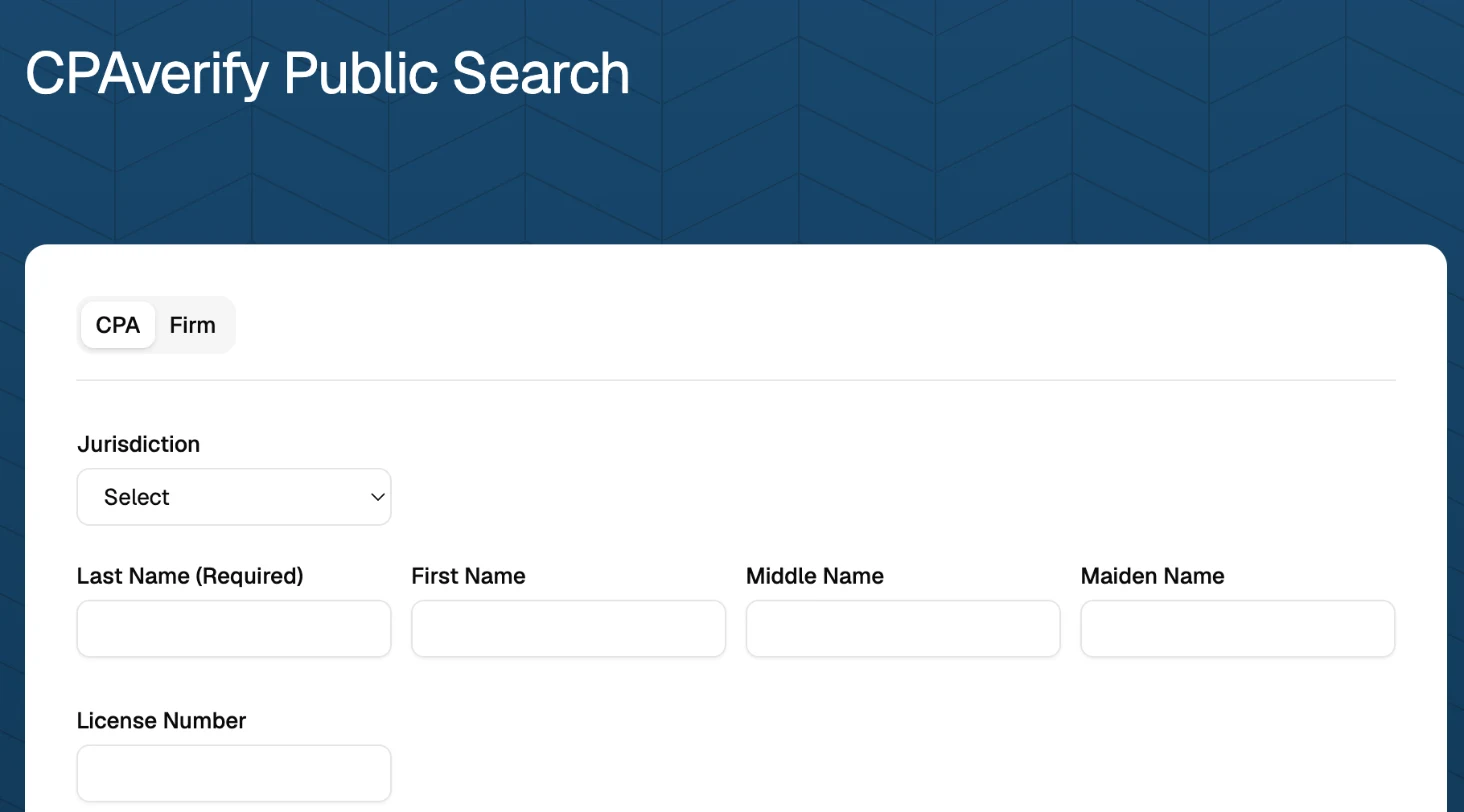
A niche matters because the licence check makes every accountant look the same. Anyone can confirm a CPA licence for free. CPAverify, hosted by NASBA, pulls official licensing data straight from boards of accountancy, with 53 jurisdictions taking part, and shows enforcement and disciplinary markers alongside each record2.
Passing that check makes you eligible. It doesn’t make you the obvious choice. A dental practice owner with three names on a list wants the one who already understands dental practices: associate pay, equipment financing, the practice sale five years out. A Shopify seller wants the one who talks about sales tax across states and inventory. When your public profiles say “tax, accounting and advisory services for individuals and businesses”, you look like everyone else on the list.
Ways to define a niche
A niche can be an industry, a service, a client type or a combination. Industry niches (dental practices, construction contractors, nonprofits, e-commerce brands, farms) are the easiest for a business owner to recognise. Service niches are often backed by a credential. AICPA & CIMA list four specialty credentials: the PFS for personal financial planning, the CITP for information technology and data, the CFF for forensic accounting, and the ABV for business valuation3. A credential you actually hold is a niche marker anyone can verify.
| Niche type | What it tells a business owner | Example wording |
|---|---|---|
| Industry | You already know how businesses like theirs make and lose money | “CPA for dental practices in the Dallas area” |
| Service | You go deep on one problem | “Business valuations for owners planning a sale (CPA/ABV)” |
| Client type | You work with people in their situation | “Tax and planning for first-generation business owners” |
| Combination | Both of the above, which is easiest to remember | “Sales tax and bookkeeping for Shopify brands selling in many states” |
Source: Examples are illustrative. AICPA credential descriptions from AICPA & CIMA.
There’s one more reason a niche has to live in your words, not in your listings. Google’s Business Profile guidelines say a practitioner shouldn’t have multiple profiles to cover all of their specializations4. You get one profile. Your specialty has to come through everywhere else.

What does a business owner find when they search your name?
A business owner who searches your name usually finds some mix of six things: your licence record, your firm’s page about you, LinkedIn, a Google Business Profile, possibly a Google Knowledge Panel and, more and more, an AI answer. Each one says something about your niche, or says nothing.
| Source | Who controls it | What it should show |
|---|---|---|
| State board record / CPAverify | The board (data you file) | Active licence, correct name and firm |
| Firm bio page | You or your firm | Your niche in the first sentence, credentials, industries served |
| You | The same niche in your headline and About section | |
| Google Business Profile | You (for your firm or as a practitioner) | The right category, a factual description, your name as Google’s rules require |
| Google Knowledge Panel | Google generates it automatically | A subtitle and description that match how you describe yourself |
| AI answers (Google AI Mode, ChatGPT, Gemini) | Built from pages the tool can find | The niche and facts your own pages state |
Source: NASBA2, Google Business Profile Help4, Google Knowledge Panel Help5, Google Search Central6
You control three of these directly, influence two, and can only keep accurate in your filings for the first. That’s the order of work later in this guide.
What do the AICPA and state boards say about advertising?
The AICPA allows advertising as long as it isn’t false, misleading or deceptive, and state boards add their own, often more detailed, rules. The rule that actually binds your licence is your state board’s, in every state where you hold a licence or practice privileges.
The AICPA rule
The AICPA’s Code of Professional Ethics banned advertising by members until 1978. After the Supreme Court struck down Arizona’s ban on lawyer advertising in 1977, the AICPA replaced its own ban with a narrower prohibition on advertising that is false, misleading or deceptive7. Writing in the Journal of Accountancy in 2014, the AICPA’s general counsel and assistant general counsel quoted the rule, then ET Section 502, as saying that “[a] member in public practice shall not seek to obtain clients by advertising or other forms of solicitation in a manner that is false, misleading, or deceptive.”7 In today’s codified Code, the rule sits at 1.600.001, the Advertising and Other Forms of Solicitation Rule8.
The same article explains that use of the CPA credential falls under state boards and state accountancy laws, and that the AICPA’s interpretations on using the credential refer members to those laws and board rules7. It also covers Ibanez v. Florida Board of Accountancy (1994), in which the Supreme Court held that a professional licensed as both a CPA and an attorney could truthfully advertise both credentials7.
1977
Bates v. State Bar of Arizona
The Supreme Court strikes down an outright ban on lawyer advertising, while allowing limits on false or misleading ads.7
1978
The AICPA drops its advertising ban
Its ban on member advertising gives way to a narrower rule against false, misleading or deceptive advertising.7
1994
Ibanez v. Florida Board of Accountancy
The Supreme Court holds that a CPA-attorney may truthfully advertise both credentials.7
2 August 2011
Circular 230, section 10.30 applies
The current IRS solicitation rule for practitioners becomes applicable.9
15 December 2014
The codified AICPA Code takes effect
The advertising rule is renumbered 1.600.001. The current edition is updated through July 2026.8
What a state board spells out: Texas
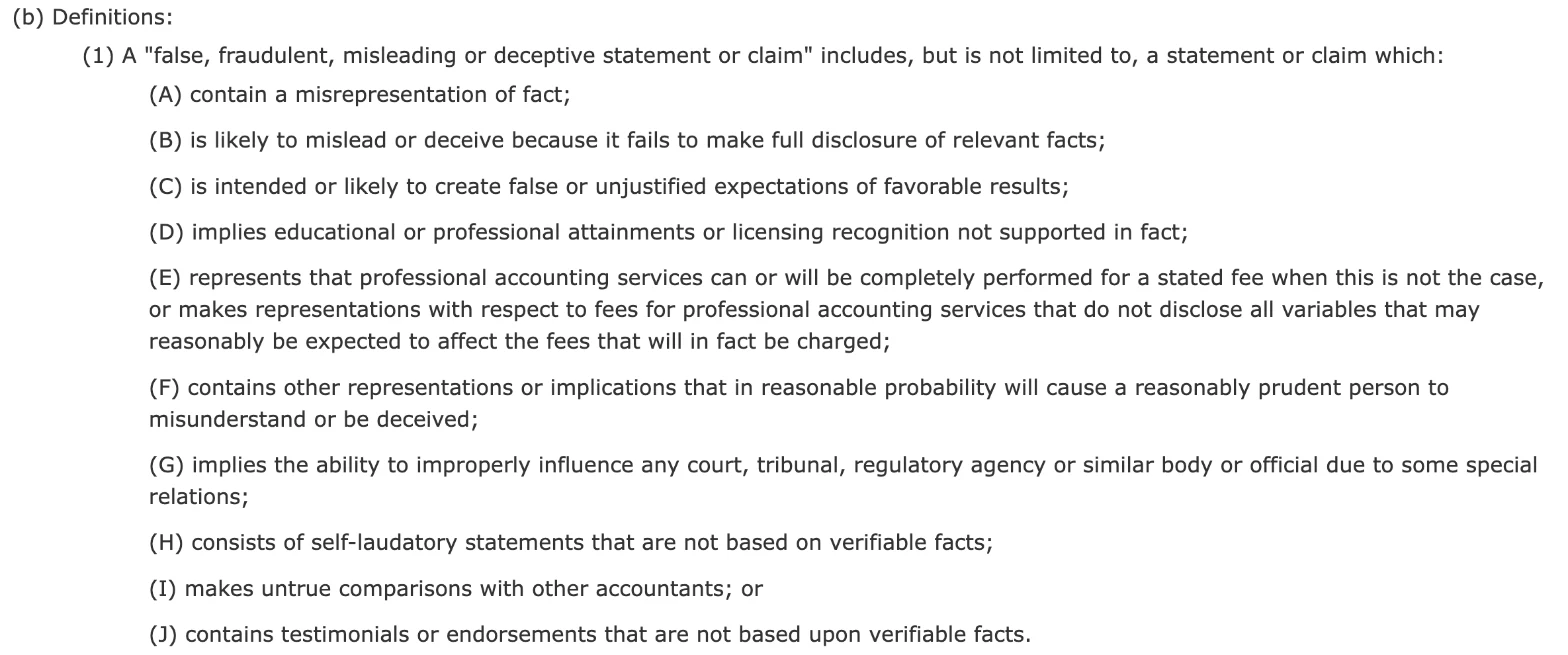
The Texas State Board of Public Accountancy’s rule 501.82 is a useful example because it lists what counts as a false, fraudulent, misleading or deceptive claim10. The list includes a claim that:
- misrepresents a fact, or misleads by leaving out relevant facts
- is likely to create false or unjustified expectations of favorable results
- implies educational or professional attainments, or licensing recognition, not supported in fact
- states a fee without disclosing the variables likely to change what is actually charged
- implies an ability to improperly influence a court or regulator
- is self-laudatory and not based on verifiable facts
- makes untrue comparisons with other accountants
- uses testimonials or endorsements not based on verifiable facts
- contains any other representation likely to mislead a reasonably prudent person
The same rule bans using a name that is misleading about who is practising under it, and bans persisting in contacting a prospect who has made clear they don’t want to be contacted. For electronic or direct mail communications, Texas requires you to keep a copy and a list of who received it for at least 36 months after the last send, with exceptions for current clients, invited messages and people who came looking for services. Broadcasts, which the rule defines to include internet and email transmissions, have to be recorded and kept for 36 months too10.
A state that mirrors the AICPA: Washington
Washington’s rule WAC 4-30-054 uses almost the same words as the AICPA rule: no advertising or solicitation that is false, misleading or deceptive, and no coercion, over-reaching or harassing conduct. It applies widely: for this rule, “licensees” includes CPA firms, non-licensee firm owners, employees, out-of-state individuals with practice privileges, and out-of-state firms permitted to offer certain services in Washington11. If you serve clients across state lines, more than one board’s rule can apply to the same ad.
For tax work: IRS Circular 230
If you practise before the IRS, section 10.30 of Circular 230 applies on top of your board’s rules. It bans false, fraudulent, coercive, misleading or deceptive statements in any public communication or private solicitation about IRS matters. Enrolled agents can’t describe themselves as “certified” or imply they work for the IRS9.
It also covers fees. You may publish fixed fees for routine services, hourly rates, fee ranges and initial consultation fees, and you can’t charge more than a published rate for at least 30 calendar days after you last published it. Copies of direct mail and e-commerce communications, with a list of recipients, have to be kept for at least 36 months9.
36
months Texas requires you to keep copies of electronic or direct mail advertising
36
months Circular 230 requires practitioners to keep direct mail and e-commerce communications
30
calendar days you must honour a published fee schedule under Circular 230
| Rule | Who it covers | Core standard | Extra detail worth knowing |
|---|---|---|---|
| AICPA Code 1.600.001 | AICPA members in public practice | No false, misleading or deceptive advertising or solicitation | Interpretations on the CPA credential refer members to state law and board rules (Journal of Accountancy, 2014) |
| Texas 22 TAC §501.82 | People subject to the Texas Board’s rules | No false, fraudulent, misleading or deceptive claims; no coercion or harassment | Lists ten kinds of misleading claim; 36-month records of email, direct mail and broadcasts |
| Washington WAC 4-30-054 | Licensees, firms, owners, employees, out-of-state practice privileges | Mirrors the AICPA wording | Also covers out-of-state CPAs with practice privileges and certain out-of-state firms |
| IRS Circular 230 §10.30 | Practitioners before the IRS | No false, misleading or coercive statements on IRS matters | No “certified” for enrolled agents; fee publication rules; 36-month records |
Source: Journal of Accountancy7, AICPA Code8, 22 TAC §501.8210, WAC 4-30-05411, 31 CFR §10.309
These are two states out of many. Look up your own board’s advertising rule, and check the rules of every state where you’re licensed or practise.
How can you show your niche within those rules?
You show a niche within those rules by stating facts someone could check, not adjectives. Industries you serve, the credentials you hold, how long you’ve been in practice, what kind of work you do and where you’re licensed are all facts. “The best CPA in Dallas” and “we’ll cut your tax bill” are not, and they sit close to what Texas lists as self-laudatory claims and unjustified expectations of favorable results10.
The wording below is made up to illustrate the principle. It is not a ruling on any particular phrase, and none of it is taken from a rule.
Easier to back up (illustrative)
- “I work with dental practices in North Texas”
- “CPA/ABV: business valuations for owners planning a sale”
- “Licensed in Texas and Oklahoma”
- “Twelve years advising construction contractors”
- A client story with their written permission and facts you can document
Harder to back up (illustrative)
- “The top accountant for small businesses”
- “Guaranteed to save you thousands”
- “Specialist” or “expert” with nothing behind it
- A fixed fee that leaves out what changes the price
- Reviews or testimonials you can’t verify
Whether a word like “specialist” is allowed depends on your state, so ask your board.
Accountants aren’t really allowed to market themselves.
The AICPA has allowed advertising since 1978. The limits are on false, misleading or deceptive claims and on coercive or harassing solicitation.
A few habits make the rules easier to live with. Keep a dated file of every email campaign and mailing, with its recipient list, because Texas and Circular 230 both expect 36 months of records109. Write every claim with the evidence in mind: if you say “dental practices”, be able to show you serve them. And use your exact licensed title in the form your board allows, on every profile.
A niche you can prove beats an adjective you can’t.
How should your niche read on your website and LinkedIn?
Your niche should read the same on your website and LinkedIn: one sentence, near the top, in the same words. Google and AI tools build their picture of you by matching what different pages say, and so do business owners comparing tabs.
Write one master sentence
“[Name], CPA, helps [type of business] with [problems you solve] in [place].” Keep it factual and keep it short. Everything else builds on it.
Give yourself a real bio page
Your firm’s team page about you, or your own site, should open with that sentence, then list your licence states, credentials, industries served and anything published about you.
Match your LinkedIn headline and About section
Use the same niche wording in the headline, not just a job title. Your exact licensed title goes in the form your board allows.
Point your profiles at each other
Link your bio page to LinkedIn and your other genuine profiles, and link them back to the bio page.
Add Person markup to the bio page
Structured data with your name, jobTitle, the firm you work for and knowsAbout for your niche helps machines read the page reliably.
Publish where your niche gathers
An article for a dental association newsletter or a talk at a contractors’ group creates an independent page that names you and your niche together.
LinkedIn often ranks near the top for a person’s name, so its headline gets read more than most of your site. How Google reads your LinkedIn headline covers what to put in it. For the markup step, Structured Data in Plain English has a complete Person example you can adapt.
Google Business Profile or Google Knowledge Panel: which helps an accountant?
Both can help, and they do different jobs. A Google Business Profile is a listing you manage for a firm, or for an individual practitioner, that clients can contact at a real location. A Google Knowledge Panel is a summary Google generates automatically about a person or thing in its Knowledge Graph5. You can’t create one, and Google alone decides whether it shows.
What Google says about practitioner profiles
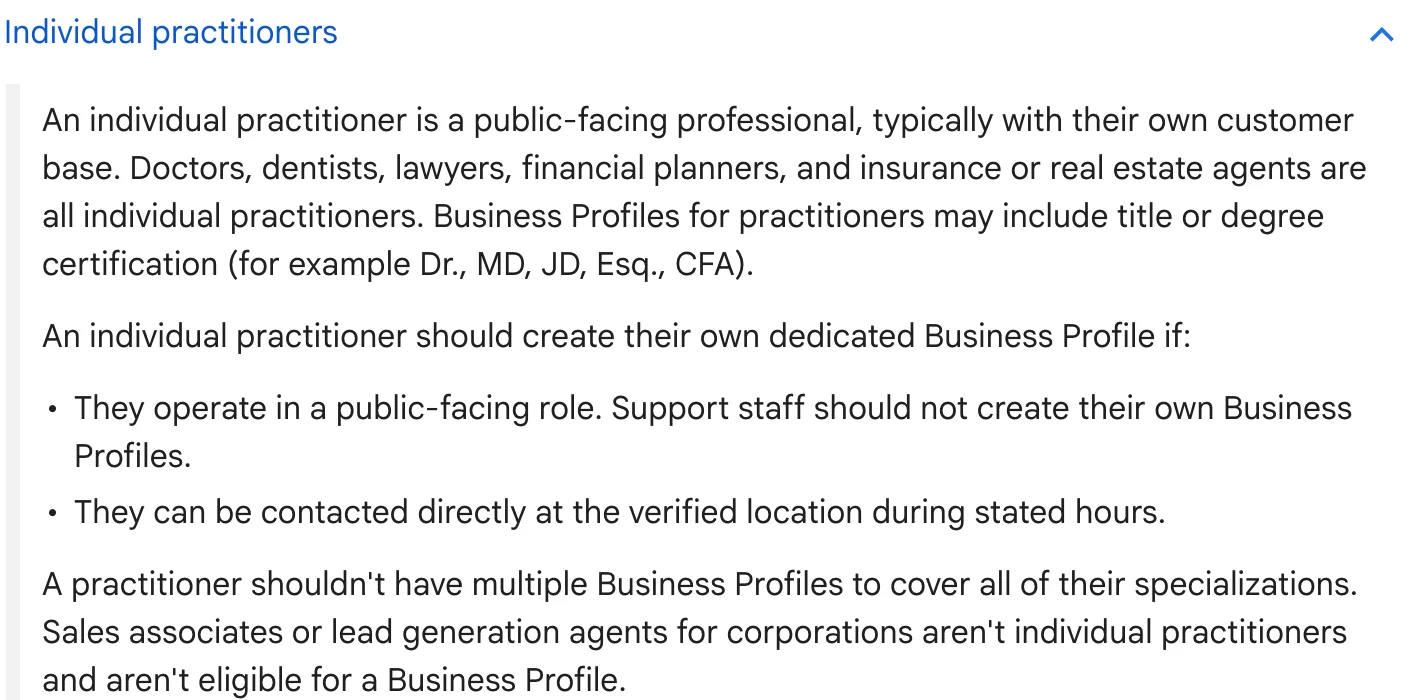
Google defines an individual practitioner as a public-facing professional with their own customer base. Its examples are doctors, dentists, lawyers, financial planners and insurance or real estate agents. Accountants aren’t named, though the definition fits many partners. A practitioner should have their own profile only if they’re public-facing and can be contacted at the verified location during stated hours. Practitioner profiles may include a title or degree certification in the name4.
The naming rules depend on your setup4:
- Several practitioners at one office: the firm gets its own profile, and your profile’s title is your name only, without the firm’s name.
- The only practitioner at a branded location: share one profile with the firm, named in the form “[Firm]: [Your name]”.
- Every case: one profile per practitioner, not one per specialty. Google’s general rules also say the business description can’t contain links or focus on promotions or prices.
Check your board’s rules before you put “CPA” in a listing name. Google’s guidelines say a degree certification may appear. Your board decides how the credential may be used.
Where a Google Knowledge Panel fits
A Business Profile answers “where is this firm and how do I contact it?” A panel answers “who is this person?” For a partner whose name brings in work, the second question is the one a business owner is asking. Google builds panels from sources across the web, and verified people can suggest edits5. That’s why the consistency work above matters: it gives Google one clear version of you to recognise. Knowledge Panel or Google Business Profile? sets the two side by side, and how to get a Google Knowledge Panel covers the steps.
Where do AI answers fit in accountant marketing?
AI answers are now part of the check. A business owner can ask ChatGPT, Gemini or Google’s AI Mode for “a CPA who works with dental practices in Dallas” and get a short list of names back. What those tools say about you depends on what they can find about you.
Google is plain about the entry ticket for its own AI features. A page has to be indexed and eligible to show a snippet in normal Search to appear as a link in AI Overviews or AI Mode, and there are no extra technical requirements. Google also tells site owners to keep their Business Profile information up to date6.
So the work is the same work. If your bio page, LinkedIn and Business Profile all say you serve dental practices, an AI tool has something consistent to repeat. If they disagree, or say nothing about a niche, it has nothing to go on. Nobody can guarantee that an AI tool will mention you. For how ChatGPT in particular finds information about people, see where ChatGPT gets its information. To see what AI tools say about you today, try the free AI Mention Checker.
In what order should you fix things?
Fix the sources you control first, then the ones you influence. This order gets the most agreement across your name search for the least effort.
Search yourself the way a business owner would
Use a private window. Try your name, your name plus “CPA”, and your name plus your city. Ask ChatGPT and Google’s AI Mode who you are. Write down every place your title, firm or niche differs.
Check your licence record
Look yourself up on CPAverify or your board’s lookup. Make sure the name and firm match how you present yourself.
Write the master sentence
One factual sentence with your niche, then a longer bio of verifiable facts: licence states, credentials, industries, years in practice.
Update your bio page and LinkedIn
Same sentence, same title, same photo. Add Person markup to the bio page.
Sort out Google Business Profiles
Check whether you need a practitioner profile, name it the way Google’s rules require, pick the right category and write a factual description.
Read every claim against your board’s rule
Remove anything self-laudatory you can’t verify, any promise of results and any fee that hides variables. Start a 36-month file for email and mail campaigns if your rules require one.
Earn one independent page about your niche
An association article, a podcast episode or a conference speaker page that names you and the industry you serve.
Check again in a month
Search engines and AI tools take time to recrawl. Look for the new wording appearing, and fix anything that still disagrees.
Use the free Knowledge Panel Checker along the way to see whether Google already holds an entity for you.
Where to start
Start with the search a business owner runs after a referral. It costs nothing, takes ten minutes, and tells you whether your niche shows up or whether you look like every other licensed name on the list.
Most of the work after that is consistency. One clear sentence about who you help, repeated in the same words on the pages you control, backed by facts your board would accept. Referrals and content then land on a name search that confirms them.
If you’d rather have it done for you, DotVisible, founded by Shobin K Jose, builds personal Google Knowledge Panels and AI visibility for professionals, accountants included. Google alone decides whether a panel shows. DotVisible guarantees a Knowledge Panel within 150 days of onboarding, or you choose between a deposit refund and free continued work. How it works explains the process, the accountants page shows what it looks like for a practice, and the accountants playbook is the full do-it-yourself guide. More guides for your profession are in Guides for Accountants, and the wider topic lives under name search.
Frequently asked questions
What is the best marketing for accountants?
Marketing that makes one thing obvious: who you help and what you are good at. Referrals, content and partnerships get your name in front of business owners. Then they check your licence and search your name, and the accountant whose website, LinkedIn, Google profiles and AI answers all describe the same niche, in claims that can be verified, is the one who gets the call.
Are CPAs allowed to advertise?
Yes. The AICPA dropped its ban on advertising in 1978 and replaced it with a rule against advertising or solicitation that is false, misleading or deceptive. State boards of accountancy set their own advertising rules, and anyone practising before the IRS also follows Circular 230, section 10.30. Check the rules of every state where you hold a licence or practice privileges.
Can I call myself a specialist or an expert?
Be careful. Texas, for example, treats claims that imply professional attainments not supported in fact, and self-laudatory statements not based on verifiable facts, as false, misleading or deceptive. Naming the industries you serve and the credentials you actually hold is easier to back up than a general claim to be the best or the leading expert. Ask your state board or counsel before using any title.
Do accountants need a Google Business Profile or a Google Knowledge Panel?
They do different jobs. A Business Profile is for a firm, or an individual practitioner, that clients can contact at a location during stated hours, and you manage it yourself. A Google Knowledge Panel is generated automatically by Google for people and things in its Knowledge Graph. Google alone decides whether a panel shows. Many partners benefit from both.
Can I list each of my specialties as a separate Google Business Profile?
No. Google’s guidelines say a practitioner should not have multiple Business Profiles to cover all of their specializations. Your niche has to come through in your one profile’s category and description, and in the other sources about you.
Do I need to keep copies of my marketing emails?
Possibly. Texas Board rule 501.82 requires a copy of electronic or direct mail communications, with a list of recipients, to be kept for at least 36 months, with some exceptions. Circular 230 section 10.30 sets a similar 36-month rule for direct mail and e-commerce communications by practitioners. Check the rules that apply to you.
How do AI answers fit into accountant marketing?
Business owners can ask ChatGPT, Gemini or Google’s AI Mode to recommend an accountant. Google says pages need to be indexed and eligible for a snippet to appear as links in its AI features, with no extra technical requirements. What these tools say about you comes from the pages they can find, so a clear, consistent description of your niche helps. Nobody can guarantee an AI mention.
Sources
- 1New Research Study: How Professional Services Buyers Check You Out (Beyond Referrals)Hinge Research Institute · 2014↩
- 2All About CPAverifyNASBA · 12 March 2026↩
- 3AICPA credentials: PFS, CITP, CFF and ABVAICPA & CIMA · accessed 17 November 2026↩
- 4Guidelines for representing your business on GoogleGoogle Business Profile Help · accessed 17 November 2026↩
- 5About knowledge panelsGoogle Knowledge Panel Help · accessed 17 November 2026↩
- 6AI features and your websiteGoogle Search Central · updated 10 December 2025↩
- 7Ibanez ruling set precedent for right of CPAs to advertise dual credentialsJournal of Accountancy (AICPA) · October 2014↩
- 8AICPA Code of Professional Conduct (effective 15 December 2014, updated through July 2026)AICPA, hosted by the Minnesota Board of Accountancy · 2026↩
- 931 CFR §10.30, Solicitation (Circular 230)Cornell Law School LII · accessed 17 November 2026↩
- 1022 Tex. Admin. Code §501.82, AdvertisingTexas State Board of Public Accountancy (via Justia) · current through 27 June 2025↩
- 11WAC 4-30-054, Advertising and other forms of solicitationWashington State Legislature · effective 21 November 2024↩
Keep reading
 Name searchExecutive Personal Branding: What Investors and Hires FindShobin K Jose · 17 Nov 2026 · 15 min read
 Name searchHow Prospects Vet a Financial Advisor Online, and What You Can Check FirstShobin K Jose · 17 Nov 2026 · 18 min read
 Name searchHow to Get More Referrals as a Financial AdvisorShobin K Jose · 17 Nov 2026 · 19 min read