Where Does ChatGPT Get Its Information About People?
When someone asks ChatGPT about you, the answer comes from what the model learned in training or from pages it finds through live search. Here is what OpenAI documents about each route, and which kinds of pages published citation studies show it reading.
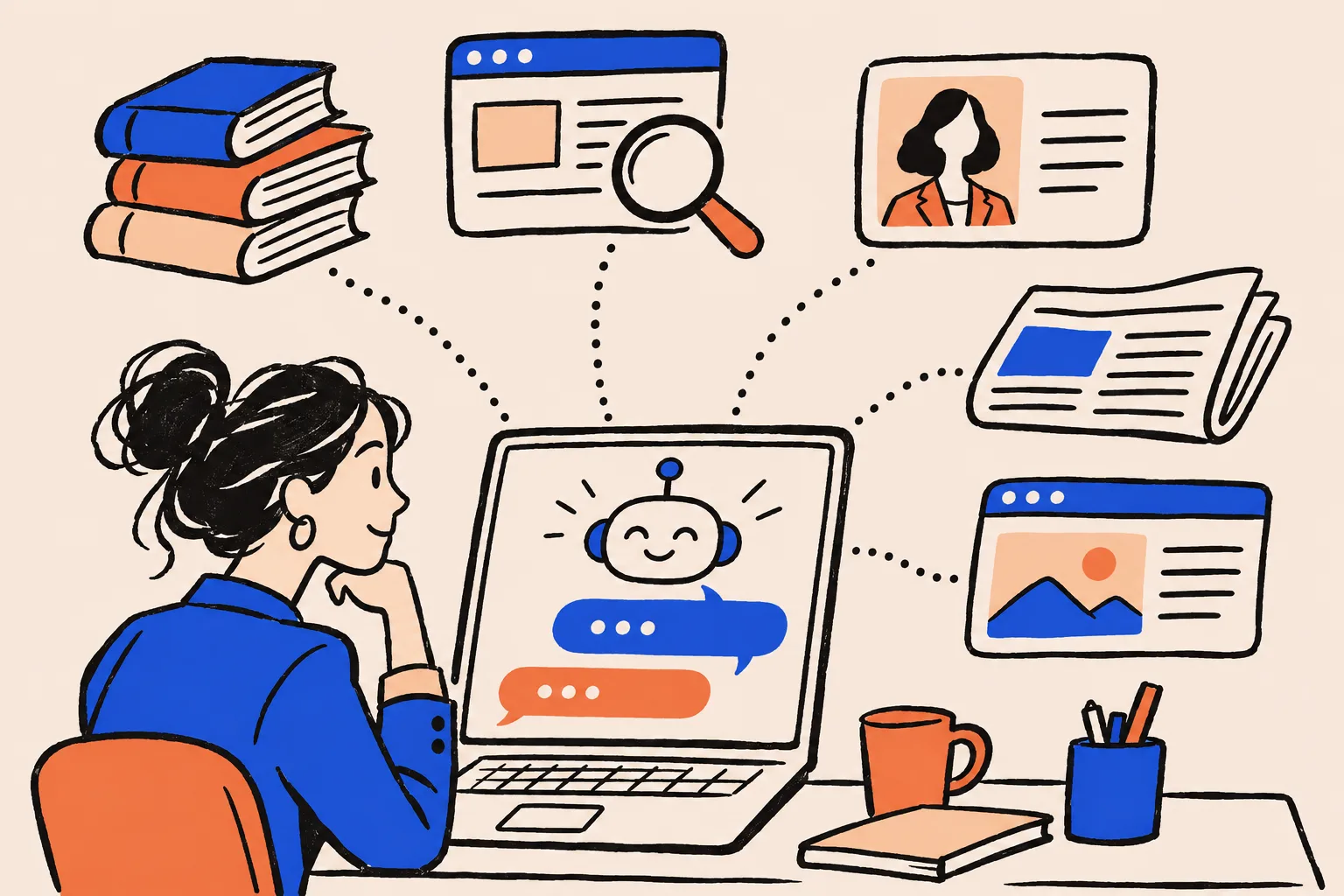
When someone asks ChatGPT about you, the answer comes from one of two places: what the model learned about you during training, or pages it finds through a live web search at the moment of the question. OpenAI says its training data comes from public web pages, licensed partner data and data from users and trainers, and that it filters out sites that aggregate personal information. Live search uses third-party providers such as Bing plus OpenAI’s own crawler, and for a professional, the pages it reads tend to include LinkedIn, your own website, press coverage, directories and, for some people, Wikipedia.
What are the two routes into a ChatGPT answer about you?
Every answer ChatGPT gives about a person starts with a decision: answer from what the model already knows, or go and look. OpenAI’s help documentation says ChatGPT will automatically search the web “if your question might benefit from information on the web”, and that you can also trigger a search yourself1. Without a search, the answer comes from the model’s training. With one, it comes from pages ChatGPT fetched a few seconds earlier, blended with what the model already knew.
The difference matters a great deal for you. Training is a snapshot. It reflects whatever was public about you before the model’s cutoff date, and it can’t be corrected after the fact. Search is live. It reads the pages about you that exist today, which means it’s only as accurate as those pages.
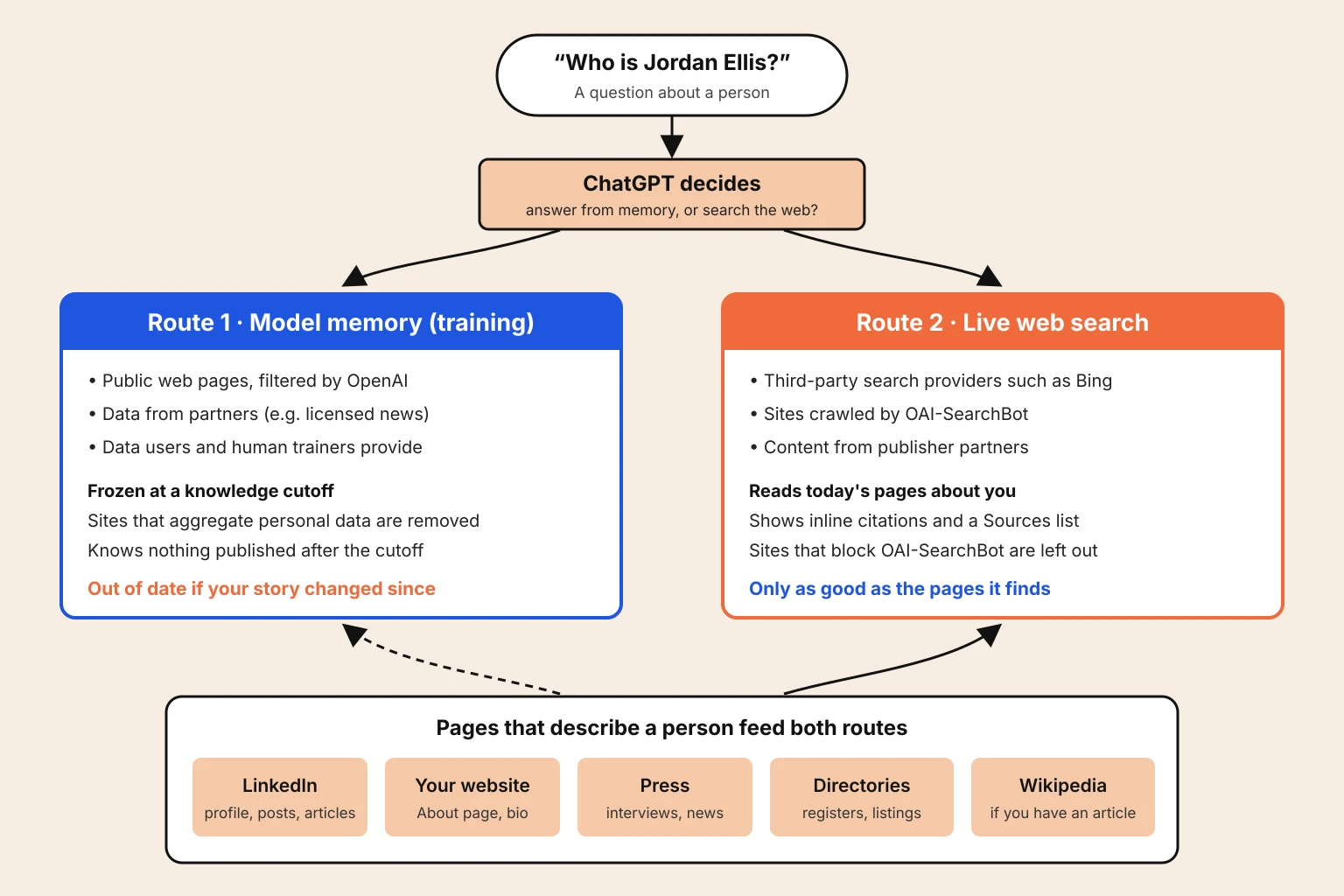
You can usually tell which route you got. OpenAI says responses that use search contain inline citations, with all the sources gathered under a Sources button at the end of the answer1. An answer about you with no citations most likely came from memory. That’s the one to treat with the most caution.
How often does ChatGPT search at all? OpenAI doesn’t publish a figure. One third-party analysis by Profound, an AI search analytics company, looked at roughly 700,000 US English conversations on ChatGPT.com from October to December 2025 and found that about 18% triggered at least one web search2. That covers every kind of question, from recipes to code, so it says little about questions about people specifically. It does show that plenty of answers still come from memory.
What does ChatGPT learn about people during training?
OpenAI’s help article on how its models are developed names three sources of training data: information publicly available on the internet, information accessed through partnerships with third parties, and information that users or human trainers and researchers provide or generate3. It says it uses only publicly available information that’s freely and openly available on the internet, and applies filters to remove material it doesn’t want models to learn from or repeat.
On people, the same article is unusually direct. It says the training information “does incidentally include personal information”, and that OpenAI won’t use that information to build profiles about people3. The models may learn about famous people and public figures. OpenAI also says it removes websites that aggregate large volumes of personal information and trains its models to refuse requests for private or sensitive information about people.
For most working professionals, that means the model’s memory of you is thin or empty. Unless you’re widely written about, there may be little in training for it to recall, and what it does recall may be stitched together from a few pages.
Knowledge cutoffs: why memory goes stale
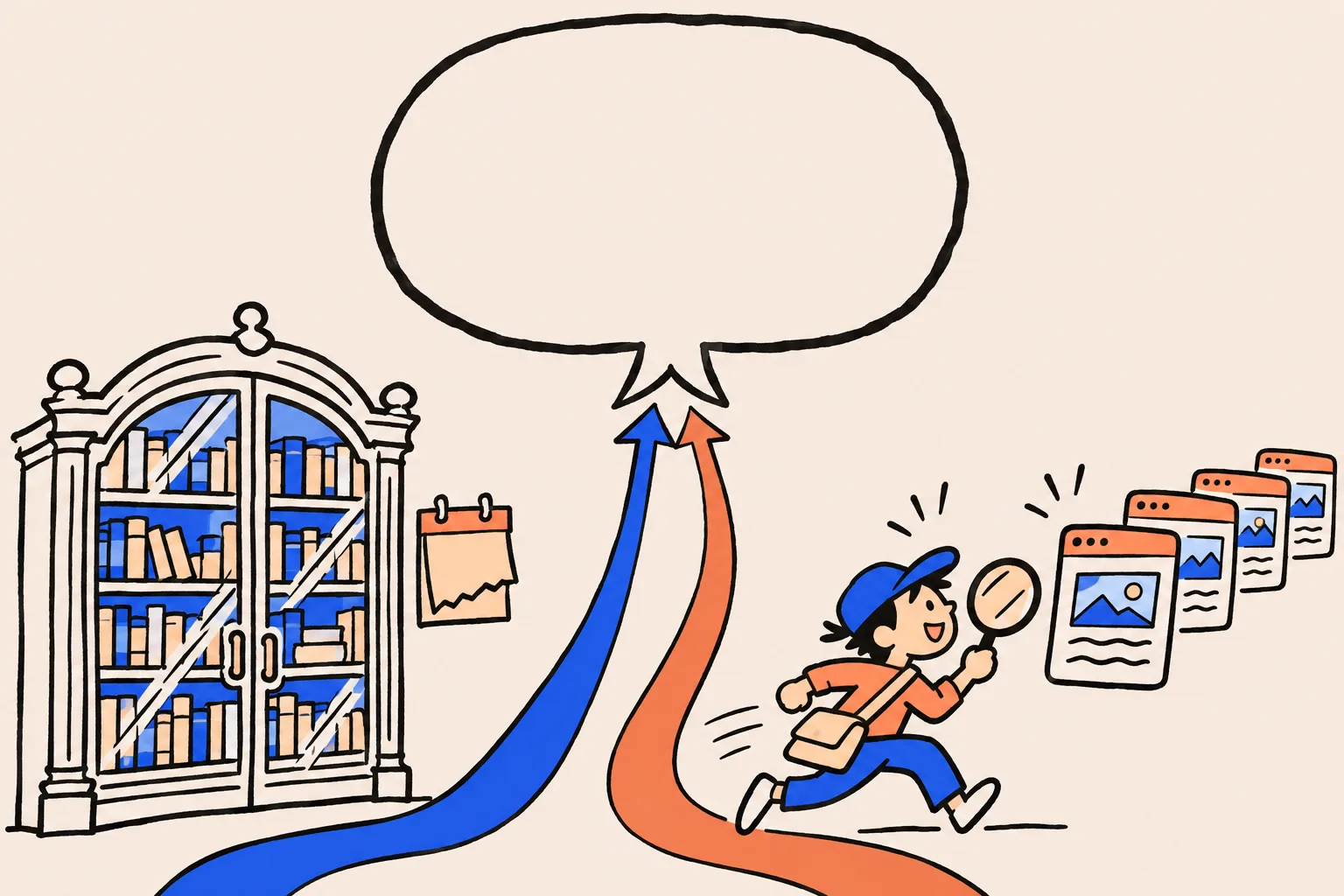
Every model has a knowledge cutoff, the point after which it learned nothing. OpenAI’s API documentation lists 30 September 2024 for GPT-5, now marked deprecated,4 and 30 April 2026 for the newer GPT-6 Astra5. Which model you meet in ChatGPT depends on your plan and changes over time, so read those dates as examples. If you changed firms, published a book or moved city after a model’s cutoff, its memory doesn’t know.
What was in the training mix?
OpenAI no longer publishes a breakdown of training sources for its current models. The last detailed one it released is for GPT-3, in 2020. It’s history now, but it shows how a model’s “reading list” was weighted.
| Item | Value |
|---|---|
| Common Crawl (filtered web pages) | 60% |
| WebText2 | 22% |
| Books1 | 8% |
| Books2 | 8% |
| Wikipedia | 3% |
Source: Brown et al., OpenAI, “Language Models are Few-Shot Learners”, Table 2.26
The paper notes that the mix wasn’t proportional to size: datasets the authors judged higher quality were sampled more often. Wikipedia made up only 3% of the mix, but it was read about 3.4 times during training, while the filtered web crawl was seen less than once6. In GPT-3, at least, Wikipedia counted for far more than its size.
When does ChatGPT search the web instead?
ChatGPT searches when it judges a question would benefit from current web information, or when you ask it to1. OpenAI says it shares disassociated search queries with “third-party search providers such as Bing”, along with a general location inferred from your IP address1. When OpenAI launched ChatGPT search in October 2024, it said the feature “leverages third-party search providers, as well as content provided directly by our partners”7.
Those partners are mostly news publishers. In the Axel Springer deal, announced in December 2023, ChatGPT shows summaries of the group’s journalism with attribution and links back to the full articles, and OpenAI also gets content to train on8. If you’ve been interviewed or profiled by a partner publication, that coverage likely has a more direct path into answers.
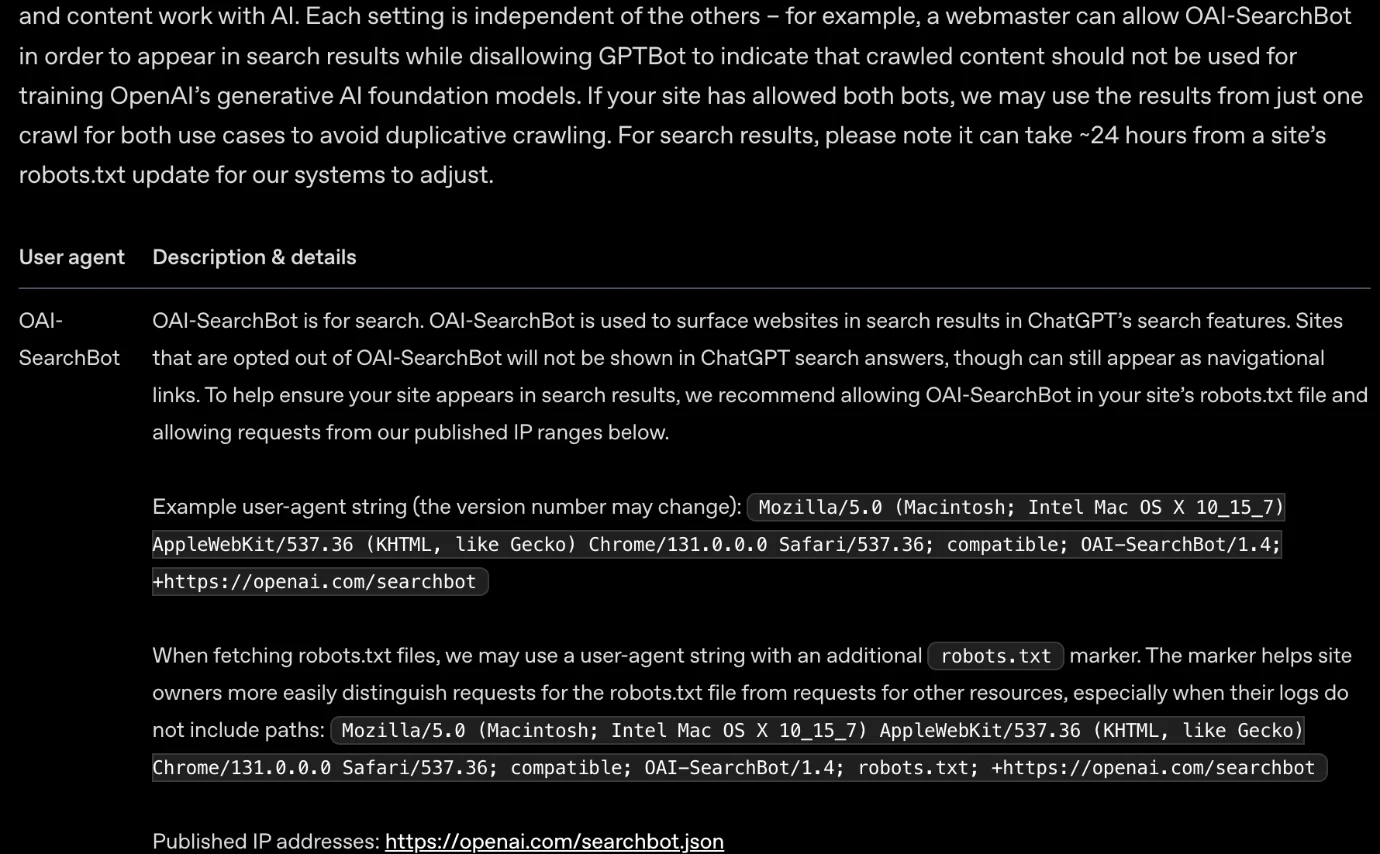
OpenAI also runs its own crawlers, and its documentation explains what each one does9:
| Crawler | What OpenAI says it does | What blocking it does |
|---|---|---|
| OAI-SearchBot | Surfaces websites in ChatGPT’s search features | Your site won’t appear in ChatGPT search answers (it may still show as a navigational link). Changes take about 24 hours |
| GPTBot | Crawls content that may be used to train OpenAI’s foundation models | Signals that your content shouldn’t be used for training |
| ChatGPT-User | Visits a page when a user’s request needs it; not automatic crawling | robots.txt rules may not apply, and it doesn’t decide search inclusion |
Source: OpenAI, Overview of OpenAI crawlers9
Does ChatGPT just copy Google’s top results?
No, at least not in one recent test. High Salience, an AI search and SEO agency in Colorado, checked 200 ChatGPT answers with search on, on a single day in October 2026. In the 33 answers it compared against both Google’s and Bing’s first pages, 79% of the 221 pages ChatGPT cited appeared on neither10. It’s a small, one-day sample, and none of its question groups covered people, so treat it as a hint. The practical point stands, though: ranking first on Google for your name doesn’t mean ChatGPT will read that page.
Which sites does ChatGPT cite when it describes a person?
OpenAI doesn’t publish a list of the sites it cites, or a ranking method. Everything in this section comes from third-party citation studies, most of them by companies that sell AI visibility tracking. They measure different things over different periods, so read each one on its own terms.
18%
Share of ChatGPT conversations that triggered a web search, Oct–Dec 2025 (Profound)2
14.3%
ChatGPT Search responses citing LinkedIn, Jan–Feb 2026 (Semrush)11
5%
Wikipedia’s share of all ChatGPT citations, Oct–Dec 2025 (Profound)2
Here’s how the main kinds of pages about a person map onto the two routes, and what the evidence says about each.
| Source | Training route | Search route | What the evidence says |
|---|---|---|---|
| Public pages only | Frequently cited | Cited in 14.3% of ChatGPT Search responses (Semrush, 2026); rose to about 5th among ChatGPT’s cited domains (Profound, 2026) | |
| Your own website | Yes, if public and crawlable | Yes, unless you block OAI-SearchBot | Your one source you fully control |
| Press and interviews | Yes, including licensed partners | Yes, including partner content | Partner publishers have a direct route (OpenAI, Axel Springer deal) |
| Wikipedia | Yes, weighted heavily in GPT-3 | Often cited | 5% of all ChatGPT citations (Profound, late 2025) |
| Wikidata | Unconfirmed | Unconfirmed | Open CC0 data; no OpenAI statement that ChatGPT uses it |
| Directories and registers | Public pages only | Can be cited | No person-specific study; people-search aggregators are removed from training (OpenAI) |
LinkedIn is the strongest pattern in the recent data. Semrush analysed 325,000 prompts and 89,000 LinkedIn URLs cited by AI search tools in January and February 2026, working with LinkedIn on the data. It found LinkedIn cited in 14.3% of ChatGPT Search responses, more than in Google AI Mode or Perplexity11.
| Item | Value |
|---|---|
| ChatGPT Search | 14.3% |
| Google AI Mode | 13.5% |
| Perplexity | 5.3% |
Source: Semrush, 89K LinkedIn URLs study, March 202611
Two details from that study matter for individuals. Individual members, not company pages, accounted for 59% of LinkedIn citations on ChatGPT Search. And members with fewer than 500 followers were as likely to be cited as those with more11. A small following doesn’t seem to hold you back.
What kind of LinkedIn page gets read is shifting, though. Profound tracked which LinkedIn URLs ChatGPT cited between November 2025 and February 2026. Profiles fell sharply as a share, while posts and long-form articles grew12.
| Item | 15 Nov 2025 | 15 Feb 2026 |
|---|---|---|
| Profiles | 33.9% | 14.5% |
| Feed posts | 20.9% | 26% |
| Long-form articles | 6% | 8.9% |
Source: Profound, LinkedIn citation study, March 202612
Profound’s figures and Semrush’s measure different things, so they don’t contradict each other: “individual members” in Semrush’s data includes posts and articles written by people, not just profiles. The common thread is that what you write on LinkedIn under your own name now gets read as often as your profile. Your headline and About section still set the facts. How Google Reads Your LinkedIn Headline covers how to word them so machines read your role correctly.
Wikipedia and Wikidata
Wikipedia matters on both routes. It was heavily weighted in GPT-3’s training6, and it’s one of the domains ChatGPT search cites most. Profound measured it at 5% of all ChatGPT citations, appearing in 18% of conversations that had citations, in late 20252. Semrush saw its presence swing: during a July to October 2025 study, Wikipedia went from appearing in roughly 55% of ChatGPT responses to under 20%13.
Most professionals don’t have a Wikipedia article, and shouldn’t write one about themselves. Wikidata, the free structured database that sits alongside Wikipedia, is often mentioned in the same breath. It’s a collaboratively edited knowledge graph released as CC0 open data, and assistants such as Siri and Alexa have used it14. We found no OpenAI statement that ChatGPT uses Wikidata directly, so treat any claim that it does as unproven.
Press and interviews
News coverage reaches ChatGPT through ordinary search and through publisher partnerships78. Semrush’s 2025 study also saw Forbes double the number of ChatGPT responses citing it after September 202513. For a person, an interview or profile in a recognised publication is one of the few sources written by someone else that clearly describes you.
Your own website
Your website is the only source on this list you fully control. It can appear in training if it’s public and crawlable, and in search answers as long as OAI-SearchBot isn’t blocked9. A clear About page that states your name, role, firm, location and credentials in plain sentences gives both routes something accurate to read. Adding Person markup makes those facts machine-readable too; Structured Data in Plain English explains how.
Directories, registers and people-search sites
Professional directories and registers (a medical register, a bar listing, a speaker bureau page) are public pages like any other, so they can be cited when they match a search. No published study we could find measures how often ChatGPT cites them for people. People-search aggregators are a different case: OpenAI says it removes sites that aggregate large volumes of personal information from training3. It doesn’t say the same about search results.
Why does ChatGPT get people wrong or mix them up?
Each route has its own failure. Memory is frozen at the cutoff and may hold only scraps about you, so the model fills gaps with plausible-sounding guesses. Search depends on what it finds, so an outdated speaker bio, an old firm’s team page or a namesake’s LinkedIn can end up in your answer.
Results also vary from run to run. In High Salience’s test, only 40% of the sites cited for the median question appeared in both runs of the same question10. Asking about yourself once tells you little.
How often AI models state false facts about people is a separate question, with its own data. How often AI gets facts about people wrong compares every published figure, from OpenAI’s own PersonQA test to news audits.
ChatGPT reads your Google Knowledge Panel.
OpenAI names Bing as an example of its search providers, and we found no OpenAI statement that ChatGPT has access to Google’s Knowledge Graph.
The same clear, consistent sources that help Google understand you are on the open web, so they help both. But a Google Knowledge Panel isn’t a direct feed into ChatGPT.
Can you control which sources ChatGPT uses?
Only at the edges. You decide whether OpenAI’s crawlers can read your own site: blocking OAI-SearchBot keeps your pages out of ChatGPT search answers, and blocking GPTBot signals that they shouldn’t be used for training9. Neither does anything about what other sites say about you. For most professionals, blocking search is counterproductive, because ChatGPT then describes you only from other people’s pages.
What you can control is the content of the pages most likely to be read. That means your website, your LinkedIn profile, posts and articles, the bios you supply to event organisers and publications, and your listings in the directories that matter in your field. When they agree on the same name, role, firm and story, whichever page ChatGPT happens to pick says the right thing.

How do you check what ChatGPT reads about you?
ChatGPT shows its sources whenever it searches1, which makes this an easy check to run yourself.
Ask with search on
Ask “Who is [your name]?” and “Who is [your name], [profession] in [city]?” with search turned on.
Open the Sources list
Click Sources under each answer and write down every page cited: your site, LinkedIn, directories, press, anything else.
Ask again, in a new chat
Sources can change between runs, so repeat each question three or four times and note which pages keep coming back.
Spot the uncited claims
OpenAI doesn’t label uncited sentences, but a claim with no citation probably came from model memory. Note which of those facts are missing or out of date.
Fix the pages, not the chat
Start with the pages cited most often in your runs. Then make your website, LinkedIn and key listings agree with each other.
Our free AI Mention Checker runs the questions buyers ask across ChatGPT, Gemini and Perplexity and puts the answers side by side, so you can see the differences without running every prompt by hand.
Which sources should you fix first?
Start where the evidence is strongest and your control is greatest.
- Your website’s About page. It’s the one page you fully own. State who you are in plain, factual sentences, and keep it current.
- Your LinkedIn profile, then your writing. Match the headline and About section to your website. Then publish posts or articles under your own name about the work you do, since the studies above show those being cited more than profiles.
- Coverage written by others. Interviews, podcast guest pages and bylined articles in recognised publications give search something independent to read.
- The directories that matter in your field. Correct or complete them, and skip mass submissions.
- Old bios. Track down outdated speaker pages and former employers’ team pages, and ask for updates.
This is the same groundwork that helps Google build a clear picture of you, which is why we treat Google and AI visibility as one job. A Google Knowledge Panel is a separate goal, and Google alone decides whether one shows. If you want help with both, here’s how we work. More on how AI tools pick and describe people is in our AI search guides, including how ChatGPT decides which coaches to recommend.
What to check on your own name this week
Run the five steps above for your name, and keep the list of cited pages. Fix the ones that come up most often or are out of date first, then check again in a few weeks. ChatGPT search reads the web as it stands today1, so corrected pages can start showing up quickly. What a model learned in training only changes when a newer model arrives.
Frequently asked questions
Where does ChatGPT get its information about people?
From two places. The model learned some facts during training on public web pages, licensed partner data and data from users and trainers, up to a knowledge cutoff. When a question might benefit from current information, ChatGPT searches the web through third-party providers such as Bing and its own crawler, then cites the pages it used.
Does ChatGPT use LinkedIn?
Third-party studies say LinkedIn is one of the sites ChatGPT search cites most for professional topics. Semrush found LinkedIn cited in 14.3% of ChatGPT Search responses in early 2026, and Profound saw LinkedIn rise from about 11th to about 5th among domains ChatGPT cites. OpenAI has not published a list of the sites it uses.
Does ChatGPT use Wikipedia or Wikidata?
Wikipedia was part of the training data for GPT-3, and citation studies show ChatGPT search citing it often. Profound measured Wikipedia at 5% of all ChatGPT citations in late 2025. There is no OpenAI statement that ChatGPT uses Wikidata directly.
Does ChatGPT use Google or my Google Knowledge Panel?
OpenAI names Bing as an example of the third-party search providers it uses, and we found no OpenAI statement that ChatGPT has access to Google’s Knowledge Graph. The same clear, consistent sources that help Google understand you are also on the open web that ChatGPT reads.
Why does ChatGPT have old or wrong information about me?
If it answers from training, it only knows what was published before the model’s knowledge cutoff. If it searches, it depends on the pages it finds, which may be outdated profiles, a namesake’s pages or a directory with errors. Fixing the source pages is the lasting fix.
Can I stop ChatGPT from using my website?
Partly. Blocking OAI-SearchBot in robots.txt keeps your site out of ChatGPT search answers, and blocking GPTBot signals that your content should not be used for training. Neither removes what other sites say about you, and blocking search usually means ChatGPT reads only other people’s descriptions of you.
How do I see which sources ChatGPT uses for my name?
Ask ChatGPT who you are with search turned on, then open the Sources list under the answer. Repeat it a few times and with your name plus your profession and city, because the sources can change between runs.
Sources
- 1ChatGPT searchOpenAI Help Center · Accessed 17 Nov 2026↩
- 2How ChatGPT sources the web (Brandon Punturo)Profound (third-party study) · 3 Feb 2026↩
- 3How ChatGPT and our foundation models are developedOpenAI Help Center · Accessed 17 Nov 2026↩
- 4GPT-5 model pageOpenAI API documentation · Accessed 17 Nov 2026↩
- 5GPT-6 Astra model pageOpenAI API documentation · Accessed 17 Nov 2026↩
- 6Language Models are Few-Shot Learners (Brown et al.)OpenAI, via arXiv · 2020↩
- 7OpenAI adds search function to ChatGPT in challenge to GoogleReuters, via Yahoo Finance · 31 Oct 2024↩
- 8OpenAI partners with Politico, Business Insider publisher Axel Springer to surface and train on news contentVentureBeat · 13 Dec 2023↩
- 9Overview of OpenAI crawlersOpenAI · Accessed 17 Nov 2026↩
- 10Where does ChatGPT get its information? 200 answers checked (Bike Hawley)High Salience (third-party study) · 21 Oct 2026, updated 4 Nov 2026↩
- 11We analyzed 89K LinkedIn URLs cited in AI search (Margarita Loktionova)Semrush (third-party study) · 10 Mar 2026↩
- 12LinkedIn is the most-cited domain for professional queries in AI search (Davis McCain, Brandon Punturo)Profound (third-party study) · 9 Mar 2026↩
- 13The most-cited domains in AI: a 3-month study (Luke Harsel)Semrush (third-party study) · 10 Nov 2025↩
- 14WikidataWikipedia · Accessed 17 Nov 2026↩
Keep reading
 AI searchGEO vs SEO: What Changes When Clients Ask AI About YouShobin K Jose · 17 Nov 2026 · 15 min read
 AI searchHow to Get ChatGPT to Recommend You (for Professionals)Shobin K Jose · 17 Nov 2026 · 17 min read
 AI searchWhat Is AI Visibility for a Person (Not a Brand)?Shobin K Jose · 17 Nov 2026 · 16 min read