
How to Get More Referrals as a Financial Advisor
Referrals still bring in most new clients, yet only a fraction of them ever reach your calendar. Here’s what the research says about why, how to make referring you easier, and what the SEC Marketing Rule says about rewarding it.

You get more referrals as a financial advisor by making them easier to give and easier to confirm. Give clients and professional partners a clear, specific way to describe who you help, then make sure the person they refer finds a website, profiles and reviews that back that description up when they search your name. Referrals still bring in more than half of advisors’ new clients, but many of them are lost in the gap between the recommendation and the first call.
Where do financial advisors’ new clients actually come from?
Mostly from people who already trust them. Cerulli’s research finds that referrals from clients, friends or family members account for 54.2% of advisors’ new clients, and contacts from centers of influence (CPAs, attorneys and other professionals) are the second most common source at 13.9%1. Put together, that’s roughly two in every three new clients arriving on someone else’s word.
Kitces Research’s 2026 marketing study points the same way. As Family Wealth Report described the findings, client referrals and centers of influence are by far the two most widely used marketing tactics among advisory firms2. They’re also cheap. Kitces measures marketing efficiency as revenue acquisition cost: what a practice spends, including the value of advisor and staff time, to win each new dollar of annual revenue. In Wealthtender’s summary of the 2026 report, client referrals came in at $0.34, second only to online directory listings at $0.283. These figures come from Wealthtender’s summary rather than the full report, and Wealthtender sells advisor directory listings and is named in the research, so it has a stake in how the directory numbers read.
| Item | Value |
|---|---|
| Online directory listings | 0.28 |
| Client referrals | 0.34 |
| SEO | 0.45 |
| Third-party review sites | 0.67 |
| Average across all tactics | 2.01 |
| Answer engine optimization | 3.45 |
| Social media | 4.88 |
Source: Kitces Research, The Kitces Report 2026 (506 advisors), as summarised by Wealthtender3
There’s a catch, and the same study names it. Kitces found that high-growth firms lean more on tactics they control than on actions taken by clients. Mark Tenenbaum, Kitces’ director of advisor research, described referrals as passive: the advisor’s input doesn’t change the outcome much, and as a firm grows, the share of clients with untapped networks shrinks, which slows referral-driven growth over time2.
That doesn’t make referrals less valuable. It means that leaving them to chance is the expensive part.
Why do referrals stall even when clients are happy?
Because giving a referral and making an introduction are two different things, and most referrals stop at the first. Julie Littlechild of Absolute Engagement has studied client referral behaviour over several years, including a survey of more than 1,200 financial planning clients. As Kitces reported, her work found that while 25% to 35% of clients have given their advisor a referral, advisors only meet referrals from 3% to 5% of their client base4.
The same research explains a lot of the gap. In Littlechild’s survey, 55% of clients said they didn’t know anyone who needed an advisor, 18% said making referrals felt uncomfortable and 13% weren’t sure who they should refer4. Clients who do refer mostly do it because a friend or relative asked them, not because their advisor did. And 34% referred someone unprompted, because they thought that person could use the help4.
So the referral usually happens at a dinner or on a golf course, without you. Your client says something like “you should talk to my advisor” and hands over a name. What happens next is out of your sight.
If clients aren’t referring, you need to ask them more often.
The 2026 Kitces marketing report found that repeated asking doesn’t raise referral volume and appears to lower it, because clients feel solicited.
Family Wealth Report quoted the report’s finding directly: asking more “not only fails to increase referral volume, but actually appears to reduce it”2.

What happens after someone refers you?
The person who was referred goes and checks. In Wealthtender’s 2025 survey of 500 US adults with household incomes over $100,000 who plan to hire an advisor within five years, 96% said they would research an advisor online even if that advisor came highly recommended, and 97% planned to interview more than one advisor5. Their most common next step was looking for online reviews and awards (83%), followed by an introductory call (73%) and a visit to the advisor’s website (72%)5. Wealthtender runs an advisor directory and review platform, so read those as a vendor’s numbers and as stated intentions rather than observed behaviour.
What they look for is ordinary. The two things respondents most wanted to know before contacting an advisor were the advisor’s areas of specialization (64%) and the fee structure (62%)5.
When that information isn’t there, many referred prospects simply leave. Kitces’ Sydney Squires cites a 2026 survey of Colorado prospects by B2BSalesMagic, a firm that helps businesses grow referrals, which found that, even among referred prospects, 44% would move on if they couldn’t find the information they wanted. Another 45% would fill the gap with AI, friends or another website, and only 11% would call the advisor to ask6. Treat that 44% with real caution: it comes from a small, regional survey of 100+ Colorado prospects with household incomes of $100,000 or more, who researched advisors between January and early June 2026, run by marketing consultants7. The direction matches the rest of this section, but the exact split may not hold elsewhere.
Regulators encourage the checking, too. The SEC’s investor education site tells people to always check the background of any financial professional, and sends them to the Investment Adviser Public Disclosure site and FINRA’s BrokerCheck to do it8.

A referral gets you onto the shortlist. What a prospect finds when they search your name decides whether you stay there.
If you want a fuller list of the warning signs, five signs your online presence is costing you referrals walks through them with a quick test for each.

How do you make client referrals easier to give?
Give clients the words, and give them a clear picture of who you’re for. For clients who feel they “don’t know anyone”, Kitces’ write-up recommends what Littlechild calls referral story questions, asked naturally during a review meeting rather than as a pitch4:
What problem did we work on?
Ask the client to name the issue that brought them to you, in their own words. Their phrasing is the phrasing their friends will recognise.
What did we do about it?
Let them describe the work. You’ll often hear which part of your process they actually value.
What was the biggest impact?
The answer becomes the sentence they repeat when a friend mentions a similar problem over lunch.
Kitces’ write-up adds two practical moves. When you do raise referrals, frame it as asking for advice. One approach it cites, from Carl Richards, is to say you’d like more clients like them and ask, “If you were me, how would you go about that?” When a client offers a name, suggest an introductory email or an invitation to a client event, so the referral turns into an introduction4.
Be specific about who you help
A client can only refer you to someone if they can tell that person fits. In the 2026 Kitces data, practices that prominently communicated their niche on their website had a referral acquisition cost of $0.06, against $0.13 for those that didn’t, according to Wealthtender’s summary3. Kitces’ own analysis says the same thing in plainer terms: a niche gives prospects a clear signal about who is, and isn’t, a good fit6.
Publish your fees
This one makes many advisors nervous. Kitces found that displaying a fee schedule on an advisor’s website was associated with the largest decline in acquisition cost per client and with more referral-driven growth, because referred prospects could confirm quickly that they could afford you6. That’s an association in survey data, not proof of cause, but it fits what prospects say they want.
Ask every new client how they found you, and where they checked
Squires recommends asking clients how they first found you and pairing the answers with basic website analytics, so you can see which efforts reach good-fit prospects6. Wealthtender’s summary adds a useful detail: make the intake question multi-select, because a client who says “referral” may also have read your reviews or checked a directory listing first3.
How do you build referral relationships with CPAs and attorneys?
Treat them as two-way professional relationships, not lead sources. Cerulli reports that 63% of practice management professionals rate working with centers of influence or forming strategic alliances as highly effective marketing for advisors1. The three most effective ways they named to build those alliances were joint meetings with clients or prospects, connecting with other professionals over shared personal interests and referring clients to the other professional first, so the partnership starts naturally1.
A useful way in is the work you already share. Estate plans, business sales, a death in the family and a large tax bill all need an advisor, an attorney and an accountant at the same table. Offering to run a joint meeting for a shared client shows the other professional how you work far better than a coffee pitch does.
There’s also a referral source inside your existing client families. J.D. Power’s 2026 U.S. Investor Satisfaction Study found that only 39% of advised clients aged 40 and over said their advisor had discussed what’s needed for a future wealth transfer. Even fewer, 18%, said their advisor had met, or suggested meeting, other family members about their financial needs9. Heirs who have never met you are prospects who will one day search your name with no context at all.
Small service details matter too. In J.D. Power’s 2024 study, advisors who didn’t clearly explain their firm’s digital tools to clients got half the referrals of more digitally supportive peers10.

What should a referred prospect find when they search your name?
Enough to confirm what your client said, in a minute or two, without having to call you. Based on the research above, that means a short list of things you mostly control.
| They want to know | Where they look | What helps |
|---|---|---|
| Is this the person I was told about? | Your name search on Google | A website that ranks for your name, the same name, title and photo everywhere |
| Do they work with people like me? | Your website, directory profiles | A clearly stated niche and plain-English client examples |
| What will it cost? | Your website | A fee schedule or at least your minimums and fee structure |
| Can I trust them? | Reviews, credentials, regulator records | Up-to-date IAPD or BrokerCheck records, credentials, reviews your compliance team has approved |
| What do others say? | Review sites, directories, AI answers | Consistent facts across every profile, so third parties repeat the right ones |
Source: Wealthtender 2025 study; Kitces (Squires), 2026; FINRA Rule 2210; Investor.gov56118
A few of those deserve a note.
Your name search. Search your own name in a private window, on desktop and mobile, and then your name with your city. If the first page doesn’t lead clearly to you, a referred prospect may land on a namesake or an old profile. The name search checklist covers what to look for. If Google shows a Google Knowledge Panel for you, it confirms at a glance that Google recognises you as a distinct professional, though Google alone decides whether one appears.
Regulatory records. For FINRA members, Rule 2210 requires a readily apparent link to BrokerCheck on the website page meant for retail investors and on any page with a registered person’s professional profile11. Even where it isn’t required, make it easy for a prospect to find the record they’ve been told to check.
Directories. In the 2026 Kitces data, online advisor directories had the lowest revenue acquisition cost of any tactic, and Kitces points to them as a credibility signal for smaller practices, according to Wealthtender’s summary3. Remember that Wealthtender sells directory listings. Even so, the logic is simple: a referred prospect who checks a directory and finds a complete, accurate profile has one more reason to call.
AI answers. Some prospects now ask ChatGPT or Google’s AI about an advisor. In the small Colorado survey above, 45% of prospects who couldn’t find what they needed said they would turn to AI, friends or another site6. AI answers draw on what’s published about you, which is another reason to keep your facts consistent everywhere.
What does the SEC Marketing Rule say about referrals and testimonials?
More than many advisors expect. The rule, 17 CFR 275.206(4)-1, applies to investment advisers registered or required to be registered with the SEC12. It was adopted on 22 December 2020 and has had to be followed since 4 November 202213.
A client’s referral is a testimonial, by definition
The rule defines a testimonial as a statement by a current client about their experience with you, or one that solicits or refers someone to become your client. An endorsement is the same kind of statement from someone who isn’t a current client, such as a CPA or a former client12. So the sentence “you should talk to my advisor” falls squarely inside those definitions.
The rule text attaches its testimonial conditions to two situations: a testimonial or endorsement can’t appear in your advertisement, and you can’t compensate anyone for one, directly or indirectly, unless you meet those conditions12. Any testimonial or endorsement you pay for also counts as an advertisement in its own right12. Read that way, a client who recommends you to a friend, unprompted and unrewarded, wouldn’t trigger the conditions on its own. That’s our reading of the rule text, not an SEC statement: the SEC’s compliance guide doesn’t address unpaid referrals made outside an advertisement13, so ask your compliance team how your firm treats them.
What paying for a referral brings with it
“Compensation” is broad. The SEC’s compliance guide lists non-cash examples such as directed brokerage, awards or other prizes, and reduced advisory fees13. So a gift card, a fee discount or a dinner given for a referral is likely to count as compensation too.
When a testimonial or endorsement is used in an ad or paid for
- Disclose clearly and prominently, at the time it’s shared, whether the person is a current client and whether they were paid
- Give a brief statement of any material conflicts of interest, plus the material terms of the compensation
- Have a reasonable basis for believing the testimonial or endorsement meets the rule
- Have a written agreement with the person describing the agreed activities and the terms of pay
- Don’t pay anyone who is an ‘ineligible person’ under the rule’s disqualification provisions
Exceptions in the rule
- Unpaid or de minimis compensation ($1,000 or less in the preceding 12 months, including non-cash value): no written agreement or disqualification check needed, but disclosures still apply
- Your own partners, officers and employees: lighter conditions if the affiliation is apparent or disclosed and documented
- SEC-registered broker-dealers: partial exemptions, some tied to Regulation Best Interest
Those conditions come from paragraphs (b) and (e) of the rule12. The compliance guide confirms the written-agreement exception at $1,000 or less over twelve months13.
Ratings, awards and “top advisor” lists
A ranking by an unrelated firm is a third-party rating. To use one in an advertisement, you need a reasonable basis to believe its survey made favourable and unfavourable answers equally easy, and clear and prominent disclosure of the rating’s date and period, who produced it, and any compensation you paid in connection with it12.
If you’re a FINRA-registered representative
FINRA Rule 2210 has its own testimonial requirements. Communications with a testimonial about investment advice or performance must prominently disclose that it may not be representative of other customers’ experience, that it’s no guarantee of future performance and, if more than $100 in value was paid, that it’s a paid testimonial11. If you’re dually registered, ask which standard your firm applies. Our guide to AI search for financial advisors covers both rulebooks, including adoption and entanglement, in more depth.
What did SEC examiners find in referral and review programmes?
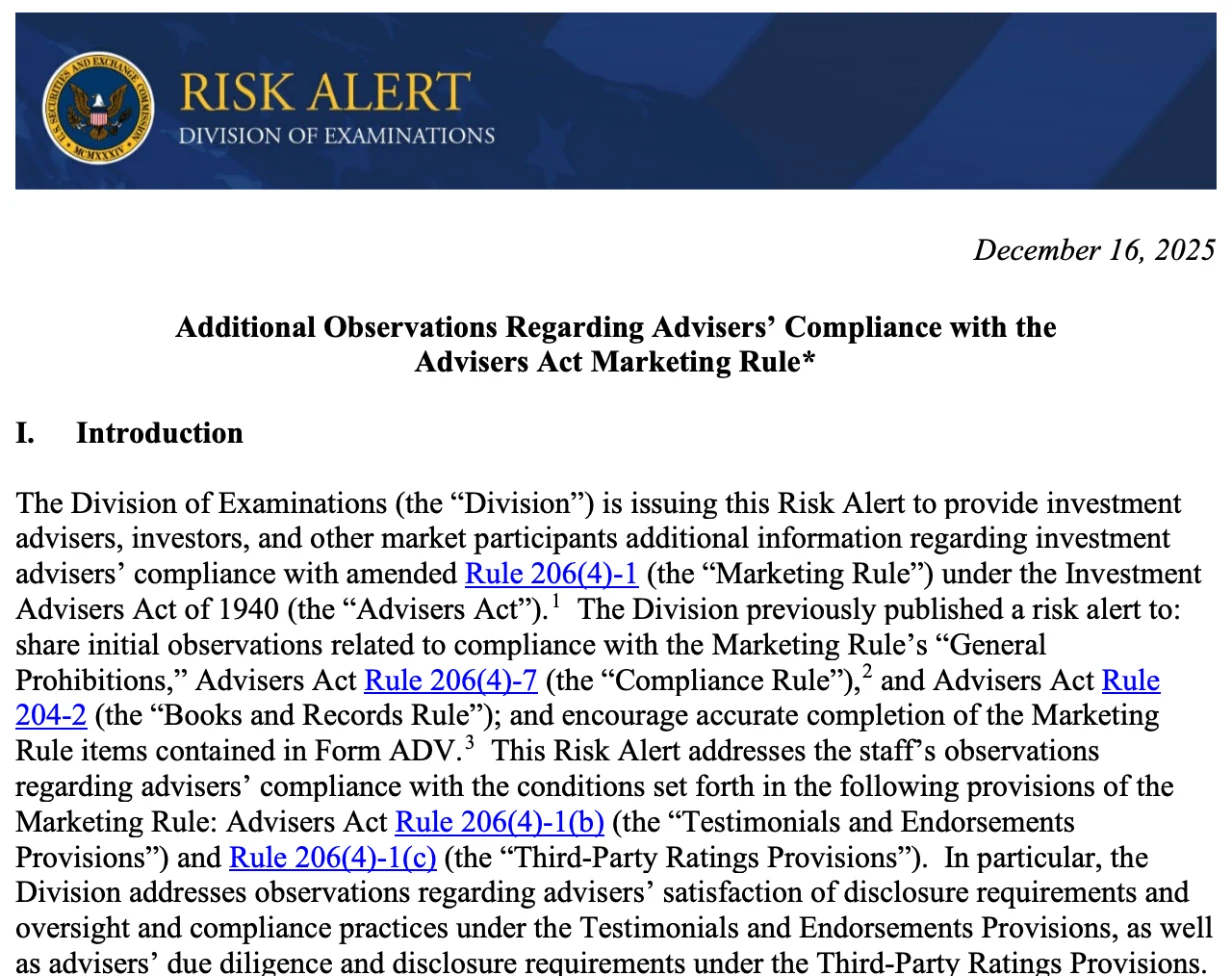
The SEC’s Division of Examinations published its latest observations on 16 December 2025, and several apply directly to referrals14. Risk Alerts describe what staff saw in examinations; the alert itself says it isn’t a rule and has no legal force. Still, they show where examiners look.
Missing disclosures at the moment of sharing
The most common testimonial problem was disclosures that weren’t provided when the testimonial or endorsement was disseminated.
Referral networks and lead-generation firms
Staff observed advisers using lead-generation firms, social media influencers and adviser referral networks, all arrangements that can involve endorsements.
Refer-a-friend programmes
Some advisers offered current clients refer-a-friend rewards at de minimis amounts. Under the rule text, a de minimis payment removes the written-agreement and disqualification conditions, not the disclosures.
Gift cards for reviews
Some advisers gave clients gift cards to write reviews on third-party websites, which makes those reviews paid testimonials.
Reviews copied onto the adviser’s own site
Some advisers placed client testimonials or former-client endorsements from third-party websites on their own websites without making client status clear.
Disclosures hidden behind a link
Some advisers used hyperlinked disclosures instead of clear and prominent disclosures included with the testimonial or endorsement.
Each item above paraphrases the Risk Alert14. If any of them describes something you do today, that’s a conversation for your compliance team this week.
A 90-day plan to earn more referrals
None of this needs a big budget. It needs a little structure, and it builds on itself.
Weeks 1–2: See what a referred prospect sees
Search your name in a private window on desktop and mobile, with and without your city. Ask ChatGPT and Google what they say about you. Note anything that’s wrong, missing or about someone else.
Weeks 2–4: Fix the basics on your website
State who you help on the home page, publish your fees or minimums, and make your About page a clear, factual bio. Link to your IAPD or BrokerCheck record.
Weeks 3–6: Make your profiles agree
Use the same name, title, photo and short bio on LinkedIn, your firm’s page, CFP Board or association listings and any directory you use.
Weeks 4–8: Start referral story conversations
In your next round of review meetings, ask the three questions. Write down the words clients use and reuse them on your website.
Weeks 6–10: Pick two professional partners
Choose one CPA and one attorney who already share clients with you. Offer a joint meeting for a shared client, and refer them business first.
Weeks 8–12: Put reviews and rewards past compliance
Before you ask for reviews or thank anyone for a referral with anything of value, get your compliance team’s written answer.
Every new client: ask how they found you
Use a multi-select intake question for both how they heard about you and where they checked you out.
The point of weeks one to six is that every referral you already get has a better chance of turning into a meeting. The later steps raise the number of referrals in the first place.
Where to start
Referrals are still the cheapest, most trusted way for a financial advisor to grow. The leak is in what happens after someone says your name: most people check, and some never call. Start by searching yourself the way a referred prospect would, then make the clear, specific version of you easy to find everywhere they look.
If you’d like to know how your name looks to a referred prospect, including in AI answers, book a free audit. You can also check whether Google’s Knowledge Graph already holds an entity for you with the free Knowledge Panel Checker, see how to get a Google Knowledge Panel step by step, or read what DotVisible does for financial advisors. More guides for advisors are in the financial advisors hub and the name search topic.
Frequently asked questions
Can financial advisors pay for referrals?
For SEC-registered advisers, the Marketing Rule allows paid testimonials and endorsements only under conditions: clear and prominent disclosure that the person is or isn’t a client and was paid, a description of the compensation and any conflicts, a reasonable basis for believing the rule is met, a written agreement and no payments to disqualified ‘bad actors’ (the rule waives those last two when the total is $1,000 or less over 12 months, and waives the agreement for affiliates). Non-cash rewards such as prizes or reduced fees count as compensation. FINRA members and state-registered advisers have their own rules. Ask your compliance team before offering anything.
How many clients actually refer their advisor?
Julie Littlechild’s research, reported by Kitces, found that 25% to 35% of financial planning clients have given a referral, but advisors meet referrals from only 3% to 5% of their client base. In her survey, 55% of clients said they didn’t know anyone who needed an advisor.
Should I keep asking clients for referrals?
Ask well rather than often. The 2026 Kitces marketing report, as reported by Family Wealth Report, found that repeatedly asking doesn’t increase referral volume and appears to reduce it by making clients feel solicited. Kitces’ earlier referral research suggests helping clients describe the problem you solved, and being clear about who you help, instead.
Do referred prospects really look me up before they call?
The surveys say most intend to. In Wealthtender’s 2025 study of $100k+ households planning to hire an advisor, 96% said they would research an advisor online even after a strong recommendation; Wealthtender runs a paid advisor directory. A small 2026 survey of about 100 Colorado prospects by a marketing firm, cited by Kitces, found 44% of referred prospects would move on if they couldn’t find the information they wanted, so treat that figure as indicative only.
Is a client’s referral a testimonial under the SEC Marketing Rule?
By the rule’s definition, a statement by a current client that refers someone to you is a testimonial. As the rule text reads, its testimonial conditions attach when a testimonial appears in your advertisement or when you compensate for it, directly or indirectly. That is a reading of the text, not SEC guidance, so ask your compliance team how your firm treats unpaid referrals.
Who are the best referral partners for financial advisors?
Cerulli’s research found centers of influence such as CPAs and attorneys are the second most common source of new clients, at 13.9%, behind client, friend and family referrals at 54.2%. Practice management professionals ranked joint meetings, shared personal interests and referring clients to the other professional first as the most effective ways to build those alliances.
Can I ask clients to leave Google reviews?
Possibly, with care. Reviews are testimonials under the Marketing Rule, and SEC examiners have reported advisers who gave clients gift cards for third-party reviews and who copied reviews onto their own sites without disclosing client status. Get your compliance team’s answer before you ask, and don’t offer anything in return without it.
Sources
- 1Financial Advisors Increasingly Leverage COIs to Capture New Client Growth (The Cerulli Report: U.S. Advisor Metrics 2025)Cerulli Associates · 4 Feb 2026↩
- 2Marketing Study: Referral Paradox, Rise Of AEO And Advisor Antipathy (Charles Paikert), on The Kitces Report 2026Family Wealth Report · 21 Sep 2026↩
- 3The Kitces Marketing Report 2026: The Most Cost-Effective Ways Advisors Are Getting Found Online (Brian Thorp), summarising The Kitces Report Vol. 2, 2026Wealthtender · Accessed 17 Nov 2026↩
- 43 Ways To Ask For Referrals More Effectively Based On Pro-Social Psychology (Meghaan Lurtz), citing Julie Littlechild, Absolute EngagementKitces.com · 17 Apr 2023↩
- 5How Americans Will Choose Financial Advisors in 2026 and Beyond (Wealthtender 2025 Study of $100K+ Households Seeking Financial Advice)Wealthtender · Aug 2025↩
- 6What Information Prospects Actually Seek When Choosing An Advisor (Sydney Squires)Kitces.com · 12 Oct 2026↩
- 7We asked 100+ Colorado prospects how they research financial advisorsB2BSalesMagic · 2026↩
- 8Check Out Your Investment ProfessionalSEC, Investor.gov · Accessed 17 Nov 2026↩
- 9FinTech Brands Disrupt DIY Investor Landscape (2026 U.S. Investor Satisfaction Study)J.D. Power · 18 Mar 2026↩
- 102024 U.S. Full-Service Investor Satisfaction StudyJ.D. Power · 21 Mar 2024↩
- 11Rule 2210. Communications with the PublicFINRA · Accessed 17 Nov 2026↩
- 1217 CFR § 275.206(4)-1, Investment adviser marketingLegal Information Institute, Cornell Law School · Accessed 17 Nov 2026↩
- 13Investment Adviser Marketing: A Small Entity Compliance GuideU.S. Securities and Exchange Commission · 28 Apr 2021↩
- 14Additional Observations Regarding Advisers’ Compliance with the Advisers Act Marketing Rule (Risk Alert)SEC Division of Examinations · 16 Dec 2025↩
Keep reading
 Name searchHow Prospects Vet a Financial Advisor Online, and What You Can Check FirstShobin K Jose · 17 Nov 2026 · 18 min read
 Name searchMarketing for Financial Advisors: The Name-Search LayerShobin K Jose · 17 Nov 2026 · 17 min read
 Name searchFive Signs Your Online Presence Is Costing You ReferralsShobin K Jose · 29 Oct 2026 · 17 min read