
How Prospects Vet a Financial Advisor Online, and What You Can Check First
The SEC, FINRA and CFP Board all tell investors to look you up before they hire you. Here are the exact checks a careful prospect runs, what each one shows about you, and what you can keep accurate.
A careful prospect vets a financial advisor in about seven checks: they confirm your registration and any disciplinary history on Investor.gov and FINRA BrokerCheck, read your firm's Form ADV and relationship summary, verify any CFP® certification with CFP Board, check their state securities regulator, look into your designations and reviews, search your name on Google and, in some cases, ask an AI assistant. The SEC, FINRA and CFP Board all tell investors to do most of this. Your part is making sure every one of those checks returns accurate, current information that matches what you tell people in the first meeting.
Why does it matter how prospects vet you?
It matters because the vetting steps aren't a mystery: regulators publish them, and prospects who follow them will see whatever those tools hold about you, accurate or not.
The SEC's Investor.gov puts it bluntly. It tells investors to always check the background of any financial professional, because unlicensed, unregistered people commit much of the investment fraud in the United States.1 FINRA goes further. Even when a friend recommends you, it tells investors to do their own independent review: search the professional and their firm online, check registration on BrokerCheck, consult the state securities regulator, and ask about disciplinary actions, arbitration awards and complaints. Then, in parentheses, it adds the line every advisor should read twice: compare the professional's answers with what BrokerCheck and other third-party sources say.2
CFP Board's own verification page ends with a similar instruction: run an internet search on the CFP® professional's name and business name.3
So a referral doesn't skip the check; it often triggers it. If your website says one thing, BrokerCheck another and an old directory listing a third, you've given a prospect a reason to hesitate before you've spoken.
Everything below is written from your side of the table: what the prospect sees at each check, and what you can make sure is right. If you want the wider picture of what a name search shows, the name search checklist covers it in detail.

What are the seven checks a careful prospect runs?
The list below starts where the SEC's own tips start, with registration, then moves to documents and credentials, then the open web.4
Investor.gov and IAPD
Is this person registered, with whom, and is there any disciplinary history? Investor.gov sends the search to the SEC’s Investment Adviser Public Disclosure site.
FINRA BrokerCheck
For anyone who is or was a registered representative: employment history, exams passed, disclosures and customer complaints.
Form ADV and the relationship summary
The firm brochure and Form CRS, both public on IAPD, plus your brochure supplement (Part 2B), which the firm gives to clients.
CFP Board verification
Whether you currently hold CFP® certification, and whether CFP Board has publicly disciplined you.
State securities regulator
Especially relevant for smaller, state-registered advisory firms and their representatives.
Designations, awards and reviews
What the letters after your name mean, whether an award was paid for, and what clients say online.
Google and AI answers
A search of your name and firm, and a question to ChatGPT, Gemini or Google’s AI about who you are.
Here are the official tools behind the first five checks, and the part of each one you can look after.
| Tool | Run by | What a prospect sees | What you can check |
|---|---|---|---|
| Investor.gov “Check Out Your Investment Professional” | SEC | A name search that redirects to IAPD, or to BrokerCheck for brokers | That a search for the name you use professionally finds you |
| IAPD (adviserinfo.sec.gov) | SEC | Registration with the SEC and states, Form ADV filings, disciplinary history | Your firm’s Form ADV and your Part 2B details are current |
| BrokerCheck (brokercheck.finra.org) | FINRA | Form U4/U5 information, registrations, exams passed, disclosures | Factual accuracy, and that your website links to it clearly |
| Form CRS (relationship summary) | Your firm, public on IAPD | Services, fees, conflicts, legal or disciplinary history | That what you say in meetings matches it |
| Verify a CFP® Professional (cfp.net) | CFP Board | Current or former certification, public discipline | Renewal status and your public profile |
| State securities regulator | Your state, listed by NASAA | Background information on brokers and certain advisers | Your state record, especially if state-registered |
Source: Investor.gov, FINRA and CFP Board, accessed 17 Nov 20265
Check 1: does Investor.gov and IAPD find you?
Yes or no is the first thing a prospect wants to know, and Investor.gov is where the SEC sends them. Type a name into its search box and the site redirects to the Investment Adviser Public Disclosure (IAPD) website, which shows whether the person and their firm are licensed with the SEC, a state and/or FINRA, along with any disciplinary history. For brokers, it may redirect to BrokerCheck instead.1

IAPD holds information on investment adviser firms registered with the SEC or one or more states. The SEC typically regulates larger advisory firms and the states generally regulate smaller ones. IAPD also carries information that investment adviser representatives file with the states, plus some broker-dealer information.5
What you can check
- Search yourself the way a prospect would. Use the name on your business card and website, not your legal name in full if you don't go by it. If a prospect can't find you under the name you use, they may assume you aren't registered.
- Look at the firm too. A prospect may also search the firm name in your email signature. Make sure it matches the registered firm name, or that your site explains the link.
- Note your CRD number. It's the reliable way to point people at the right record, especially if you share a name with someone else in the industry.
Check 2: what does BrokerCheck show about you?
If you are, or were, a registered representative, BrokerCheck shows a lot, and the rule that governs it is public. FINRA Rule 8312 says BrokerCheck releases information from your most recently filed Form U4 and U5, your current registrations, the qualification exams you've passed and when, certain historic complaints, and your most recently submitted comment about the report. It doesn't release exam scores or failed exams.6
That full report stays available while you're associated with a FINRA member firm and for ten years after you were last associated with one. Some events, such as final regulatory actions, can stay visible after that.6
When something is wrong
Rule 8312 also sets out a dispute process. An eligible person can send FINRA a written notice that identifies the inaccurate factual information, explains why it's wrong and includes all available supporting documents. If FINRA decides the dispute is eligible, it generally adds a notation to the report saying information has been disputed, then either updates the record, confirms it as accurate or says it couldn't verify it. The decision can't be appealed.6
The rule is clear about what doesn't qualify. A submission that only explains information, rather than challenging its accuracy, isn't eligible. Nor is one that re-argues the allegations behind a reported complaint, regulatory action or termination.6 Talk to your firm's registration or compliance team before you file anything.
Make the record easy to find
This applies if your firm is a FINRA member. FINRA Rule 2210(d)(8) requires member firms to put a readily apparent reference and hyperlink to BrokerCheck on the first page meant for retail investors and on any web page that profiles registered people who deal with retail investors. FINRA's guidance says a link tucked in the footer generally won't meet that standard. It also explains how to link straight to an individual's BrokerCheck page using their CRD number.7
For vetting, a direct link also saves a prospect a search and removes any doubt about which person with your name they've found.
Check 3: do your Form ADV and relationship summary match what you say?
They should, because prospects can read most of it before they meet you. Form ADV Part 1 and the Part 2A firm brochure are public on IAPD. The brochure has 18 standard items covering services, fees, conflicts and disciplinary information. Part 2B, the brochure supplement, describes the individual advisor: education after high school, business experience for the past five years, disciplinary information, other business activities and how you're supervised. Certain disciplinary events are presumed to be material if they happened in the last ten years. Brochure supplements aren't filed with the SEC; clients get them from the firm, though IAPD still shows information about advisory personnel, including disciplinary information.8
Part 3 is the relationship summary, also called Form CRS. An SEC investor bulletin says it must cover services, fees, conflicts of interest, the standard of conduct and whether the firm and its professionals have reportable legal or disciplinary history, plus where to research it. Prospects can find it through the Investor.gov firm search. The bulletin even suggests a conversation starter: ask your financial professional whether they have any disciplinary history, and for what type of conduct.9
What you can check
- Your Part 2B biography against your website bio. Same employers, same dates, same education. Small mismatches look careless; bigger ones look worse.
- Your fee description. If you explain fees differently in a meeting than the brochure does, a prepared prospect will notice.
- Your answer to the disciplinary question. If there's something on your record, have a short, factual explanation ready that matches what the documents say. FINRA tells investors to compare.2
Check 4: does CFP Board show you as currently certified?
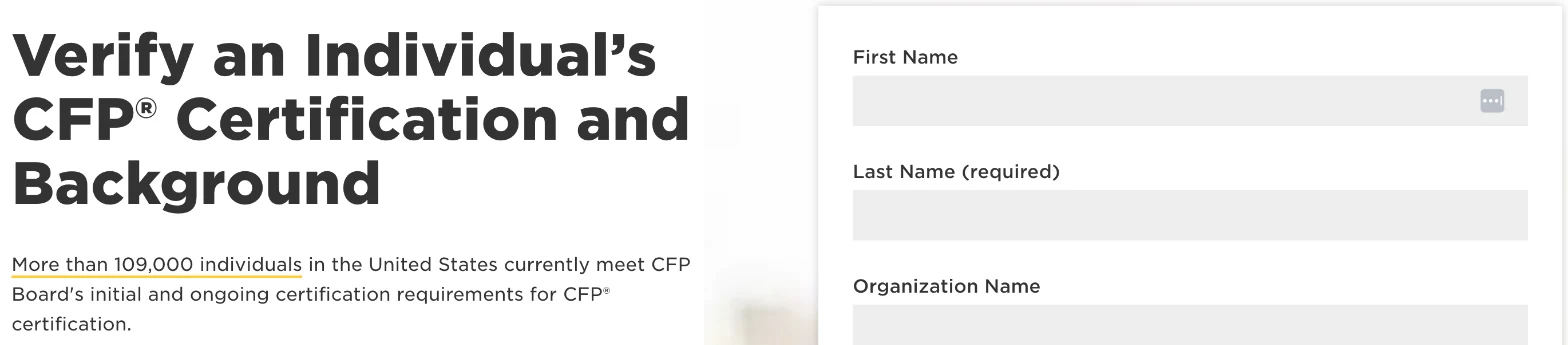
If you use the CFP® marks, prospects can confirm it in seconds. CFP Board's verification search identifies people who currently hold CFP® certification and also people who held it in the past but don't now. It shows anyone CFP Board has publicly disciplined, and bankruptcy disclosures made under its 2012–2020 procedures stay on the site for ten years.3 More than 109,000 people in the United States currently meet the certification requirements, according to the same page.3
What you can check
- Renewal dates. CFP Board requires an annual renewal application and fee, and 30 hours of continuing education every two years, including a 2-hour CFP Board ethics course. Seven days after a certification period expires without those done, CFP Board marks the person as not certified, and they are no longer authorized to use the marks.10 A lapse can sit unnoticed on your bio, LinkedIn and email signature while the verification page says something different.
- Your public profile. CFP Board says more than 900,000 searches take place annually through its "Find a CFP® Professional" tool on LetsMakeAPlan.org, though it doesn't say which year that figure covers. To appear, you need current certification, agreement to the listing terms, a search address on file and a note that you're accepting new clients.11
- The name on the record. If CFP Board has you under a different form of your name than your website, prospects may not connect the two.
Check 5: what does your state regulator hold?
The SEC, FINRA and CFP Board all point investors to their state securities regulator, and the SEC links to the regulator directory run by NASAA, the association of state securities regulators.4 For representatives of smaller, state-registered advisory firms, the state record matters most, since the states generally regulate smaller advisers.5
CFP Board also points investors to state insurance departments for insurance professionals.3 If you sell insurance or annuities as well as advice, a thorough prospect may look there too.
What you can check
- Find your own record with each state where you're registered or licensed, and make sure your name, firm and contact details are current.
- If you've moved firms or states recently, check that the old details aren't the ones a prospect sees first.
- State rules differ, and this guide doesn't cover them. Ask your state regulator or your compliance team what applies to you.
Check 6: do your designations, awards and reviews hold up?
They hold up when every letter after your name is current and every award can be explained. The SEC, NASAA and FINRA say plainly that they don't grant, approve or endorse any financial professional designation, and that a designation doesn't tell anyone whether you're registered. Some designations require serious study, exams and continuing education. Others take very little effort.12 FINRA runs a Professional Designations database where investors can look up what the letters mean and whether the issuing body requires continuing education, takes complaints or lets the public verify holders.13
An SEC investor bulletin lists the situations in which awards, rankings and designations can mislead. They include an award with minimal criteria, a fee paid to receive it, membership required to qualify, a regional ranking presented without its geographic scope, and designations that have lapsed but are still in use.14
Reviews and comments
Reviews are where marketing rules come into play, so tread carefully. FINRA's Regulatory Notice 17-18 applies to FINRA member firms and their registered representatives, not to every advisor. It says unsolicited third-party opinions posted on a social network aren't treated as the firm's or the representative's communications. But if a representative likes or shares favorable comments on their business social media page, FINRA treats them as adopted, and the communications rules, including the testimonial requirements, apply.15 For testimonials about investment advice or performance, those requirements include disclosing that a testimonial may not be representative, that it's no guarantee of future performance or success and, if more than $100 in value was paid, that it's a paid testimonial.15 SEC-registered advisers have their own rules on testimonials and endorsements. Our guide to AI search for financial advisors covers the SEC Marketing Rule and these questions in more depth.
What you can check
- List only designations you currently hold, with the full name of each, so a prospect can look it up.
- For any award, be ready to say who gave it, for what period and on what basis. If you can't, think hard before displaying it.
- Agree with compliance on how you handle reviews before you ask anyone for one.
Check 7: what do Google and AI answers say?
They say whatever the public web says about you, assembled automatically. This is the check every regulator mentions and none controls. FINRA tells investors to do an internet search of the professional and their firm,2 the SEC suggests a simple internet search for any news about the person,4 and CFP Board says to search the name and business name.3
The Google search
A name search brings up your website, your profiles, directory listings, news and sometimes a Google Knowledge Panel. Google says Knowledge Panels are generated automatically from sources across the web and updated as that information changes. The person they describe can claim the panel and suggest edits.16 Google alone decides whether a panel appears. If you're unsure what a panel is or why some advisors have one, start with what a Google Knowledge Panel is.
Directory sites can carry stale details. For FINRA member firms and their representatives, Regulatory Notice 17-18 addresses a narrow but useful case: if an unaffiliated directory lists you without your request, solicitation or payment, contacting the publisher to fix a factual error, such as a misspelled name or a wrong phone number or address, doesn't make the corrected listing the firm's or the representative's communication. That guidance covers factual corrections to the listing only.15

The AI answer
Some prospects skip the search box and put the question to ChatGPT, Gemini or Google's AI Mode. Google says a page can appear as a supporting link in AI Overviews or AI Mode if it's indexed and eligible to show in Search with a snippet, with no extra technical requirements, and that structured data should match what's visible on the page.17 ChatGPT search answers with links to sources. OpenAI itself warns that search results and citations can be incomplete, outdated or incorrect, and tells users to open the sources and rely on an authoritative one when accuracy matters.18
A careful prospect may click through to the sources an AI cites, so those sources need to be right. Neither OpenAI nor Google documents that their answers check BrokerCheck or IAPD, so don't assume the official record will correct a wrong AI answer for you. For how these tools pick their sources, see where ChatGPT gets its information.
What you can check
- Search your name and firm in a private window and note anything outdated, wrong or about someone else.
- Ask ChatGPT and Google's AI what they know about you, by name and city. Our AI Mention Checker does a quick version of this for free.
- Make your website bio, LinkedIn, CFP Board profile and Form ADV Part 2B tell the same story, in the same words where you can.
Where should you start?
Start with the official records: they're the ones regulators send prospects to, and BrokerCheck at least has a formal route to fix factual errors. Then tidy your own website and profiles so they match those records. Leave the open web for last. You don't control it, and Google and AI tools can only work from what's already public, so cleaner sources give them better material to draw on.
Then make it a quarterly habit
Run all seven checks on yourself every quarter, and after any change of firm, title, registration or credential. You'll see what a prospect sees before they do.
Official records
- Investor.gov and IAPD find you under the name you use
- BrokerCheck details are factually accurate
- Form ADV Part 2B matches your bio
- CFP Board shows you as currently certified
- State records list your current firm
Your own pages
- Website links clearly to BrokerCheck or IAPD
- Bio lists only current designations, in full
- Awards come with who, when and on what basis
- Same name, title and firm everywhere
- Fee wording matches the brochure
The open web
- Google results for your name are about you
- Directory listings have the right phone and address
- Reviews handled the way compliance agreed
- AI answers describe your role and firm correctly
- Anything wrong has a fix in progress
The point isn't to polish anything. It's to remove the small contradictions that make a careful person pause. FINRA tells investors to compare your answers against third-party sources,2 so consistency is the thing being tested.
If you notice that warm referrals are going quiet after first contact, the signs your online presence costs you referrals are worth a look too.
The open web is the layer DotVisible, founded by Shobin K Jose, works on, including building toward a personal Google Knowledge Panel. If a panel isn't live within 150 days of onboarding, the client chooses between a deposit refund and free continued work. Google alone decides whether a panel shows, which is why the guarantee is written that way. Optional ongoing AI visibility work is a commitment to keep improving what AI tools can find about you, not a guarantee that they will mention you. None of this is financial, legal or compliance advice.
You can read more about how this works for advisors on our financial advisors page, browse more name search guides and guides for financial advisors, or request a free audit of what prospects see when they look you up.
Frequently asked questions
How do prospects vet a financial advisor online?
A careful prospect usually checks registration and disciplinary history on Investor.gov (which leads to the SEC's IAPD database) and FINRA BrokerCheck, reads the firm's Form ADV brochure and relationship summary, verifies any CFP certification with CFP Board, checks their state securities regulator, looks up designations and reviews, searches the advisor's name on Google and may also ask an AI assistant. The SEC, FINRA and CFP Board all recommend most of these steps.
Can I correct a mistake on my BrokerCheck report?
FINRA Rule 8312 lets an eligible person dispute the accuracy of factual information in their BrokerCheck report by written notice with supporting documents. FINRA may add a notation that the information is disputed while it investigates. A dispute that only explains information, or challenges the allegations behind a reported matter, isn't eligible. Your firm's compliance or registration team is the place to start.
Do I have to link to BrokerCheck on my website?
It depends on whether your firm is a FINRA member. FINRA Rule 2210(d)(8) requires FINRA member firms to include a readily apparent reference and hyperlink to BrokerCheck on the initial web page meant for retail investors and on any page with a professional profile of registered persons who work with retail investors. FINRA says a footer link generally isn't readily apparent. Ask your firm how it applies to your pages.
What happens if my CFP certification lapses?
CFP Board says that seven days after a certification period expires without the renewal requirements completed, the person is marked as not certified and is no longer authorized to use the CFP marks. CFP Board's verification search shows former certificants as well as current ones, so prospects can see the difference.
Does Google show BrokerCheck in my search results?
There is no rule that it will. Google builds name results, including any Knowledge Panel, automatically from sources across the web. Linking clearly to your BrokerCheck or IAPD record from your own site makes the official record easy for prospects to find, but Google alone decides what appears.
Do AI tools like ChatGPT check BrokerCheck?
Neither OpenAI nor Google documents that their AI answers use BrokerCheck or IAPD. ChatGPT search answers with links to web sources, and OpenAI warns that results can be incomplete, outdated or incorrect. Check what AI tools say about you and make sure the public sources they cite are accurate and consistent.
Is this financial or compliance advice?
No. This article summarizes public investor guidance and rules from the SEC, FINRA and CFP Board in general terms. It isn't financial, legal or compliance advice and doesn't say whether any practice is compliant for you or your firm. Take specific questions to your compliance team or counsel.
Sources
- 1Check Out Your Investment ProfessionalU.S. Securities and Exchange Commission, Investor.gov · accessed 17 Nov 2026↩
- 2Working With an Investment ProfessionalFINRA · accessed 17 Nov 2026↩
- 3Verify an Individual’s CFP® Certification and BackgroundCFP Board · accessed 17 Nov 2026↩
- 4Investor Bulletin: How to Select an Investment ProfessionalSEC Office of Investor Education and Advocacy · 1 Jul 2019↩
- 5What is IAPD (Investment Adviser Public Disclosure)?U.S. Securities and Exchange Commission, Investor.gov · accessed 17 Nov 2026↩
- 6Rule 8312. FINRA BrokerCheck DisclosureFINRA · amended eff. 27 Jun 2024↩
- 7Complying with the BrokerCheck Reference and Link Requirements in FINRA Rule 2210FINRA · reviewed 12 Feb 2026↩
- 8Investor Bulletin: Form ADV – Investment Adviser Brochure and Brochure SupplementSEC Office of Investor Education and Advocacy · 24 Jun 2016, updated 27 Aug 2020↩
- 9Relationship Summaries (Form CRS or Form ADV Part 3): Investor BulletinSEC Office of Investor Education and Advocacy · 6 Aug 2020↩
- 10CFP® Certification Renewal PoliciesCFP Board · accessed 17 Nov 2026↩
- 11Your Public ProfileCFP Board · accessed 17 Nov 2026↩
- 12Investor Bulletin: Making Sense of Financial Professional DesignationsSEC, NASAA and FINRA · accessed 17 Nov 2026↩
- 13Professional DesignationsFINRA · accessed 17 Nov 2026↩
- 14Investor Bulletin: Financial Professionals’ Use of Professional Honors – Awards, Rankings, and DesignationsSEC Office of Investor Education and Advocacy · 14 Sep 2017↩
- 15Regulatory Notice 17-18: Guidance on Social Networking Websites and Business CommunicationsFINRA · Apr 2017↩
- 16About knowledge panelsGoogle · accessed 17 Nov 2026↩
- 17AI features and your websiteGoogle Search Central · accessed 17 Nov 2026↩
- 18Searching the web with ChatGPTOpenAI · accessed 17 Nov 2026↩
Keep reading
 Name searchHow to Get More Referrals as a Financial AdvisorShobin K Jose · 17 Nov 2026 · 19 min read
 Name searchMarketing for Financial Advisors: The Name-Search LayerShobin K Jose · 17 Nov 2026 · 17 min read
 Name searchFive Signs Your Online Presence Is Costing You ReferralsShobin K Jose · 29 Oct 2026 · 17 min read