Executive Personal Branding: What Investors and Hires Find
Before the term sheet, the offer letter or the interview, someone types your name into Google. Here is what investors, candidates, board members and journalists find, what the research says it is worth, and how to make that page work for you.

When an investor, a candidate, a board member or a journalist wants to know who you are, they search your name before they ask you. Personal branding for executives is the work of making sure what they find is accurate, current and clearly about you. It has less to do with posting every day than with getting a handful of sources to tell the same true story.
What is personal branding for executives, really?
Personal branding for executives is the picture of you that someone can put together without speaking to you. That picture comes from your Google results, your LinkedIn profile, your company's leadership page, interviews, conference pages and, more and more, the summary an AI tool writes when someone asks about you.
Most advice on the topic starts with content: post on LinkedIn three times a week, find your voice, build a following. That has its place. But it skips a simpler question. When a stranger with a reason to care types your name, what do they actually see?
For a founder or senior executive, those strangers are rarely casual. They are an investor deciding whether to take a second meeting, a VP of Engineering deciding whether to take your call, a director being asked to join your board, or a reporter deciding whether you're the right person to quote. Each arrives with a specific question, and each reads your results looking for the answer.
Your executive brand is the answer people get to "who is this?" when you're not in the room.
Why does an executive's name carry so much weight?
An executive's name carries weight because stakeholders read the leader as a proxy for the company. The best-known primary research on this comes from Weber Shandwick, the communications firm, which surveyed more than 1,700 senior executives in 19 countries with KRC Research1.
Those executives, from managers up to the C-suite but excluding CEOs themselves, attributed 45% of their company's reputation to the reputation of their CEO. They estimated that 44% of their company's market value was attributable to the CEO's reputation too. And 81% said CEO engagement and visibility were critical to company reputation1.
Two cautions are worth stating plainly. These are executives' own estimates, not measured effects. And the survey ran in 2014, with results published in March 2015. Still, it is one of the few large primary studies to ask the question directly, and half of respondents expected CEO reputation to matter even more in the years ahead1.
45%
of company reputation attributed to the CEO's reputation
44%
of company market value attributed to the CEO's reputation
81%
say CEO engagement and visibility are critical to company reputation
For founders the link is tighter still. In an early-stage company there is often no long track record, no analyst coverage and no brand that customers already know. The founder's name is the company's reputation for a while, and the founder's name search is where people check it.
What do investors look for when they search a founder?
Investors look for evidence about the team, because the team is what most of them weigh most heavily. The clearest primary data comes from a survey of almost 900 venture capitalists by Will Gornall, Paul Gompers, Steven Kaplan and Ilya Strebulaev, written for the Journal of Financial Economics2.
When asked what matters in choosing investments, 47% of VC firms ranked the team as the single most important factor, and 95% named the team as an important factor. The business model, product and market came next2.
| Item | Value |
|---|---|
| Team | 95% |
| Business model | 83% |
| Product | 74% |
| Market | 68% |
| Industry | 31% |
Source: Gornall, Gompers, Kaplan and Strebulaev, survey of almost 900 VCs, via Harvard Law School Forum on Corporate Governance, 20192
The survey doesn't measure name searches, and nobody should pretend it does. But if the team is what an investor is judging, the public record of the team is an obvious place to look. A pitch meeting gives an investor your version. Your name search gives them everyone else's.
What an investor is checking for
From the investor's side, a founder's name search is answering a few practical questions:
- Is the track record real? Previous roles, companies and exits should match the deck, the LinkedIn profile and any press.
- Is this person who they say they are? A common name, an outdated photo or a profile that mixes you up with someone else makes this harder than it should be.
- What do other people say? Interviews, podcast appearances, conference pages and coverage written by someone else carry more weight than anything you wrote about yourself.
- Is there anything awkward? Old disputes, failed ventures described badly, or a gap that nobody explains.
None of these needs a famous founder. They need a founder whose public details agree with each other.
What do candidates find when they look up the CEO?
Senior candidates look up the person they would be working for, and they find much the same set of results an investor does, read with a different question in mind: would I want to work for this person?
LinkedIn's research into how candidates decide, based on a survey of more than 14,000 professionals in 28 countries, found that the corporate website is the source candidates turn to most before applying. It also found that hiring managers, the people candidates would report to, have considerable power to grab a candidate's attention4. For a senior hire, the hiring manager is often you. LinkedIn's post gives no percentages, so this is a finding about where candidates look and who they listen to, not a measurement of how often they search a CEO.
Brunswick's research also measures attitudes rather than search behaviour, and its page doesn't say how the research was done. Brunswick Group's Connected Leadership research in the United States reports that four in five US employees use social media to get information, and that employees would prefer a leader who uses social media by more than three to one. Among financial readers, a CEO who uses social media would be trusted over one who doesn't by more than eight to one3. The page gives no sample size, method or fieldwork dates, so treat those ratios as a rough signal, not a measurement.
Weber Shandwick's executives pointed the same way in their 2014 survey. Asked which visible activities matter for a CEO, they rated being visible on the company website at 68% and sharing insights with the public at 67%1. For a candidate, the leadership page and the CEO's public thinking are often the closest thing to meeting the boss before the interview.
What a senior hire is checking for is narrower than people expect:
- Does the CEO's story match the recruiter's pitch? The role, the company stage and the CEO's background should line up.
- Is this person visible in a way that suggests they lead? Talks, interviews and a clear point of view count for more than a big follower count.
- Is there a pattern of short tenures or public conflict? Candidates notice.
If your results show an old title, a company you left two years ago, or nothing beyond a thin LinkedIn profile, a strong candidate fills in the gaps themselves. They rarely fill them in your favour.
What do board members and journalists check?
Board members and journalists both search an executive's name, but for different reasons.
A prospective director is weighing their own reputation. Joining a board ties their name to yours, so they want to know your record, how you've handled setbacks and whether anything in your public history could become their problem. They read slowly and they read old results.
A journalist is checking two things: that you are who you say you are, and that you are worth quoting on the topic. Reporters look for prior interviews, talks and a clear statement of your expertise. Weber Shandwick's respondents rated being accessible to the news media as important for a CEO at 71%, second only to speaking at events at 82%1.
| Item | Value |
|---|---|
| Speak at events | 82% |
| Be accessible to the news media | 71% |
| Be visible on the company website | 68% |
| Share insights and trends with the public | 67% |
| Be active in the local community | 64% |
| Hold leadership roles outside the company | 53% |
| Participate in social media | 43% |
Source: Executives' own ratings. Weber Shandwick with KRC Research, 2014 survey, published March 20151
Notice where social media sits in that list: near the bottom, at 43%. The two activities executives rated highest, speaking and press, leave a trail of pages written by someone else: event pages, interviews and coverage. Those are exactly the pages that show up when someone searches your name.
What actually shows up when someone searches your name?
What shows up is a mix of pages you control, pages you can influence and pages you can't touch. The exact layout changes with the name, the device and the searcher's location, but for a founder or executive the first page usually draws from the same handful of sources.
| Source | What the searcher learns | Your control |
|---|---|---|
| Your own website or bio page | Your role, background and how you describe yourself | Full |
| LinkedIn profile | Current title, career history, who you know | Full |
| Your company's leadership or team page | Your role inside the business | High, through your team |
| Directory and database listings (Crunchbase, PitchBook, association directories) | Funding history, roles, board seats | Partial: claim and correct where allowed |
| Press coverage and interviews | What others say about you | Low: you can earn it, not edit it |
| Conference and podcast pages | Your expertise and how often you're asked to speak | Medium: supply the bio and photo |
| Google Knowledge Panel | Google's own summary of who you are | Low: Google generates it; verification lets you suggest edits |
| AI answers (AI Overviews, ChatGPT and others) | A summary written from whatever sources the tool finds | Indirect: fix the sources it reads |
The last two rows are where executives most often get surprised. A Google Knowledge Panel is generated automatically for entities in Google's Knowledge Graph, from sources across the web, and updates as that information changes5. Nobody writes their own. Our guide to what a Google Knowledge Panel is explains where its facts come from. AI answers are built from the open web, so an outdated bio on an old conference page can resurface as a confident sentence in a chatbot. Where ChatGPT gets its information about people maps the sources involved.
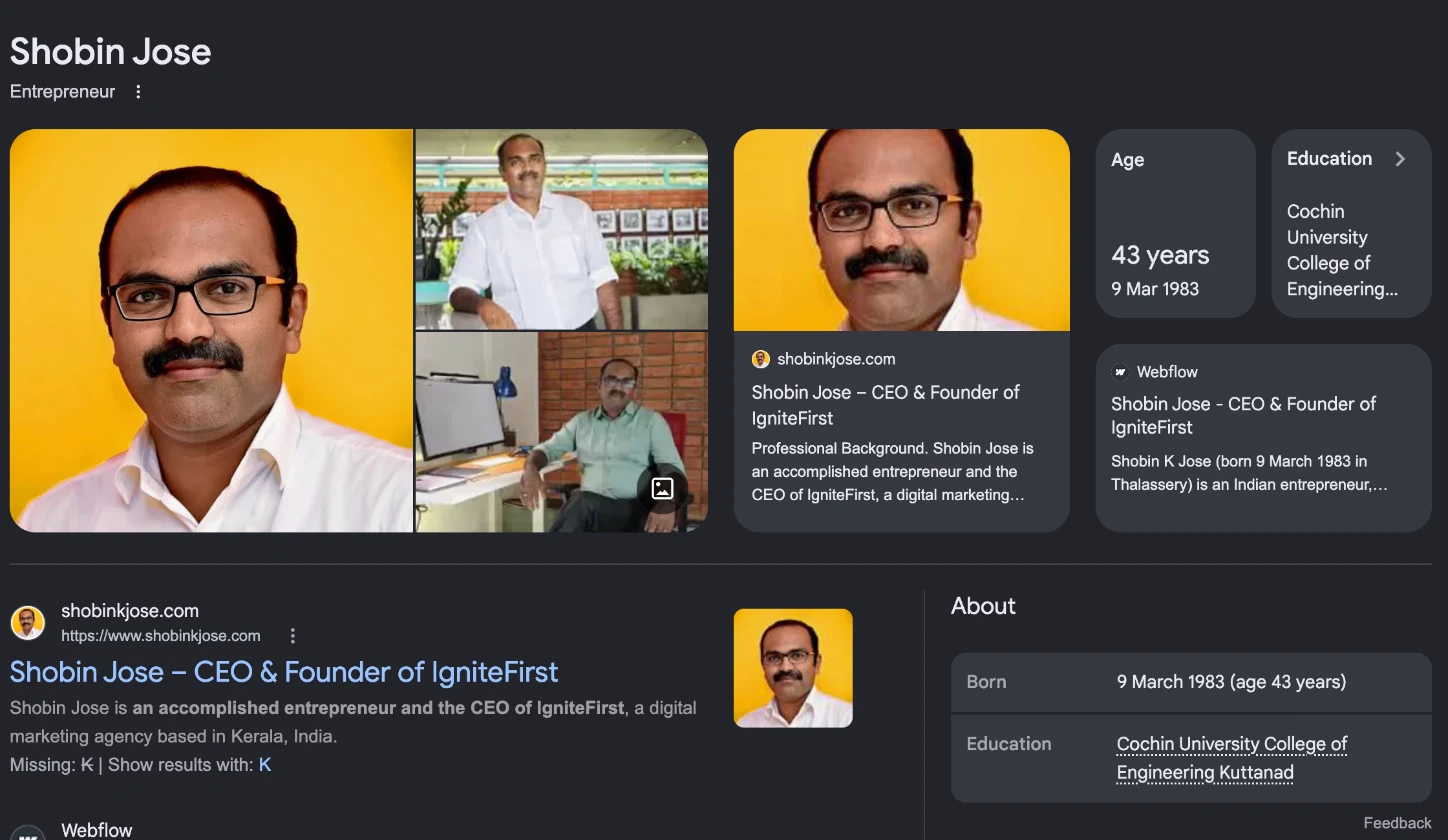
Here is what that looks like for a real name. A Google search for Shobin K Jose, DotVisible's founder, shows a Knowledge Panel above the top results, so a searcher can see at a glance which person the page is about.
Where do executive name searches go wrong?
Executive name searches usually go wrong in one of five predictable ways, and most of them are fixable without any content strategy at all.
- The company is visible, the person isn't. Press releases name the business, the website has no proper bio, and your name search returns the company's homepage and little else. Searchers learn nothing about you.
- The details disagree. Your LinkedIn says Co-founder and CEO, an old speaker page says Head of Product, Crunchbase lists a company you left. Each source is small; together they look careless.
- A namesake gets there first. Someone with the same name has a stronger web presence, and Google shows their results, or worse, blends their details with yours.
- Old news dominates. A five-year-old article about a previous venture is the most-linked page about you, so it ranks.
- AI repeats the mistakes. Chatbots and AI summaries draw on the same sources. If the sources disagree or are out of date, the summary will be too. Why ChatGPT says the wrong thing about you covers how to correct it.
Personal branding for executives means becoming a LinkedIn influencer.
Most of what an investor or candidate sees is static: your bio, your profiles, your company page and what others have written about you.
Posting can add to that picture. It can't fix a picture that is inconsistent underneath.
How do you build an executive brand that holds up to a search?
You build it from the sources outward: one authoritative page about you, the same details everywhere else, and a steady trail of independent pages that confirm them. The order below is the order we'd suggest working in.
Search yourself the way a stranger would
Use a private window, signed out, on desktop and on mobile. Then try your name with your company and with your city. Note what appears, whether it is clearly you and whether it is current. The Name Search Checklist walks through it in ten minutes.
Write one master bio
Open with your name, current role and company, and what you do in one sentence. Follow with the two or three facts an investor or candidate most needs: prior companies, outcomes, areas of expertise. Keep a long and a short version.
Give yourself a home page
A dedicated bio page on your company site or a personal site, with your full name in the title, a current headshot and the master bio. This is the page you want Google to treat as the definitive source on you.
Make every profile agree
LinkedIn, your company's leadership page, Crunchbase or PitchBook, association directories, speaker and podcast pages. Same name, same title, same photo, same short bio.
Link both ways
Your home page links to your genuine profiles, and each profile links back. Add Person structured data to the home page so machines can read who you are.
Earn pages written by other people
Talks, interviews, podcast appearances, bylined articles in your field and board or advisory roles. Speaking at events topped the list of CEO visibility activities in the Weber Shandwick survey above.
Check what AI says about you
Ask ChatGPT, Gemini and Perplexity who you are. Where they get something wrong, trace it to the source page and fix that page.
Review it every quarter, and before every big moment
A funding round, a senior hire, a board appointment or a launch is exactly when people search you. Check the results a few weeks beforehand.
Step six is where most executive branding advice starts, and it matters. But it works far better on top of steps one to five, because new coverage then reinforces a story Google and AI tools can already read clearly. If you want the same groundwork applied to your LinkedIn profile specifically, how Google reads your LinkedIn headline covers the details that carry into search.
Where does a Google Knowledge Panel fit in?
A Google Knowledge Panel fits at the end of this work, not the start. It is the box Google shows beside the results when it is confident it knows exactly who a person is, with a photo, a short description, key facts and links to profiles. For an executive with a common name, or one whose company is better known than they are, a panel settles the question "is this the right person?" before the searcher scrolls.
Google decides on its own whether a panel appears, and it generates panels automatically5. Nobody can buy one, and nobody outside Google controls the outcome. What you can do is make the underlying signals clear: one authoritative page, consistent details, independent sources that agree. If you're weighing whether that work pays back, our founder's check on whether a Google Knowledge Panel is worth it sets out the costs, the benefits and when to wait.
That is the work DotVisible, founded by Shobin K Jose, does for founders and executives. We build the sources that let Google recognise you as a distinct person, with a guarantee that your Knowledge Panel appears within 150 days of onboarding or you choose a deposit refund or free continued work. Optional ongoing AI visibility work is a commitment to keep improving what AI tools can find about you, not a promise of AI mentions. The CEOs and founders page explains how it works for leaders.
Content-first executive branding
- Starts with posting schedules and follower growth
- Adds new pages on top of whatever is already there
- Success measured in impressions
- Inconsistent old sources stay in place
Search-first executive branding
- Starts with what your name search shows today
- Fixes the sources investors and candidates actually read
- Success measured in accurate, consistent results
- New content then reinforces a clear story
Where should you start?
Start with the search. Type your name into Google in a private window, on your phone and on your laptop, and read the first page as if you were an investor seeing it the night before a meeting. Then ask an AI tool who you are and compare its answer with your own bio.
If the results are accurate, consistent and clearly about you, your executive brand is doing its job, and content will build on it. If they aren't, fix the sources first. You'll find more guides written for leaders on the CEOs and founders hub and the wider name search topic page. And if you'd like a second pair of eyes on what your name search says today, book a free audit.
Frequently asked questions
What is personal branding for executives?
It is the picture of you that other people can assemble without asking you: your name search on Google, your LinkedIn profile, your company's leadership page, press coverage, talks and what AI tools say about you. For an executive, good personal branding means that picture is accurate, current and consistent, so investors, candidates, board members and journalists reach the right conclusions quickly.
Do investors really care about a founder's personal brand?
Investors care about the team more than almost anything else. In a survey of almost 900 venture capitalists written for the Journal of Financial Economics, 47% of firms ranked the team as the single most important factor in their decisions and 95% named it as important. Your name search is part of how an investor forms a view of that team before and after a meeting.
Do I need to post on LinkedIn every day to have an executive brand?
No. Regular posting can help, but most of what a stranger sees when they search you is static: your website bio, your LinkedIn profile, your company's team page, press mentions and speaker pages. Getting those accurate and consistent matters more than posting volume.
How is an executive brand different from the company brand?
The company brand describes the business. Your personal brand describes you: your role, your track record and what you stand for. They overlap, but when someone searches your name, Google and AI tools need sources that are about you specifically, not only about the company.
Will a Google Knowledge Panel help my executive brand?
It can, because it shows a searcher at a glance that Google recognises you as a distinct person and summarises the key facts. Google generates panels automatically and alone decides whether one appears. The work that earns one, clear and consistent information confirmed by independent sources, helps your name search either way.
What should I fix first?
Search your name in a private window on desktop and mobile. Then make your current title, company, photo and one-line bio identical across your website, LinkedIn, your company's leadership page and any directory listing. Inconsistent or outdated details are the most common and the easiest problem to fix.
Can I remove negative or outdated results about me?
Usually not, unless a result breaks a Google policy or exposes personal details such as your home address or phone number. For everything else, update the source where you can and publish accurate, current pages about you so the newer information is easy to find.
Sources
- 181% of Global Executives Report that External CEO Engagement is Now a Mandate for Building Company Reputation (The CEO Reputation Premium: Gaining Advantage in the Engagement Era, with KRC Research)Weber Shandwick, via PR Newswire · 5 Mar 2015↩
- 2How Do Venture Capitalists Make Decisions? (Gornall, Gompers, Kaplan and Strebulaev)Harvard Law School Forum on Corporate Governance · 20 Aug 2019↩
- 3Connected Leadership in the United StatesBrunswick Group · Accessed 17 Nov 2026↩
- 4Inside the Mind of Today's Candidate (survey of 14,000+ professionals in 28 countries)LinkedIn Talent Blog · 2017, accessed 17 Nov 2026↩
- 5About knowledge panelsGoogle Knowledge Panel Help · Accessed 17 Nov 2026↩
Keep reading
 Name searchPersonal Branding Consultant vs Agency: What a Coach or Consultant NeedsShobin K Jose · 17 Nov 2026 · 17 min read
 Name searchHow Google Reads Your LinkedIn HeadlineShobin K Jose · 29 Oct 2026 · 15 min read
 Name searchHow Prospects Vet a Financial Advisor Online, and What You Can Check FirstShobin K Jose · 17 Nov 2026 · 18 min read