
SEO for Doctors: Your Name, Your Profiles, Your AI Answer
Referred patients search your name before they book. Here’s how to make that search clear and accurate, from your physician bio and schema to Google’s practitioner rules, AI answers and the advertising and privacy rules that apply.
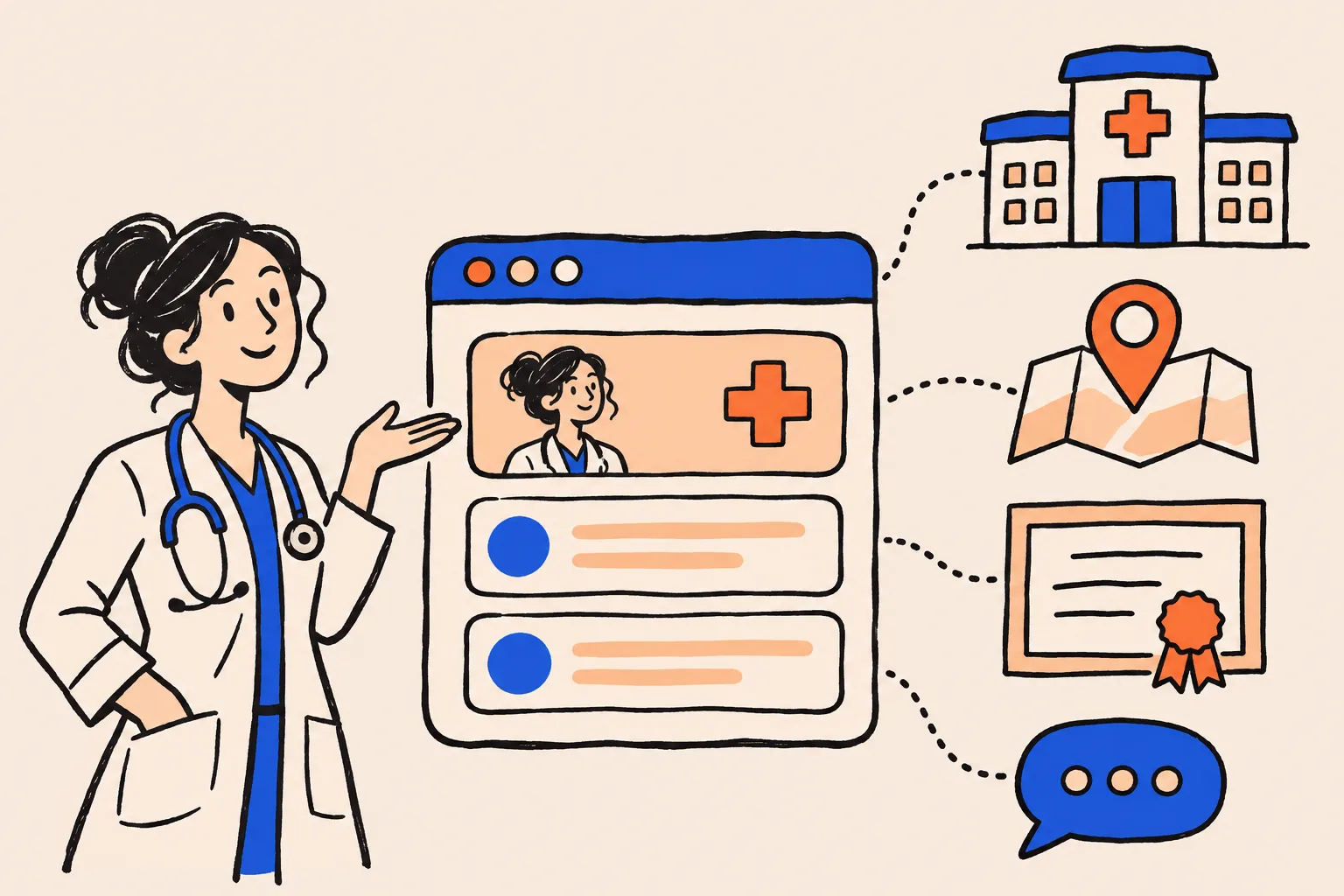
SEO for doctors usually means ranking a practice for searches like “dermatologist near me”. For an individual physician, start with your own name. When a referred patient types it into Google or asks ChatGPT about you, they should find your practice bio, your Google profile and your listings, all saying the same thing about who you are, where you practise and what you treat.
That search is far less competitive than any specialty keyword, most of the pages that win it are yours to fix, and the same pages are what Google’s panels and AI answers are built from.
What does SEO for doctors mean when patients search your name?
It means making sure the pages that appear for your name are accurate, consistent and clearly about you. Practice marketing chases searches like a specialty plus a city. But a patient who was referred to you, a GP deciding where to send someone, or a hospital checking a new hire searches the name they were given.
Patients are also asking AI tools. In rater8’s 2026 Patient Choice Report, a vendor survey of 992 US patients run in April 2026, 47% said they had used AI to research healthcare providers, up from 31% the year before1. Among respondents who searched for a provider, 36% named AI tools such as ChatGPT as an influence on their choice, against 34% for Google search results and 32% for a doctor’s referral1. Their most common first search was still “specialty near me”, at 55%1.
Those AI answers are only as good as what they find. Of the 465 respondents who had used AI for provider research, 66% said they had come across incorrect provider information from an AI tool, and 60% said they had trusted the summary without checking it1. If your details are scattered, outdated or mixed up with another doctor’s, that is what gets repeated.
Why does Google hold medical pages to a higher bar?
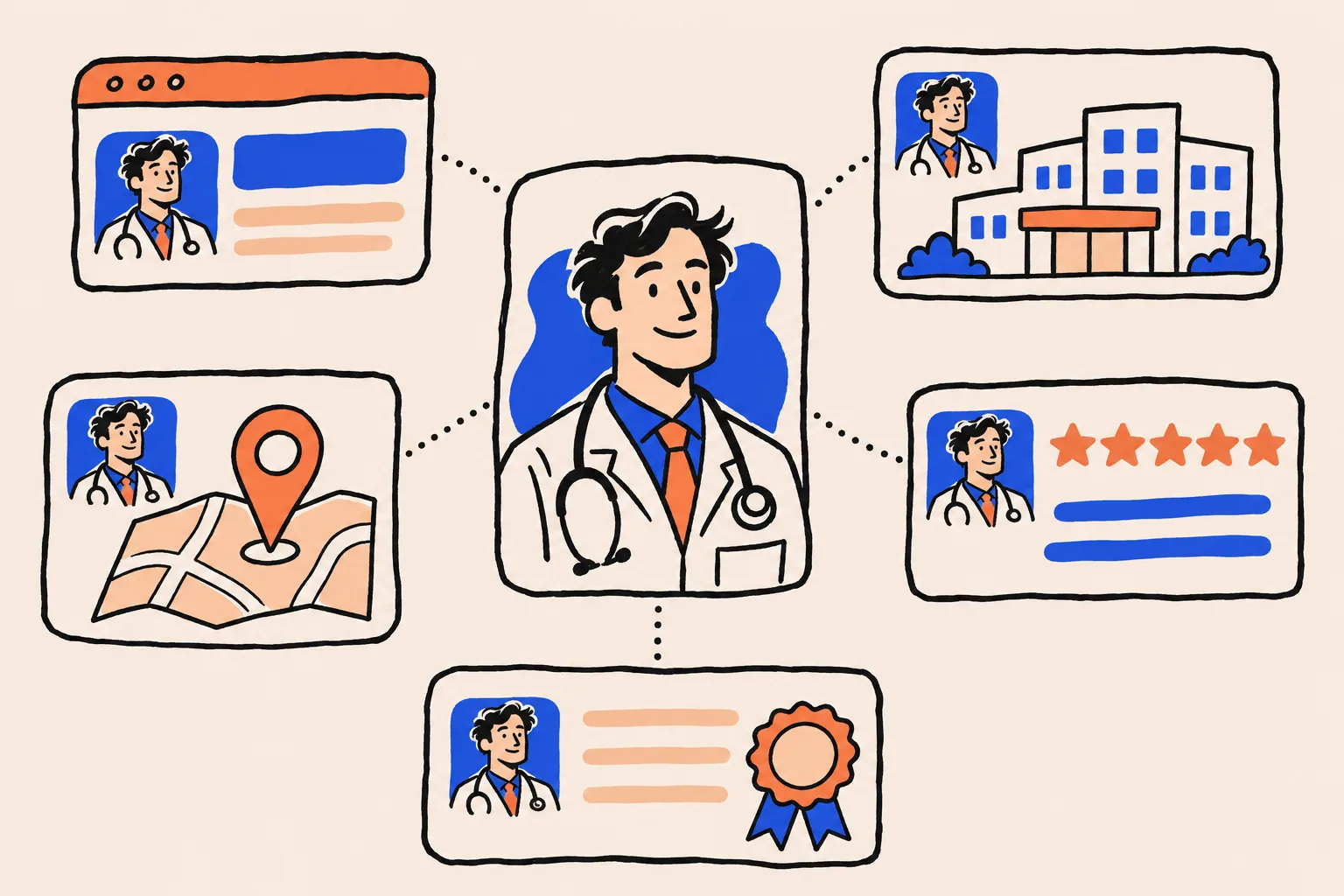
Because health is one of the topics where Google says it looks hardest for trust. Its guidance on helpful content explains that its systems give even more weight to content with strong experience, expertise, authoritativeness and trustworthiness (E-E-A-T) on topics that could significantly affect people’s health, financial stability or safety, and that of those four, trust matters most2. Google also says E-E-A-T isn’t a single ranking factor2.
For a doctor, this is good news. You have exactly what that guidance looks for: a real name, real training and a licence anyone can check. The job is to make those things easy to see. A practice site full of unsigned articles about conditions gives Google little to go on. The same articles, each carrying the name of the physician who wrote or reviewed them and linking to that physician’s bio, tell a much clearer story.
What should your physician bio page say?
Your bio page should say, in plain words at the top, who you are, what you treat and where. Everything else on the web about you should be able to point back to it.
Google’s documentation on profile pages lists “an employee page on a company website” as a suitable kind of profile page, as long as the page focuses on a single person affiliated with the site3. A physician bio on a practice or hospital website fits that well.
A strong physician bio usually has:
- Your name, written the same way everywhere, with your credential: “Dr. Priya Raman, MD”, not “Dr. P. Raman” on one page and “Priya Raman-Iyer” on another.
- A first sentence that could stand alone: your specialty, your subspecialty if you have one, and where you see patients.
- Verifiable facts: medical school, residency, fellowship, board certification with the name of the board, hospital affiliations and languages spoken.
- Practical details: locations, how to book, and whether you see new patients.
- Links out to your genuine profiles elsewhere, so each one confirms the other.
- Bylines: every article you wrote or reviewed should name you and link to this page.
Keep every claim checkable. The AMA’s ethics opinion on advertising says objective claims about a physician’s experience, competence and quality may be made only if they are factually supportable4. “Board certified in dermatology by the American Board of Dermatology” is a fact. “The region’s leading skin specialist” is a claim you would have to prove.
Should you use Physician schema or Person markup?
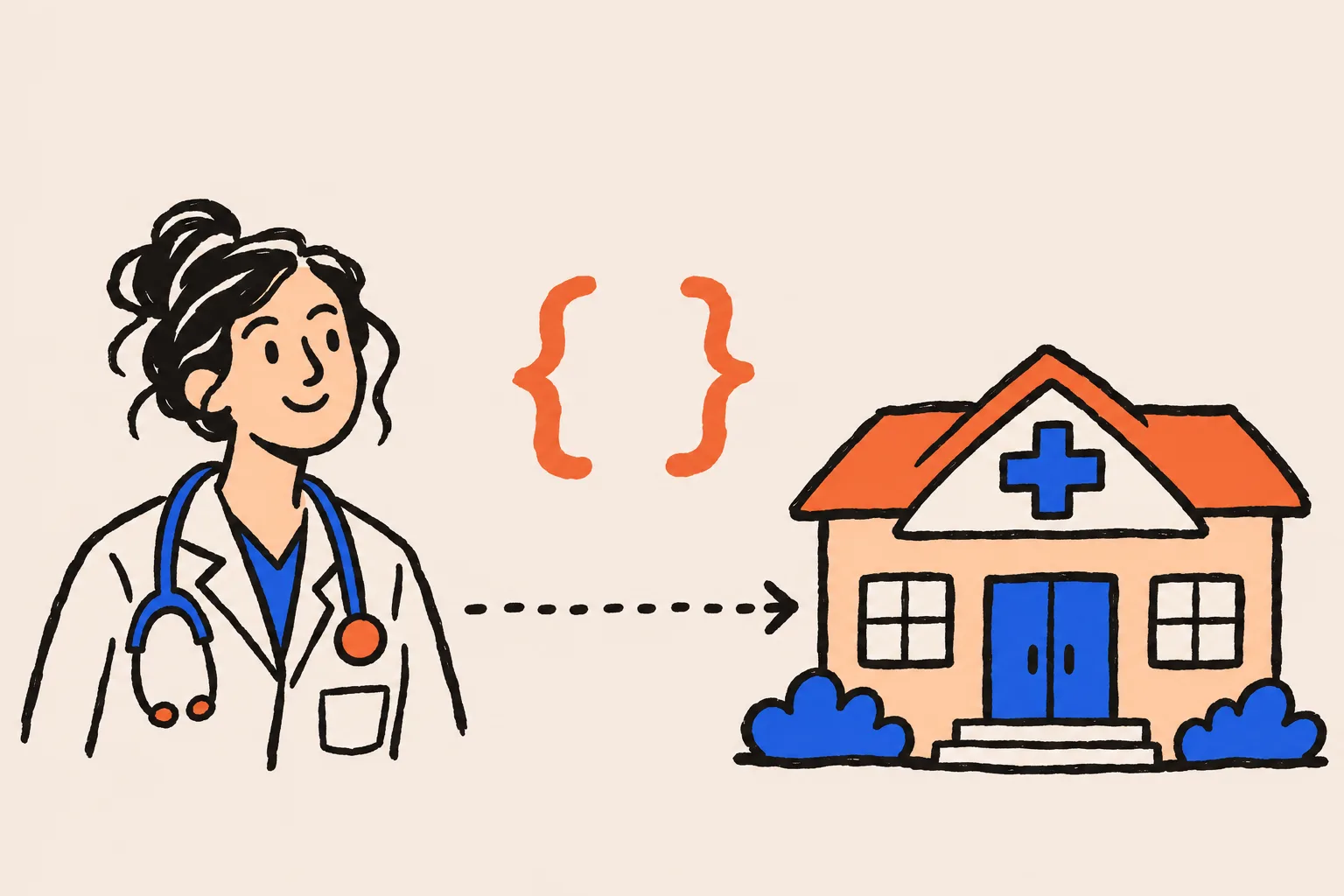
Use Person markup for yourself. Many medical SEO guides recommend Physician schema for a doctor’s page, but look at where schema.org puts it. The current schema.org pages show IndividualPhysician, defined as “an individual medical practitioner”, sitting under Physician. Physician in turn sits under MedicalOrganization and, through MedicalBusiness, under LocalBusiness, which puts it under both Organization and Place56. Person doesn’t appear in that hierarchy at all.
Schema.org added IndividualPhysician in version 24.0, released in January 2024, when Physician was redefined as “an individual physician or a physician’s office considered as a MedicalOrganization”76. Physician carries useful properties such as usNPI for your National Provider Identifier, medicalSpecialty and hospitalAffiliation, and IndividualPhysician adds practicesAt, which points to the clinics or hospitals where you work65. Those are the details of a listing for a practice or a practitioner.
You, the doctor, are a person. So the clearest setup is:
- On your bio page: a ProfilePage whose
mainEntityis a Person. Google’s ProfilePage documentation requires amainEntitythat is a Person or Organization, and recommendssameAsfor links to your other profiles3. - Link the person to the practice with
worksFor, pointing at the practice’s own markup. - On the practice or location page: MedicalClinic, Physician or IndividualPhysician markup with the address,
usNPIandmedicalSpecialty.
{
  "@context": "https://schema.org",
  "@type": "ProfilePage",
  "mainEntity": {
    "@type": "Person",
    "@id": "https://example-clinic.com/doctors/priya-raman#person",
    "name": "Priya Raman",
    "honorificPrefix": "Dr.",
    "honorificSuffix": "MD",
    "jobTitle": "Dermatologist",
    "image": "https://example-clinic.com/images/priya-raman.jpg",
    "worksFor": {
      "@type": "MedicalClinic",
      "@id": "https://example-clinic.com/#clinic",
      "name": "Example Skin Clinic"
    },
    "alumniOf": {
      "@type": "CollegeOrUniversity",
      "name": "Example University School of Medicine"
    },
    "knowsAbout": ["Mohs surgery", "Skin cancer screening"],
    "sameAs": [
      "https://www.linkedin.com/in/example",
      "https://www.example-hospital.org/find-a-doctor/priya-raman"
    ]
  }
}
Two cautions. First, the markup must match what’s visible on the page; Google’s guidance for its AI features asks site owners to check exactly that8. Second, Google says plainly that it doesn’t guarantee structured data will produce any search feature3. Markup is a clear label, not a switch. If the idea is new to you, Structured Data in Plain English explains it from the start, and the same Person-not-business logic applies to SEO for lawyers.
Does every doctor need their own Google Business Profile?
Not every doctor, but many can have one. Google’s guidelines name doctors and dentists among “individual practitioners”, public-facing professionals with their own patients, and say a practitioner should have a profile if they work in a public-facing role and can be contacted directly at the verified location during stated hours9. Support staff shouldn’t create their own profiles9.
The rules that trip doctors up most:
| Situation | What Google’s guidelines say |
|---|---|
| Titles in the name | Allowed: titles or degrees such as Dr. or MD can be included |
| Several specialties | One profile per practitioner, not one per specialisation |
| Several doctors at one practice | The practice gets its own profile; each doctor’s profile uses only the doctor’s name, not the practice’s |
| You’re the only public-facing doctor at a branded practice | Share one profile, named in the form “Brand: Practitioner name” |
| Hospital departments | A public-facing department that operates as a distinct entity can have its own profile, such as “Massachusetts General Hospital Department of Dermatology” |
| Virtual office or mail drop | Not eligible |
| Appointment-only | Don’t list opening hours |
Source: Google Business Profile Help, Guidelines for representing your business on Google9
A Business Profile and a Google Knowledge Panel are different things, and doctors often confuse them. Knowledge Panel or Google Business Profile? explains the difference in detail.
Which other pages show up for a doctor’s name?
Usually a mix of pages you control, pages you can claim, and pages you can only influence. Search your name in a private window, then your name plus your city, and list every result on the first screen. The name search checklist walks through that audit step by step.
| Page | Who controls it | What to do |
|---|---|---|
| Your practice bio | You or your practice | Make it the anchor (see above) |
| Hospital “find a doctor” page | The hospital | Ask the medical staff office or marketing team to match your bio |
| Your Google Business Profile | You, once claimed | Claim it and keep it current |
| NPI Registry record | You, through NPPES | Keep your practice address and specialty up to date |
| Health directories and booking sites | The directory; you can usually claim your listing | Claim the ones on page one and copy your bio details exactly |
| LinkedIn and professional networks | You | Same name, photo, title and affiliation as your bio |
| News, podcasts, journal profiles | Others | Make sure your bio links to the good ones |
Source: DotVisible summary
Your NPI record deserves more attention than it gets, because it is an official source that directories and data vendors draw on. Federal rules require a provider to report changes to their NPI data to the national system within 30 days of the change10. An old practice address there can surface in directories long after you move.
Reviews matter too: the same rater8 survey found 75% of patients wouldn’t book with a doctor rated below 4.0 stars1. Handling reviews, and replying without disclosing anything about a patient, is a subject of its own with its own privacy rules.
How do AI answers describe a doctor?
They summarise whatever they can find and trust about you, so they inherit every inconsistency in your name search. Google says there are no extra technical requirements to appear in AI Overviews or AI Mode: a page needs to be indexed and eligible to show with a snippet in normal Search. Its advice for those features is ordinary good practice, plus checking that structured data matches the visible text and that your Business Profile information is up to date8. Google also notes that AI Overviews only appear when its systems judge them additive, so they often don’t trigger8.
ChatGPT works on a similar principle. OpenAI says any public website can appear in ChatGPT search, provided it doesn’t block OpenAI’s search crawler, OAI-SearchBot, in its robots.txt file. Links from ChatGPT carry utm_source=chatgpt.com, so you can see those visits in your analytics11. If your practice website blocks that crawler, ChatGPT has to rely on what other sites say about you.
You can see what the main AI tools say about you today with our free AI Mention Checker. If an answer is wrong, this guide to wrong ChatGPT answers explains where the error usually comes from and how to fix the source.
Where does a Google Knowledge Panel fit?
A Google Knowledge Panel is the box Google generates automatically for a person or organisation in its Knowledge Graph. Google says panels are generated from sources across the web, update as the web changes, and can be claimed by the person they describe, who can then suggest changes12. You can’t create or buy one. Google decides whether it appears.
For a doctor, a panel is what consistent name-search work tends to build towards: one clear entity, with your name, specialty and affiliation agreed across your bio, your profiles and official records. That clarity also helps when you share a name with another doctor, a common problem in medicine. You can check whether Google already recognises you with the free Knowledge Panel Checker, and the doctors’ Knowledge Panel playbook covers the full route.
What do the advertising and privacy rules mean for doctor SEO?
They mean every page about you counts as a communication about your services, so it has to be true and not misleading. Two sets of rules matter most.
AMA Code of Medical Ethics, Opinion 9.6.1. It says there are no restrictions on physician advertising except those justified to protect the public from deception, and that the key question is whether a communication is true and not materially misleading. It lists the physician’s educational background, how fees are set, payment methods and any other non-deceptive information as acceptable content4. It also warns that patient testimonials about a physician’s skill tend to be deceptive when they don’t reflect the results that patients with comparable conditions generally get, and that claims of having cured or successfully treated large numbers of cases of serious illness are deceptive if they imply a certainty of result4.
HIPAA’s marketing rule. HHS guidance says that, with limited exceptions, the Privacy Rule requires a patient’s written authorization before their protected health information is used or disclosed for marketing13. A patient story, a before-and-after photo or a named case on your website can involve protected health information, so get proper authorization first.
| Task | What to watch |
|---|---|
| Writing your bio | State credentials you can document; avoid superlatives you can’t support |
| Listing board certification | Name the certifying board, and keep it current |
| Patient stories and photos | Written HIPAA authorization; stories representative, not cherry-picked cures |
| Condition and treatment articles | Accurate, signed or reviewed by a named clinician, no promised outcomes |
| Directory profiles | Same facts as your bio; correct anything outdated |
A 30-day plan to own your name search
You don’t need an agency for most of this. You need an hour or two a week for a month, and one master version of your details.
Week 1: write your master details
One version of your name and credential, one specialty line, one headshot, a one-sentence bio and a 150-word bio. Every other step copies from this.
Week 1: search yourself
Private window, desktop and mobile. Your name, your name plus specialty, your name plus city. Ask ChatGPT and Gemini who you are. List what you find.
Week 2: fix your bio page
Stable URL, a clear first sentence, documented credentials, links out to genuine profiles, bylines on anything you’ve written or reviewed.
Week 2: check your NPI record
Practice address, specialty and contact details in NPPES. Report changes within 30 days of them happening.
Week 3: sort out Google Business Profile
Decide whether you need your own practitioner profile, the practice’s profile or the combined “Brand: Practitioner” form, following Google’s rules.
Week 3: claim the directories on page one
Same details, same photo, a link back to your bio page.
Week 4: add Person markup
ProfilePage with a Person as mainEntity on your bio, worksFor pointing at the practice, sameAs to your profiles. Test it at validator.schema.org.
Week 4: read everything against the rules
Check every bio, profile and patient story against AMA Opinion 9.6.1, HIPAA and your state board’s rules. Remove anything you can’t document.
After that, check your name search every quarter, and any time you change practice, title or photo.
When it makes sense to get help
Help is worth considering when you share a name with another doctor, when Google or an AI answer mixes you up with someone else, when you’ve moved and your old affiliation won’t go away, or when you want a Google Knowledge Panel and the AI visibility that comes with being clearly understood.
That’s the work DotVisible does. We build personal Google Knowledge Panels and AI visibility for professionals, including doctors and specialists. Google alone decides whether a panel shows, so we’re careful about what we promise: if your panel hasn’t appeared within 150 days of onboarding, you choose between a refund of your deposit and continued work at no charge. Ongoing AI visibility work is a commitment to keep working on how AI tools describe you, not a guarantee of AI mentions. See how it works, browse more guides for doctors and on name search, or get a free audit of your own name search.
Frequently asked questions
What is SEO for doctors?
It is the work of making a doctor or medical practice easy to find and easy to trust in Google and in AI answers. Most guides focus on ranking a practice for searches like a specialty plus a city. For an individual physician, the place to start is your own name: the search referred patients and colleagues run, which feeds Google's panels and AI answers too.
Should I use Physician schema for myself?
Not as your main markup. On schema.org, Physician and IndividualPhysician sit under Organization, MedicalOrganization and LocalBusiness, and Person appears nowhere in their hierarchy. Mark yourself up as a Person on a ProfilePage, linked to the practice with worksFor, and use Physician or IndividualPhysician markup, with usNPI, on the practice or listing page.
Can a doctor have their own Google Business Profile?
Often, yes. Google treats doctors as individual practitioners. A doctor who is public-facing and can be contacted directly at the verified location during stated hours can have a profile in their own name, and titles such as Dr. or MD are allowed. Google says one practitioner should not have several profiles for different specialisations.
How long does SEO for doctors take?
Fixing your own name search is quicker than ranking for competitive specialty terms, because the pages that rank for your name are mostly ones you control or can claim. Expect weeks for your own pages and profiles to be updated, and longer for Google and AI answers to reflect the changes. Nobody can promise a ranking, a panel or an AI mention.
Does Google treat medical websites differently?
Google says its systems give more weight to content showing strong experience, expertise, authoritativeness and trust on topics that could significantly affect people's health, financial stability or safety, and that trust matters most. Clear authorship by a named, verifiable clinician helps show that.
Can I use patient testimonials on my website?
Be careful. AMA Opinion 9.6.1 says testimonials about a physician's skill tend to be deceptive when they don't reflect the results patients with comparable conditions generally get, and HIPAA generally requires a patient's written authorization before their health information is used for marketing. State rules also apply. This is not legal advice.
Do AI tools like ChatGPT need special markup to mention me?
No special markup is required. Google says there are no extra requirements for AI Overviews or AI Mode beyond being indexed and eligible for a snippet, and OpenAI says any public site can appear in ChatGPT search if it doesn't block OAI-SearchBot. Accurate, consistent pages about you are what AI answers draw on.
Sources
- 12026 Patient Choice Report (vendor survey, n=992, April 2026)rater8 · Published 6 Jun 2026; accessed 20 Nov 2026↩
- 2Creating helpful, reliable, people-first contentGoogle Search Central · Accessed 20 Nov 2026↩
- 3Profile page (ProfilePage) structured dataGoogle Search Central · Accessed 20 Nov 2026↩
- 4Opinion 9.6.1: Advertising & publicityAMA Code of Medical Ethics · Accessed 20 Nov 2026↩
- 5IndividualPhysician (type)schema.org · V30.1, 16 Sep 2026; accessed 20 Nov 2026↩
- 6Physician (type)schema.org · V30.1, 16 Sep 2026; accessed 20 Nov 2026↩
- 7Schema.org v24.0 release: changes to Physician schema markupSchema App · 18 Jan 2024↩
- 8AI features and your websiteGoogle Search Central · Updated 10 Dec 2025↩
- 9Guidelines for representing your business on GoogleGoogle Business Profile Help · Accessed 20 Nov 2026↩
- 1045 CFR 162.410: Implementation specifications: health care providerseCFR · Accessed 20 Nov 2026↩
- 11Publishers and developers FAQOpenAI Help Center · Accessed 20 Nov 2026↩
- 12About knowledge panelsGoogle Knowledge Panel Help · Accessed 20 Nov 2026↩
- 13Marketing (HIPAA Privacy Rule guidance)U.S. Department of Health and Human Services · Accessed 20 Nov 2026↩
Keep reading
 Name searchHow Google Reads Your LinkedIn HeadlineShobin K Jose · 29 Oct 2026 · 15 min read
 Name searchFive Signs Your Online Presence Is Costing You ReferralsShobin K Jose · 29 Oct 2026 · 17 min read
 Name searchThe Name Search Checklist: 12 Things Prospects See Before They CallShobin K Jose · 29 Oct 2026 · 19 min read