Five Signs Your Online Presence Is Costing You Referrals
Referrals that go quiet are usually the first symptom. Here are the other four, with a quick test and a practical fix for each.

A past client tells you they mentioned you to a friend. Weeks go by and the friend never gets in touch. You assume they found someone cheaper, or decided not to bother, and you move on.
Sometimes that's exactly what happened. But often something else happened in between: the friend typed your name into Google, and what they found didn't match the person they'd just been told about.
Recommendations from people we know have long topped surveys of trusted advertising. In Nielsen's 2021 global Trust in Advertising survey, 88% of respondents trusted them more than any other channel1. That trust gets someone to search for you. It doesn't always get them to call. In a 2025 vendor survey by Wealthtender, an advisor directory, 96% of affluent Americans planning to hire a financial advisor said they would still research an advisor online even after a referral2.
This guide covers five signs that the search step is where your referrals are leaking, how to test each one in a few minutes, and what to do about it.
Why every referral now comes with a search
When someone recommends you, they hand over a name and a reason. The person receiving the recommendation then does what almost everyone does with a name: they look it up. They want to know you're real, that you do what the friend said you do, and that other people have had a good experience too.
The research on this points the same way across professions. Every survey asks a slightly different question, and all of the ones below are vendor surveys, run by companies that sell directory listings, review tools or local marketing software.
- Financial advice. In Wealthtender’s 2025 vendor survey (it runs an advisor directory) of 500 US adults with household incomes over $100,000, fielded in late July 2025, 62% said they would start with referrals from friends or family. Yet 96% said they would research an advisor online even if referred, 83% would check online reviews and awards, and 72% would visit the advisor’s website2.
- Legal services. Martindale-Avvo’s Hiring an Attorney 2019 report, a vendor survey from the legal directory and marketing company, found that 46% of legal consumers who received a referral checked the lawyer’s reviews before getting in touch, and 45% of those with a personal referral checked the lawyer’s or firm’s website first3.
- Healthcare. A 2018 vendor survey of 1,700 US adults by Doctor.com, which sells provider marketing, found 81% of patients read provider reviews even after a referral4.
- Local services in general. BrightLocal’s 2026 Local Consumer Review Survey, a vendor survey of 1,002 US adults by the local SEO software company, found 97% read reviews for local businesses, and 41% always do, up from 29% a year earlier5.
96%
of affluent prospects would research a financial advisor online even if referred (Wealthtender, 2025)2
46%
of referred legal consumers checked the lawyer’s reviews before contacting them (Martindale-Avvo, 2019 data)3
81%
of patients read provider reviews even after a referral (Doctor.com, 2018)4
Read those numbers as a direction, not a single fact. The Wealthtender figure is a stated intention from a high-income group. The legal and healthcare figures are older and measure narrower behaviour. What they agree on is the pattern: a referral earns you a look, and the look decides whether you get the call.

The awkward part is that this vetting happens privately. Nobody emails to say they found three different job titles and an old photo and decided to keep looking. They simply don't call. A lost referral leaves no trace, which is why the first sign is so easy to miss.
Sign 1: Referrals that go quiet
What it looks like
Clients tell you they recommend you, but fewer of those people get in touch. The ones who do arrive less warm than they used to. Discovery calls open with “I couldn’t find much about you” or “I wasn’t sure I had the right person”. Or referrers mention names you never heard from.
Why it happens
A referred prospect is rarely choosing between you and nobody. In Wealthtender’s 2025 vendor survey, 97% of respondents planned to interview more than one advisor, and only 3% would hire without comparing2. Your referral puts you on a shortlist. If the next person on that list looks clearer and more credible online, the warm introduction can lose to a stranger with a better first page.
Quick test
Ask your last ten new clients two questions: how did you hear about me, and what did you look at before you got in touch? Then ask two or three regular referrers whether they’ve sent anyone your way recently. If referrers name people who never reached you, or new clients say they nearly didn’t call, you have a leak worth tracing.
Fix
Add a “How did you hear about us?” question to your intake form, and record the answer every time. Give your best referrers one link to pass on, ideally your About page, so the person they recommend lands on something you control instead of a search results page you don’t. Then work through the next four signs.
Sign 2: Your name search doesn’t lead to you
What it looks like
Someone searches your name and the first page shows a namesake, an old employer’s staff page, a directory listing that scraped your details years ago, or very little at all. If there’s a knowledge panel, it belongs to someone else, or it describes a version of you that’s out of date.
Why it happens
Google can only show what it understands. Knowledge panels, for example, are generated automatically from what Google holds in its Knowledge Graph and update as information on the web changes6. If your information is scattered, thin or contradictory, Google has nothing clear to put first, and a common name makes that harder still. We explain the mechanics in What Is a Google Knowledge Panel?.
Quick test
Open a private browser window, so your own history doesn’t skew the results, and search:
- Your name on its own.
- Your name with your profession (“Priya Raman cardiologist”).
- Your name with your city.
Do it on your phone too, because many referred prospects will look there first. For each search, ask: is the first result clearly me? Is anything on page one wrong, old or about someone else? Our name search checklist walks through what to look for in more detail, and the free Knowledge Panel Checker shows whether Google already holds an entity for you.
Fix
Make one page the definitive statement of who you are, usually your About page, and keep it current. Ask the owners of stale pages, such as a former employer, to update or remove your old profile. Once a page has changed or disappeared, Google’s Refresh Outdated Content tool lets you ask Google to update the result. It only works when the old information is no longer on the live page7. If a result exposes your home address, personal phone number or email, Google’s Results about you tool can request its removal from Search, though that doesn’t delete it from the original site8.
Sign 3: Your profiles tell different stories
What it looks like
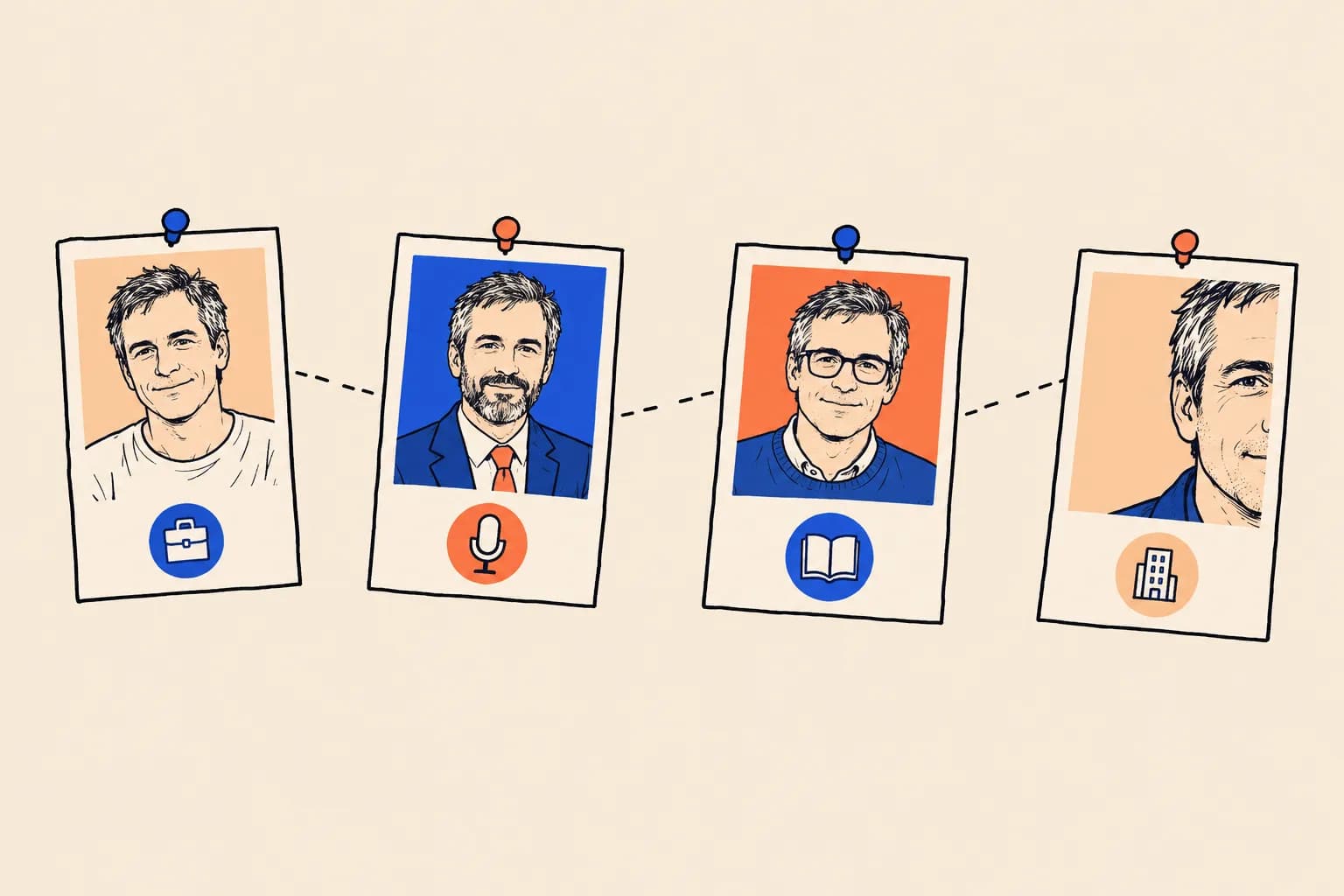
LinkedIn says “Managing Director”. Your website says “Founder and Principal”. The speaker page from 2019 says you’re at a firm you left. The headshots range from last year to the previous decade. Each profile was accurate when you wrote it. Together, they describe three slightly different people.
Why it happens
Profiles get created at different times for different purposes and are rarely updated together. To you, the differences are trivial. To a referred prospect checking whether this is the person their friend meant, they’re small doubts that add up. To Google, they make it harder to be confident that all those pages describe one person.
Google says plainly that businesses with complete and accurate information are more likely to show up in local results9. The same principle runs through how it builds knowledge panels, where verified people can suggest corrections but are asked to point to public pages that support them10. If your own pages disagree, there’s nothing consistent to point to.
Quick test
List every profile you can find: LinkedIn, your website, your firm’s team page, Google Business Profile, professional directories, association listings, speaker and podcast guest pages. For each, note your name exactly as written, your title, your firm, your photo and the first line of your bio. Put them in one table. Every difference is a fix.
Fix
Write one master bio in a short and a long version, pick one current photo, and settle on one way of writing your name and title. Update every profile you control, and send the new version to anyone who hosts a profile of you. Link each profile back to your About page, and link out from your About page to each genuine profile. LinkedIn often ranks high for a name search, so start there; we cover it in how Google reads your LinkedIn headline.
Sign 4: Your reviews are thin, old or silent
What it looks like
You have no reviews, or a handful from several years ago. A negative review from 2022 sits at the top with no reply. Your Google Business Profile shows a rating based on four reviews, while a competitor down the road has sixty recent ones.
Why it happens
Reviews are often the first thing a referred prospect checks after confirming they’ve found the right person. Many professionals don’t ask for them, because asking feels awkward and clients who are happy rarely think to leave one unprompted. Regulated professionals often avoid replying altogether, sometimes for good reason (more on that below).
The research suggests that both quantity and freshness matter to readers. In BrightLocal’s 2026 vendor survey, 74% of US consumers said they care only about reviews from the last three months5. In Wealthtender’s 2025 survey, respondents listed negative online reviews (33%) and having no online reviews at all (17%) among the red flags that would put them off an advisor, and half wanted to read client reviews before making first contact2. In Doctor.com’s 2018 survey, 60% of patients said they wouldn’t book with a provider whose reviews were poor4.
Google also says that replying to reviews shows customers you value their feedback, and that the number of reviews and ratings feeds into how prominent a business is in local results9.
Quick test
Check your Google Business Profile and the one or two review sites that matter most in your field. Write down three numbers for each: total reviews, average rating, and the date of the most recent review. Then count the reviews with no reply. If your newest review is more than a few months old, that’s the thing to fix first.
Fix
Make asking part of how you finish a piece of work. A short, personal email with a direct link to your review page, sent when the client is happiest, works far better than a generic request months later. Reply to reviews calmly and briefly, thank people for positive ones, and never argue in public. If your profession restricts what you can say, a neutral reply that invites the person to get in touch privately is often the safest option.
If you’re a doctor, lawyer or financial advisor
Reviews and testimonials carry specific rules in regulated professions. A few US examples show why care matters:
- Healthcare. In June 2023 the US Department of Health and Human Services announced that a New Jersey psychiatry practice had paid $30,000 to settle a complaint that its reply to a patient’s negative online review disclosed the patient’s diagnosis and treatment. HHS found it had done the same in replies to three other patients, and said it keeps receiving complaints of this kind11.
- Law. The American Bar Association’s Formal Opinion 496 (13 January 2021) says a negative online review alone doesn’t permit a lawyer to reveal client information. It suggests that lawyers consider not responding, and says a public reply could invite the person to get in touch privately or state that professional considerations prevent a response12. State rules vary.
- Financial advice. The SEC’s Marketing Rule allows SEC-registered advisers to use testimonials, endorsements and third-party ratings, but only with required disclosures, such as whether the person is a client and whether they were paid, plus oversight conditions13.
Sign 5: Your website and AI answers can’t back the referral up
What it looks like
Your friend’s recommendation was specific: “She’s brilliant with founders going through their first funding round.” Your website says you offer “strategic advisory services to growth-focused organisations”. There’s no photo, no clear list of who you help, nothing about how to get started. Or an AI assistant, asked who you are, describes you vaguely, mixes you up with someone else, or doesn’t know you at all.
Why it happens
Websites are often written for peers, for an old version of the business, or to sound impressive rather than to answer questions. A referred prospect visiting your site wants to confirm three things quickly: that you do what the friend described, that you’re credible, and how to take the next step. In Wealthtender’s 2025 survey, 72% of prospects said they would visit an advisor’s website2, and in Martindale-Avvo’s 2019 data, 45% of people with a personal referral checked the lawyer’s or firm’s website before getting in touch3.
Google’s own guidance on helpful content asks whether a page presents information in a way that makes you want to trust it, citing clear sourcing, evidence of the expertise involved and background about the author or site. Of the qualities it groups as E-E-A-T, it says trust matters most14. That’s a good test for an About page, not just for search.
AI assistants are a newer part of the same check. BrightLocal reported from its 2026 vendor survey that 45% of US consumers use AI tools for local business recommendations, up from 6% in its 2025 survey15, and a quarter of Wealthtender’s 2025 respondents said they would start their advisor search with tools such as ChatGPT or Gemini2. Those numbers come from single surveys and may move a lot from year to year. What’s clear is that an assistant can only describe you from what it can find. Google says there are no extra technical requirements for its AI features: to appear as a supporting link, a page has to be indexed and eligible to show in Search with a snippet16.
A referral tells someone what you’re good at. Your website has to say the same thing in the first ten seconds.
Quick test
Open your About page on your phone and read it as a stranger who has just been told one sentence about you. Within ten seconds, can you tell who this person helps, why they’re credible, and how to start? Then ask ChatGPT, Gemini or Perplexity, “Who is [your name], [your profession] in [your city]?” and note what it gets right, wrong or leaves out. Our free AI Mention Checker is a faster way to run that check.
Fix
Rewrite the top of your About page to match how your best clients describe you, in their words. Put who you help, your credentials and a clear next step above the fold. Add a current photo, one or two specific results or testimonials (within your profession’s rules), and links to your genuine profiles. Everything you fix under signs 2 and 3 also gives AI assistants more consistent information to draw on. We go deeper on that in how ChatGPT recommends coaches.
The five signs at a glance
Here’s the whole guide in one table. Keep it next to your intake notes and run the tests once a quarter.
| Sign | Quick test | First fix |
|---|---|---|
| 1. Referrals go quiet | Ask the last ten new clients how they found you and what they checked first. Ask referrers who they’ve sent | Record the referral source at intake. Give referrers one link to share |
| 2. Your name search doesn’t lead to you | Private-window search of your name, name plus profession, and name plus city, on desktop and mobile | Make your About page the definitive source. Get stale pages updated, then request a refresh |
| 3. Your profiles tell different stories | Table every profile: name, title, firm, photo, first line of bio | One master bio, one photo, one title, updated everywhere and linked both ways |
| 4. Your reviews are thin, old or silent | Count reviews, average rating, date of the newest and unanswered ones | Ask every happy client with a direct link. Reply within your profession’s rules |
| 5. Your website and AI answers can’t back the referral up | Read your About page as a stranger. Ask an AI assistant who you are | Lead with who you help, your credentials and how to start. Keep facts consistent everywhere |
Source: DotVisible
A 30-minute referral check
If you only have half an hour this week, this order gives you the most information for the least effort.
Search yourself the way a stranger would (10 minutes)
Private window, phone and desktop, three versions of your name. Screenshot page one each time.
Line up your profiles (10 minutes)
Open LinkedIn, your website, your Google Business Profile and your main directory listing side by side. Note every difference in name, title, photo and bio.
Check your reviews (5 minutes)
Write down the count, the rating and the date of the newest review on Google and the main site in your field.
Read your About page as a referred prospect (5 minutes)
Can a stranger tell who you help, why you’re credible and how to start? If not, that’s your first rewrite.
Pick one fix and do it this week
Usually the master bio. It feeds every other fix on the list.
Where to start
Referrals are still the most valuable introductions most experts get, and nothing in this guide replaces doing excellent work for the people who send them. What it does is protect the step between the recommendation and the phone call, the one you can’t see.
Start with the test for sign 2, because it shows you what every referred prospect sees. Run your name through the free Knowledge Panel Checker, work through the name search checklist, and fix your master bio before anything else. If you’d rather have someone look at the whole picture with you, book a free audit.
Frequently asked questions
Is a weak online presence really why my referrals have dropped?
It might be, but it is rarely the only reason. Referral volume also moves with your capacity, your pricing, your referrers' own circumstances and the wider market. The five signs in this guide are things to check, not a diagnosis. If several of them apply to you, your online presence is a likely contributor and one of the easier ones to fix.
Do people who are referred to me really look me up first?
The surveys we found say yes, though the numbers vary by profession and by how the question was asked, and all of them are vendor surveys from companies in the visibility and reviews business. A 2025 survey by Wealthtender, an advisor directory, found 96% of affluent prospects would research a financial advisor online even if referred. Martindale-Avvo's 2019 data found 46% of referred legal consumers checked a lawyer's reviews before making contact, and a 2018 Doctor.com survey found 81% of patients read provider reviews even after a referral.
How many reviews do I need?
There is no magic number. Recency matters as much as volume: in BrightLocal's 2026 vendor survey of US consumers, 74% said they care only about reviews from the last three months. A steady trickle of recent, genuine reviews does more than a large batch from years ago.
Should I reply to negative reviews?
For most businesses, Google encourages replying, and a calm, factual reply helps. Regulated professionals need care. US healthcare providers have paid HHS settlements after revealing patient information in replies, the ABA says a negative review alone does not let a lawyer disclose client information, and SEC-registered advisers face the Marketing Rule when using testimonials. Check your own professional rules before you reply.
How do I see what a referred prospect sees?
Search your name in a private browser window on both desktop and mobile, then try your name with your profession and with your city. Note what appears on the first page, whether it is clearly you, and whether the details match. A free Knowledge Panel Checker shows whether Google already holds an entity for you.
Do I need a Google knowledge panel for referrals to work?
No. Plenty of professionals win referrals without one. A panel helps because it shows a referred prospect, at a glance, that Google recognises you as a distinct professional. The underlying work, a clear and consistent presence that others back up, is what matters either way.
How long before fixes make a difference?
Profile updates and new website copy are visible the moment you publish them. Changes to what Google shows for your name depend on when Google recrawls the pages involved, and Google gives no fixed timeline. Expect some changes within days and others to take weeks or months.
Sources
- 1Beyond martech: building trust with consumers and engaging where sentiment is high (Trust in Advertising Study 2021)Nielsen · Nov 2021↩
- 2How Americans Will Choose Financial Advisors in 2026 and Beyond (Brian Thorp)Wealthtender · Aug 2025↩
- 3How Do Clients Research and Find Their Attorneys? (John Arciniegas), citing Hiring an Attorney 2019Martindale-Avvo · 9 Jan 2020↩
- 4Patients want providers with strong online presence (Les Masterson), reporting Doctor.com’s 2018 surveyHealthcare Dive · 21 May 2018↩
- 5Local Consumer Review Survey 2026BrightLocal · 11 Feb 2026↩
- 6About knowledge panelsGoogle Knowledge Panel Help · Accessed 19 Oct 2026↩
- 7Refresh outdated contentGoogle Search Help · Accessed 19 Oct 2026↩
- 8Find and remove personal info in Google Search resultsGoogle Search Help · Accessed 19 Oct 2026↩
- 9Tips to improve your local ranking on GoogleGoogle Business Profile Help · Accessed 19 Oct 2026↩
- 10Submit feedback on content about youGoogle Knowledge Panel Help · Accessed 19 Oct 2026↩
- 11HHS Office for Civil Rights reaches agreement with health care provider in New Jersey that disclosed patient information in response to negative online reviewsUS Department of Health and Human Services · 5 Jun 2023↩
- 12ABA issues new guidance for how lawyers should respond to online criticism, negative reviews (Formal Opinion 496)American Bar Association · 13 Jan 2021↩
- 13Investment Adviser Marketing (small entity compliance guide)US Securities and Exchange Commission · 28 Apr 2021↩
- 14Creating helpful, reliable, people-first contentGoogle Search Central · Updated 5 Oct 2026↩
- 15Nearly Half of Consumers are Asking AI for Business Recommendations (Rosie Murphy), from the Local Consumer Review Survey 2026BrightLocal · 10 Mar 2026↩
- 16AI features and your websiteGoogle Search Central · Updated 10 Dec 2025↩
Keep reading
 GuidesThe Name Search Checklist: 12 Things Prospects See Before They CallShobin K Jose · 6 Oct 2026 · 18 min read
 Knowledge PanelsWhat Is a Google Knowledge Panel, and Why Do Some People Get One?Shobin K Jose · 19 Oct 2026 · 23 min read
 GuidesHow Google Reads Your LinkedIn HeadlineShobin K Jose · 29 Sep 2026 · 15 min read