Personal Branding Consultant vs Agency: What a Coach or Consultant Needs
One sells judgement, the other sells output. Here's how to tell which one you're missing, the questions to ask before you sign, and the warning signs that should end the conversation.

A personal branding consultant is usually one senior person who helps you decide what you stand for, who it's for and how to say it. A personal branding agency is a team that produces and distributes the work, such as content, design, social posting and PR, month after month. Most coaches and consultants need the consultant's clarity before they need the agency's volume, and whichever you hire, the test is the same: does the work make you easier to find and to trust when a prospect searches your name?
That last point is the one most comparisons skip. Your next client will hear about you from a referral, a podcast or a talk, and then type your name into Google or ask ChatGPT about you. Whatever help you buy should make that moment clearer.
This guide sets out what each option really delivers, which one fits the situation you're in, the questions to ask before you sign, who should own the work afterwards, and the red flags worth walking away from. It doesn't rank firms or quote prices. It gives you a way to judge any proposal that lands on your desk.
What does a personal branding consultant actually do?
A personal branding consultant helps you make decisions about how you're known. The work is mostly thinking, interviewing and writing, done with you rather than for you.
A typical engagement covers some or all of these:
- Positioning. Who you serve, the problem you solve and what makes your approach different. For a leadership coach that might mean choosing between "executive coach" and "coach for first-time founders scaling past 50 people".
- A core bio and one-line description. The sentence you'll repeat on your website, LinkedIn, speaker pages and podcast intros.
- Messaging and proof. The three or four themes you'll talk about, and the client results, credentials and stories that back them up.
- A plan. Which channels matter for your buyers, what to publish, and what to stop doing.
You'll also see the titles personal brand strategist and personal branding coach. They overlap heavily. A coach tends to guide you with questions and exercises until you find the answers yourself. A consultant or strategist tends to bring recommendations and documents. Neither title is regulated, so look at the deliverables, not the label.
The strength of a good consultant is senior attention. You work with the person you hired, and the output is specific to you. The limit is capacity. Once the strategy is written, someone still has to update the profiles, write the posts and pitch the podcasts, and that someone is often you.
What does a personal branding agency do differently?
A personal branding agency is built to produce and distribute work continuously. Where a consultant hands you a plan, an agency usually runs it.
Agency services commonly include:
- Ghostwritten LinkedIn posts, articles and newsletters.
- Design: photography, a personal website, slide templates, social graphics.
- PR and media: podcast bookings, bylined articles, speaking applications.
- Social media management and reporting.
Most agencies include a strategy phase at the start, and the better ones do it well. The difference is the business model. An agency is set up around a team and a recurring scope of work, so its natural output is volume and consistency over time.
The strength is capacity. You get more done without writing it all yourself. The trade-offs are distance (you may work mostly with an account manager rather than the senior person who sold you the work) and the risk of generic output if the strategy underneath is thin. Volume amplifies whatever message you give it, including a muddled one.
Consultant or agency: how do they compare side by side?
Side by side, the two options differ less in quality than in what you're paying for. The comparison below describes typical setups. Plenty of providers sit in between, such as a solo consultant with freelance writers, or a small agency led day to day by its founder.
Personal branding consultant
- Usually one senior person you work with directly
- Output: positioning, core bio, messaging, a plan
- Best when you are unclear or inconsistent about how to describe your work
- Often a defined project with an end date
- You or your team carry out most of the plan afterwards
Personal branding agency
- A team, often with an account manager as your main contact
- Output: content, design, posting, PR and reporting
- Best when the message is settled and producing enough work is the bottleneck
- Often an ongoing monthly scope
- The agency carries out most of the plan for you
| Consultant | Agency | What to check either way | |
|---|---|---|---|
| Who does the work | The person you hired | A team, sometimes subcontractors | Names and roles of everyone who will touch your account |
| Main deliverable | Decisions and documents | Ongoing content and distribution | A written list of deliverables with dates |
| Your time | Interviews and reviews up front | Reviews and approvals every month | How many hours a month they expect from you |
| How it ends | Project closes, plan is yours | Scope continues until you cancel | Notice period and what you take with you |
| Typical risk | A good plan nobody executes | Lots of output on a thin message | How success will be measured, in writing |
Source: DotVisible comparison of typical service models
Which one does a coach or consultant need?
Most coaches and consultants need a consultant first, because their usual problem is clarity rather than capacity. You already have expertise, client results and probably some visibility. What tends to be missing is one consistent way of describing all of it.
Use your situation to decide.
Start with a consultant if...
- Your LinkedIn headline, website and speaker bio each describe you differently.
- You can't explain, in one sentence, who you help and with what.
- Referrals are coming in, but prospects arrive unsure what you actually do.
- You're about to change something big: a niche, a fee level, a book, a move from employee to independent.
Consider an agency if...
- You have a clear, settled message and already publish occasionally, but can't keep up.
- You need production skills you don't have, such as design, video or media pitching.
- You're prepared to spend time each month reviewing and approving work in your name.
Consider neither (yet) if...
- The basics are broken. If searching your name turns up an old employer page, a namesake or nothing at all, fix your own website, About page and main profiles first. That's a small, contained job, and it makes every later investment work harder. Our name search checklist walks through the twelve things prospects see.
Signs you are ready for an agency
- You can state who you help and how in one sentence, and it is the same everywhere
- You have a backlog of ideas, talks or client stories nobody has turned into content
- You know which channel your buyers actually use
- You have time each month to review drafts in your own voice
Signs you are not, yet
- Your bio changes depending on which profile someone reads
- You hope the agency will work out your positioning for you
- Your name search shows someone else, or nothing useful
- You want to hand over your accounts and stop looking at them
Founders and CEOs face the same choice with higher stakes. Investors, candidates and journalists all search the name before they take a meeting, and an agency publishing confidently on top of an unclear story can make that worse. The CEOs and founders page covers what that audience checks.
Does the work show up when someone searches your name?
The best test of any personal branding work is what a stranger finds when they look you up. Most comparisons of consultants and agencies focus on content and social reach, but for a coach or consultant, the decisive moment is usually quieter: a referred prospect searching your name before deciding whether to get in touch.
That search shows them your website, your LinkedIn, any coverage and, for some people, a Google Knowledge Panel: the information box Google shows for people, places and organisations in its Knowledge Graph. Google generates panels automatically from sources across the web and updates them as that information changes1. Nobody, consultant or agency, writes one for you. What good work can do is make the information Google reads clear, consistent and corroborated. What Is a Google Knowledge Panel? explains how Google decides.
The same clarity matters for AI assistants. When a prospect asks ChatGPT or Gemini about you, the answer is assembled from what's published about you. A consistent bio repeated on credible pages gives those systems something solid to draw on. Inconsistent or thin information gives them room to guess. How ChatGPT Decides Which Coaches to Recommend covers what OpenAI says about this.
So when you compare proposals, ask each provider one question: what will someone see when they search my name in six months, and how will you check? A strong answer names specific pages (your About page, LinkedIn, speaker profiles, podcast guest pages), says how they'll keep the details consistent, and explains how they'll measure it. A weak answer talks only about impressions and follower counts.
Write down your before
Your name search on desktop and mobile, whether a panel shows, your LinkedIn headline and what an AI assistant says about you.
Ask each provider the six-month question
What will someone see when they search my name, and how will you check it?
Compare answers on specifics
Named pages, a consistent bio and a way of measuring beat follower counts and vague reach.
Agree the after
Put the checks in the proposal, so you both know what will be compared at the end.
What should you ask before you hire?
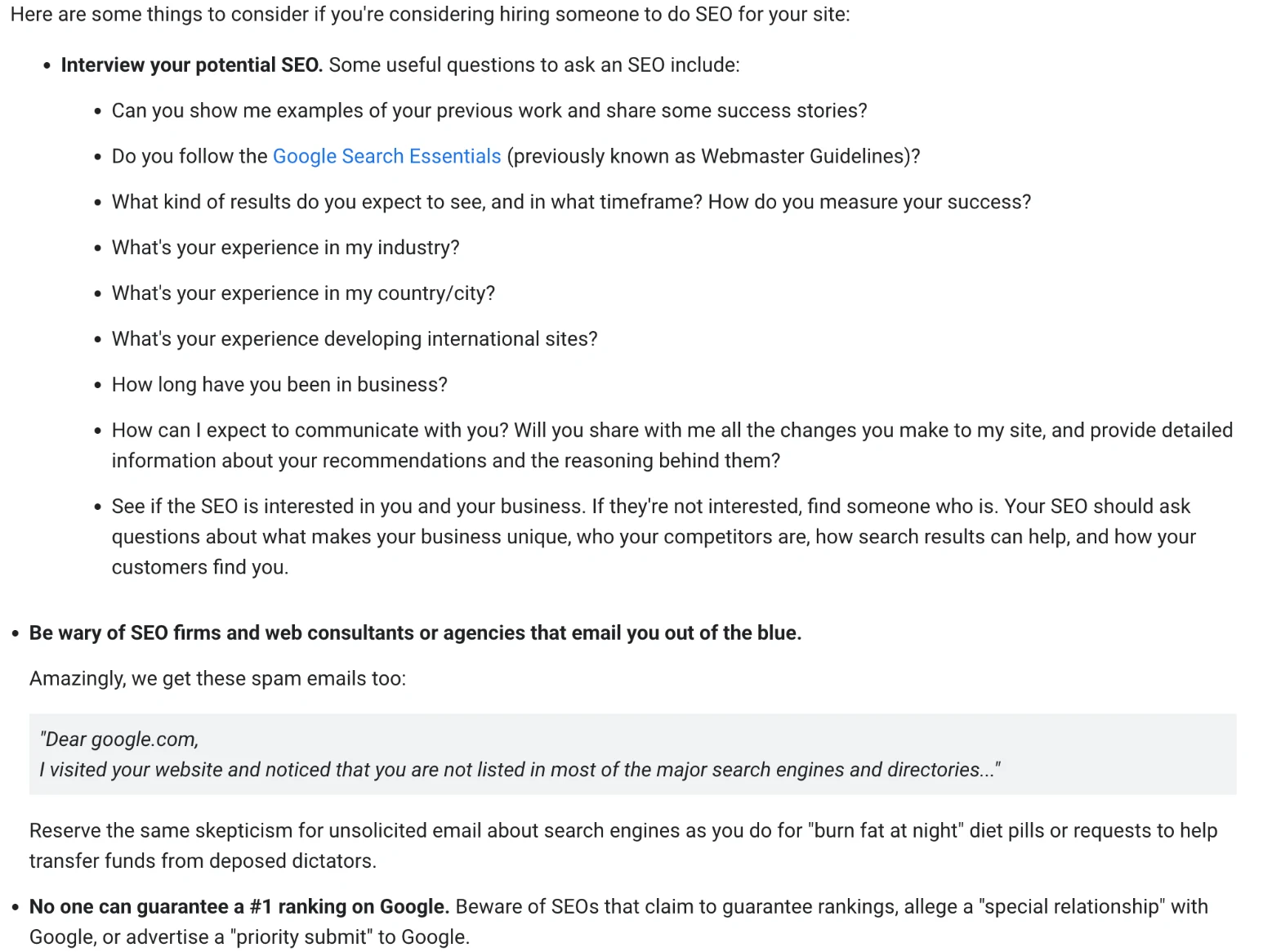
Ask questions that force specifics: what you get, who does it, how it's measured and what happens when it ends. Google's own advice on hiring an SEO is a useful model, because the risks are similar. It suggests asking for examples of previous work and success stories, what results they expect and in what timeframe, how they measure success, what experience they have in your industry, and how long they've been in business. It also suggests asking how you can expect to communicate, and whether they'll share all the changes they make and the reasoning behind their recommendations2.
Adapted for personal branding, here's the checklist.
| Ask | A good answer sounds like |
|---|---|
| Can you show me work for someone like me, and what changed? | Real examples you can look up, with before and after described honestly |
| What exactly will I get, and by when? | A written list of deliverables and dates, not "brand elevation" |
| Who will do the work day to day? | Named people and roles, including any subcontractors |
| How will we measure success? | Specific checks, such as your name search, profile consistency and enquiries, agreed up front |
| How much of my time do you need? | A realistic number of hours, with interviews and reviews scheduled |
| Will you explain every change you make to my site and profiles? | Yes, with a log you can see |
| Will anything be published under my name without my approval? | No. You approve every post, bio and quote |
| Who owns the content, website, domain and accounts at the end? | You do, in writing |
| What happens if I end the contract? | A clear notice period and a handover list |
| What can't you promise? | An honest list: rankings, Google panels, media placements, AI mentions |
Source: Adapted from Google Search Central’s advice on hiring an SEO2
The last question is the most revealing. Good providers are comfortable telling you what's outside their control. If the answer is "nothing", keep looking.
Who owns the work when the engagement ends?
You should, and you need it in writing. Ownership is easy to ignore at the start and painful to sort out at the end, especially with agencies that set things up on your behalf.
There are four things to settle.
Content and design. Under US copyright law, copyright vests initially in the author of a work. The exception is a work made for hire, where the employer or other person for whom the work was prepared is considered the author3. Don't assume that work by an outside writer or designer falls into that category. A transfer of copyright ownership, other than by operation of law, isn't valid unless it's in writing and signed by the owner of the rights conveyed or their authorised agent4. So agree in writing, before work starts, who will own what you pay for.
Your domain. ICANN says the registrant of a domain name assumes sole responsibility for its registration and use, must provide accurate information for directories such as WHOIS and keep it up to date, and must respond to the registrar's inquiries within 15 days5. Make sure the registrant is you or your company, not the agency, and that you hold the login.
Your LinkedIn account. LinkedIn's User Agreement says that, as between you and others (including your employer), your account belongs to you. It also says you agree not to share or transfer your account, and not to use or attempt to use another's account, such as by sharing log-in credentials6. If someone drafts posts for you, the safer pattern is that they draft and you publish.
Everything else. Website hosting, analytics, Google Search Console, email lists and photo libraries. Each should be in your name, with the provider given access rather than ownership.
What are the red flags to walk away from?
Some promises and practices should end the conversation, however polished the pitch. Most come down to one of two things: claiming control over systems nobody outside them controls, or faking signals that are meant to be real.
We can guarantee you rank first for your name.
Google says no one can guarantee a #1 ranking on Google, and to beware of anyone who claims to guarantee rankings.
Google's hiring advice is blunt about related claims too. It says to treat unsolicited email about search engines with scepticism, to beware of anyone who alleges a "special relationship" with Google or advertises a "priority submit", and to ask for explanations if something is unclear2.
We'll get you a Google Knowledge Panel, guaranteed.
Google generates knowledge panels automatically. Only Google decides whether one appears.
A provider can commit to doing specific work within a set time, and some offer a refund or continued work if a panel doesn't appear by a deadline. That's different from claiming control over Google1. Read the wording carefully. How much a Google Knowledge Panel costs sets out what different approaches include.
We'll write and publish your Wikipedia page.
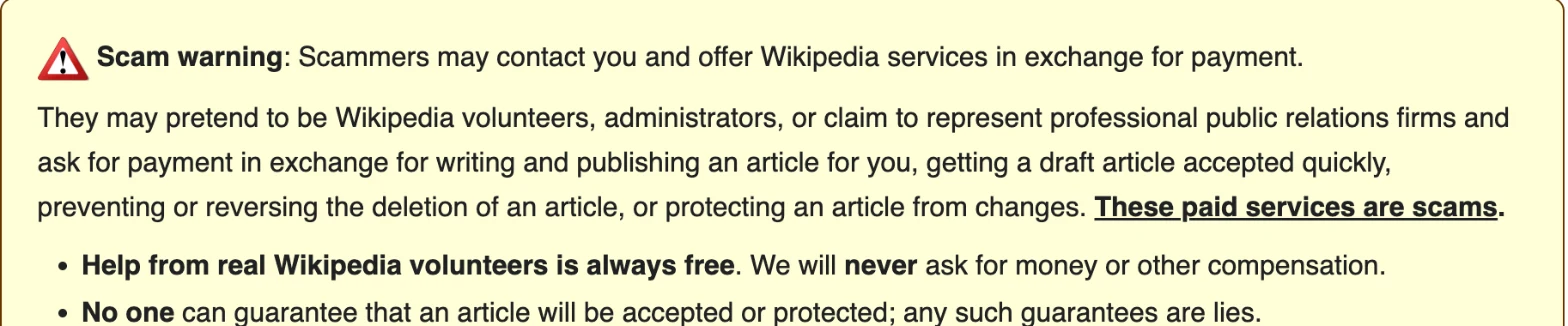
Wikipedia requires paid editors to disclose who pays them, and says paid offers to publish or protect an article are scams.
Wikipedia's policy requires anyone paid to edit to disclose their employer, client and affiliation, and editors who can't disclose are prohibited from editing. Non-disclosure agreements don't change that7. Its scam warning goes further: offers to write and publish an article, get a draft accepted quickly, prevent or reverse a deletion, or protect an article from changes in exchange for payment are scams, and "No one can guarantee that an article will be accepted or protected; any such guarantees are lies"8.
We'll grow your following fast.
Fake reviews and fake followers, likes or views are covered by an FTC rule, and agencies are not immune.
The FTC's Consumer Reviews and Testimonials Rule took effect on 21 October 20249. It prohibits selling or purchasing fake consumer reviews or testimonials, and it covers the misuse of fake "indicators of social media influence", which the rule defines as metrics the public uses to assess social media influence, such as followers, friends, connections, subscribers, views, likes and shares9. The FTC says advertising agencies, PR firms, review brokers and reputation management companies are not immune from liability under the rule, and that the fake-indicators provision covers buying indicators the buyer knew or should have known were fake, such as ones generated by bots10. LinkedIn separately bans using bots or other unauthorised automated methods to create, comment on, like or share posts, or otherwise drive inauthentic engagement6.
A few quieter warning signs are worth noting too:
- Vague deliverables. "Visibility", "authority" and "brand elevation" with no list of what will be produced or changed.
- They want your passwords. Especially for LinkedIn or your domain registrar, rather than delegated access.
- Everything is about reach. Impressions and follower counts, with nothing about what a prospect sees when they search your name.
- Content you wouldn't say. Posts in a voice that isn't yours, claims you can't back up, or results attributed to you that didn't happen.
Good help is happy to tell you what it can't control. Be careful with anyone who says it can control everything.
Where does a name-search specialist fit?
A name-search specialist sits next to both options rather than replacing either. Consultants shape what you say. Agencies produce and distribute it. A specialist focuses on what Google and AI assistants understand about you as a person: one authoritative page about you, consistent details across your profiles, structured data, and independent sources that agree.
That's the work DotVisible does. Founded by Shobin K Jose, it works on Google Knowledge Panels and AI visibility for professionals. The Knowledge Panel work comes with a guarantee: if no panel appears within 150 days of onboarding, you choose between a deposit refund and free continued work. Google alone decides whether a panel shows, which is why the guarantee is about what you get back, not a claim of control. Ongoing AI visibility work is optional, and it's a commitment to keep working, not a promise that ChatGPT or any other assistant will mention you.
If you're a coach or consultant, the coaches and consultants page explains how this fits alongside a consultant or an agency you already use. More guides for your field are in the coaches and consultants hub, and the wider name search topic covers what prospects find when they look you up.
How do you make the decision?
Decide by naming the gap, then hiring for it. Here's a short way to do that.
- Run your own name search and write down what a prospect sees today.
- Write your one-sentence description. If you can't, or it differs across your profiles, you need strategy first.
- List what you can't keep up with. If the message is clear but output is the problem, an agency may fit.
- Ask every provider the same questions from the checklist above, and get the answers in writing.
- Settle ownership before work starts: content, domain, website and accounts.
- Agree how you'll check the result, including the name search, and set a date to do it.
If referrals have gone quiet or discovery calls start cold, these five signs your online presence is costing you referrals help you work out where the leak is before you spend anything. And if you'd like a second pair of eyes on your name search, book a free audit.
Frequently asked questions
What does a personal branding consultant do?
A personal branding consultant is usually one senior person who helps you decide what you want to be known for, who it is for and how to say it. The output is mostly decisions and documents: positioning, a core bio, messaging and a plan. Some also write or coach you through the first pieces of content, but production at volume is normally not the core of the job.
What is the difference between a personal branding consultant and a personal branding agency?
A consultant sells judgement and usually works one to one with you. An agency sells capacity: a team that produces and distributes work such as content, design, social posting and PR on an ongoing basis. Many agencies include strategy, and many consultants include some delivery, so ask what you will actually get each month and who will do it.
Do coaches and consultants need a personal branding agency?
Usually not at first. Most established coaches and consultants have expertise and client results but lack a clear, consistent way of describing them. That is a strategy problem, which a consultant solves faster. An agency makes more sense once the message is settled and the bottleneck is producing and distributing enough good work.
What questions should I ask before hiring a personal brand strategist?
Ask for examples of previous work and how results were measured, what exactly you get and when, who does the work, how you will communicate, whether they will explain every change they make, who owns the content, website, domain and accounts at the end, and how they handle anything published under your name.
Can a personal branding agency guarantee a Google Knowledge Panel or a Wikipedia page?
No one outside Google decides whether a Google Knowledge Panel appears, because Google generates panels automatically. Wikipedia’s own scam warning says no one can guarantee an article will be accepted or protected. A provider can commit to doing specific work within a timeframe and offer a refund or continued work if a result does not appear, but treat any promise that sounds like control over Google or Wikipedia as a red flag.
Should a branding agency post on LinkedIn for me?
Be careful. LinkedIn’s User Agreement says your account belongs to you, that you should not share or transfer it, and that you must not use another person’s account, for example by sharing log-in credentials. It also bans using bots or other unauthorised automated methods to create, comment on, like or share posts, or otherwise drive inauthentic engagement. Having help drafting posts that you review and publish yourself avoids those problems.
Is buying followers or reviews a problem?
Yes. The FTC’s Consumer Reviews and Testimonials Rule, in effect since 21 October 2024, addresses fake reviews and testimonials and the misuse of fake indicators of social media influence, such as followers, likes and views. The FTC says advertising agencies, PR firms, review brokers and reputation management companies are not immune from liability under the rule. This is general information, not legal advice.
Sources
- 1About knowledge panelsGoogle Knowledge Panel Help · Accessed 17 Nov 2026↩
- 2Do you need an SEO?Google Search Central · Updated 5 Jun 2026, accessed 17 Nov 2026↩
- 317 U.S. Code § 201: Ownership of copyrightLegal Information Institute, Cornell Law School · Accessed 17 Nov 2026↩
- 417 U.S. Code § 204: Execution of transfers of copyright ownershipLegal Information Institute, Cornell Law School · Accessed 17 Nov 2026↩
- 5Registrants’ Benefits and ResponsibilitiesICANN · Accessed 17 Nov 2026↩
- 6User AgreementLinkedIn · Effective 3 Nov 2025, accessed 17 Nov 2026↩
- 7Wikipedia:Paid-contribution disclosureWikipedia · Accessed 17 Nov 2026↩
- 8Wikipedia:Scam warningWikipedia · Accessed 17 Nov 2026↩
- 9Trade Regulation Rule on the Use of Consumer Reviews and Testimonials (final rule, 16 CFR Part 465)Federal Register, Federal Trade Commission · 22 Aug 2024↩
- 10Consumer Reviews and Testimonials Rule: Questions and AnswersFederal Trade Commission · Accessed 17 Nov 2026↩
Keep reading
 Name searchHow Google Reads Your LinkedIn HeadlineShobin K Jose · 29 Oct 2026 · 15 min read
 Name searchExecutive Personal Branding: What Investors and Hires FindShobin K Jose · 17 Nov 2026 · 15 min read
 Name searchMarketing for Coaches: Win the Search Before the Discovery CallShobin K Jose · 17 Nov 2026 · 15 min read