Marketing for Coaches: Win the Search Before the Discovery Call
Most coach marketing advice is about getting noticed. The step that decides whether a prospect books is quieter: they search your name or ask AI about you first. This guide covers that step, with the research behind it and a plan to fix what you find.
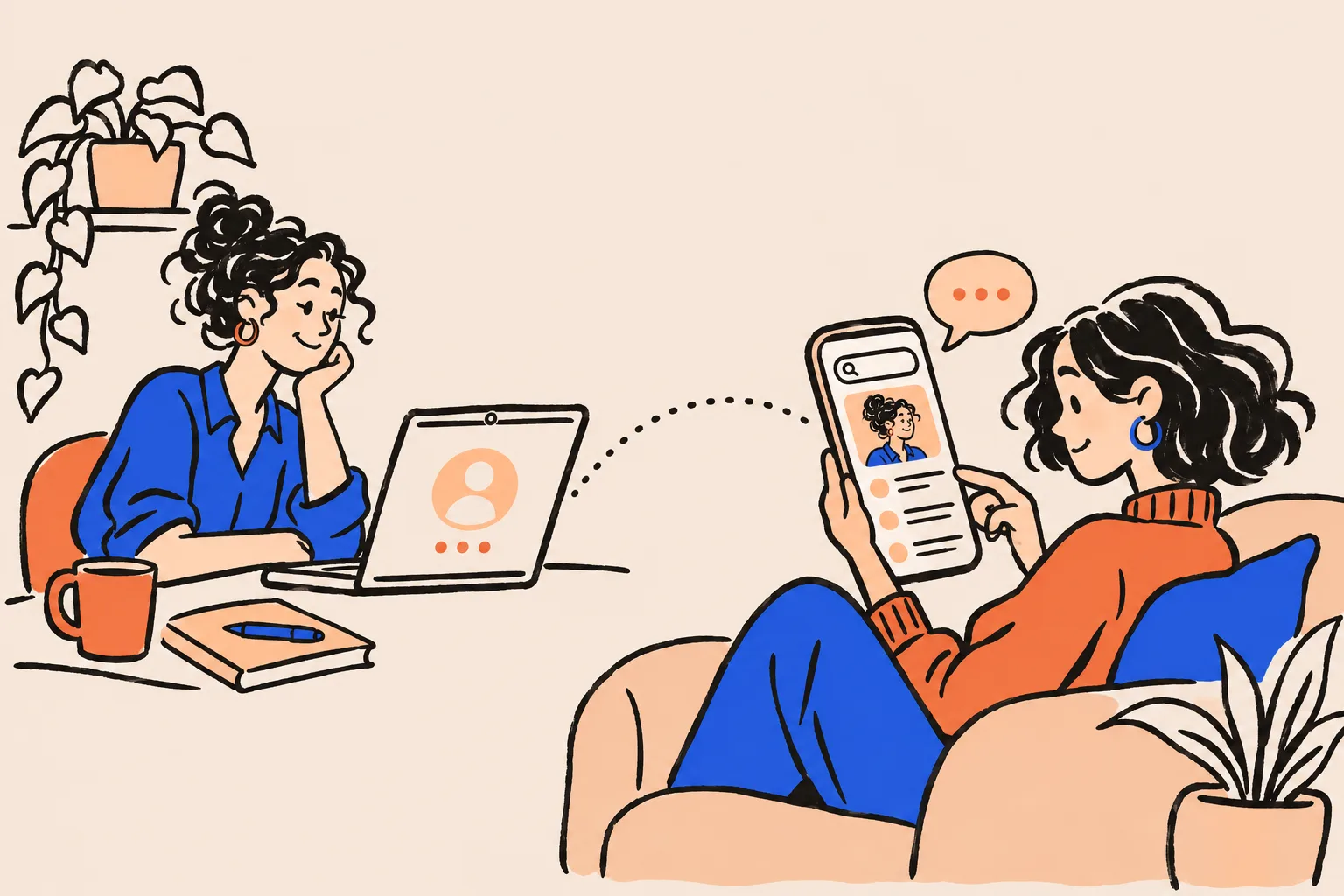
Marketing for coaches is everything that moves a stranger, or a referral, to book a discovery call with you. For most established coaches the last step before that call is a quick check: the prospect searches your name on Google or asks ChatGPT about you. If that check shows a thin, confusing or contradictory picture, the call often never gets booked, and you never hear why.
What does marketing for coaches actually involve?
Marketing for coaches involves two separate jobs. The first is attention: referrals, LinkedIn posts, podcast guest spots, talks, workshops, a newsletter, perhaps some ads. The second is confirmation: the moment a prospect who is already interested goes looking for proof that you are who the referral or the post said you are.
Almost every guide to coach marketing is about the first job. That is understandable. Attention is visible, you can measure it and there are plenty of tools to sell you. The second job happens in private, on the prospect’s phone, usually in the evening before they decide whether to fill in your booking form.
The attention layer
- Referrals and introductions
- LinkedIn posts and newsletters
- Podcast guest spots and talks
- Workshops, webinars and ads
- Measured in reach, followers and leads
The confirmation layer
- What Google shows for your name
- Whether a Google Knowledge Panel appears
- What ChatGPT, Gemini and Perplexity say about you
- Whether your profiles tell the same story
- Measured in discovery calls booked, or quietly lost
If you are an established coach, the confirmation layer is probably where your marketing leaks. You already earn attention. Clients refer you, people hear you on podcasts, your posts get read. The question is what happens in the ten minutes after that.
How crowded is the coaching market?
The coaching market is large and still growing, which is one reason prospects compare before they book. The International Coaching Federation’s 2025 Global Coaching Study, run with PwC across more than 10,000 participants in 127 countries, counted a record 122,974 coach practitioners worldwide, up 15% since 20231.
The competition is densest exactly where the fees are highest. More than half of those coaches, 54%, specialise in leadership and executive coaching1. And 59% expect their revenue to grow next year, mainly from taking on more clients rather than raising fees1. More coaches chasing more clients in the same niches means more prospects holding two or three names and checking each one.
122,974
coach practitioners worldwide, a record and up 15% since 2023
54%
specialise in leadership and executive coaching
59%
expect revenue growth next year, mostly from more clients
In a crowded field, the coach who looks easiest to verify has an advantage before anyone says a word. That is a marketing outcome, even though it never shows up in your analytics.
Why do referrals still need to survive a search?
Referrals still need to survive a search because the person referred almost always checks you out before they get in touch. A referral gets you onto the shortlist. It doesn’t get you the call.
The clearest evidence comes from the Hinge Research Institute, which studies how professional services are bought. In a 2014 survey of 1,028 buyers of professional services, over 99% said they check providers out before hiring, over 80% visit the provider’s website, and the average buyer uses more than three ways of checking2. The buyers were purchasing services such as accounting, legal, technology and management consulting. Coaching wasn’t among them, so read this as a close parallel rather than direct evidence about coaching clients.
A second Hinge study, from 2015, looked at what happens when the check goes badly. It surveyed 523 professional services firms, mostly decision-makers in accounting, consulting, legal, technology, marketing and engineering firms, about referrals they had given and received. 51.9% of respondents said they had ruled out a referral before ever speaking to the firm they had been referred to3. The most common reason, cited by 43.6% of respondents, was not being able to understand how the firm could help them4. Several of the other reasons were about what they found online.
| Item | Value |
|---|---|
| Website was unimpressive | 29.63% |
| Poor quality content | 23.46% |
| Didn’t show up when searched online | 15.64% |
Source: Hinge Research Institute, 20153
Those figures are more than a decade old and come from professional services firms rather than individual coaching clients, so read them as a direction rather than a precise measurement. The logic still holds: A referral starts the conversation, and a search decides whether it continues.

The pressure on that middle step comes from your own clients, too. According to the summary page for ICF’s 2026 Global Consumer Awareness Study, which covers 26 countries, 84% of coached respondents were satisfied with their most recent coaching experience, and close to 8 in 10 would recommend coaching to someone they knew5. The page doesn’t give a sample size or publication date, and the full report is paid, so treat these as ICF’s headline figures. Happy clients are already sending people your way. The only open question is what those people find when they look you up.
For the symptoms that suggest your check is costing you referrals, see 5 Signs Your Online Presence Is Costing You Referrals.
What do most coach marketing guides leave out?
Most coach marketing advice concentrates on the attention layer: niches, networking, social media, email, content and referrals. It covers how to get noticed, rather than what a prospect finds when they search the coach’s name or ask an AI tool.
That gap matters most for established, referral-led coaches charging premium fees. You don’t need another channel. You need the attention you already earn to convert, and that depends on what your name brings up.
What does a prospect see when they search your name?
When a prospect searches your name, they see whatever Google has gathered about you, arranged by Google. Typically that means your website (if it ranks), your LinkedIn profile, perhaps a podcast episode or an event page, images, and sometimes a Google Knowledge Panel beside the results. If you share your name with someone more prominent, they may see that person first.
A Google Knowledge Panel is the information box Google shows for people, places, organisations and things it holds in its Knowledge Graph. Google generates panels automatically from many sources across the web, updates them as that information changes, and takes input from the people they describe6. Nobody writes their own, and nobody outside Google can switch one on. For a coach, a panel tells the prospect at a glance that Google recognises you as a distinct, real professional.
Here is what a prospect is quietly asking as they scroll.
- Is this the right person? A namesake, an old employer’s page or an outdated photo creates doubt in the first second.
- Does the story match the referral? If your friend said “executive coach for new CEOs” and your LinkedIn says “transformational life coach”, the prospect notices.
- Does anyone else vouch for this person? Podcasts, talks, articles and directory listings written by other people count for more than your own pages.
- Is it current? A site last updated four years ago, or a bio listing a job you left, suggests the practice may not be active.
The full version of this check, with 12 specific things to look for, is in The Name Search Checklist.
What happens when a prospect asks ChatGPT about you?
When a prospect asks ChatGPT about you, it answers from what it learned in training and, often, from a live web search, and it may summarise you in a few sentences without the prospect ever visiting your site. If the sources it finds are thin or contradictory, the answer can be vague, out of date or wrong.
This is no longer a niche habit. In a Pew Research Center survey of 5,123 US adults in early 2025, 34% had used ChatGPT. Among adults with a postgraduate degree the figure was 52%, and 28% of employed adults said they used it for work7.
Google’s own results are moving the same way. In Pew’s analysis of the browsing of 900 US adults in March 2025, 18% of Google searches produced an AI summary. When one appeared, people clicked a traditional search result on 8% of visits, against 15% when there was no summary, and clicked a link inside the summary on only about 1% of visits8.
| Item | With an AI summary | Without an AI summary |
|---|---|---|
| Clicked a traditional search result (% of visits) | 8% | 15% |
| Ended their browsing session (% of pages) | 26% | 16% |
Source: Pew Research Center, 20258
The practical meaning for a coach: the summary itself is often the whole impression. If Google or ChatGPT describes you accurately, the prospect may book without ever opening your About page. If it describes you vaguely or mixes you up with someone else, they may move on just as quickly.
Google says there are no special requirements or optimisations needed for its AI Overviews and AI Mode beyond the page being indexed and eligible to show a snippet, and that these features may run several related searches to build an answer9. In other words, the same clear, consistent pages that help a normal name search also feed the AI summary.

How ChatGPT picks which coaches to name for a request like “a leadership coach for new managers in Leeds” is a separate question, and OpenAI hasn’t published a ranking method. We cover what is known in How ChatGPT Decides Which Coaches to Recommend.
How do you audit your own name search in 20 minutes?
You audit your name search by running the same checks a prospect would, writing down what you find, and comparing it with how you actually describe your practice. Twenty minutes is enough for a first pass.
Write down your one-line description
Before you look at anything, write the sentence you want a prospect to come away with: who you are, who you coach and what changes for them. This is the yardstick for everything else.
Search your name three ways
In a private window, search your name, your name plus “coach”, and your name plus your city. Note which of your pages appear on the first page, in what order, and what each snippet says.
Check for a panel and for namesakes
Is there a Google Knowledge Panel? Is it about you? Does anyone else with your name appear above you, or get mixed into your results?
Compare your profiles side by side
Open your website About page, LinkedIn, your coaching directory listings and any speaker or podcast pages. Compare name, title, niche, photo and short bio. List every mismatch.
Ask ChatGPT, Gemini and Perplexity about you
In fresh chats, ask who you are and whether you’d suit a specific kind of client. Ask more than once. Note anything wrong, missing or borrowed from a namesake.
Score it against your one-liner
Would a stranger who only saw these results describe you the way your one-line description does? Every place where the answer is no goes on your fix list.
How do you fix it? Tell one consistent story
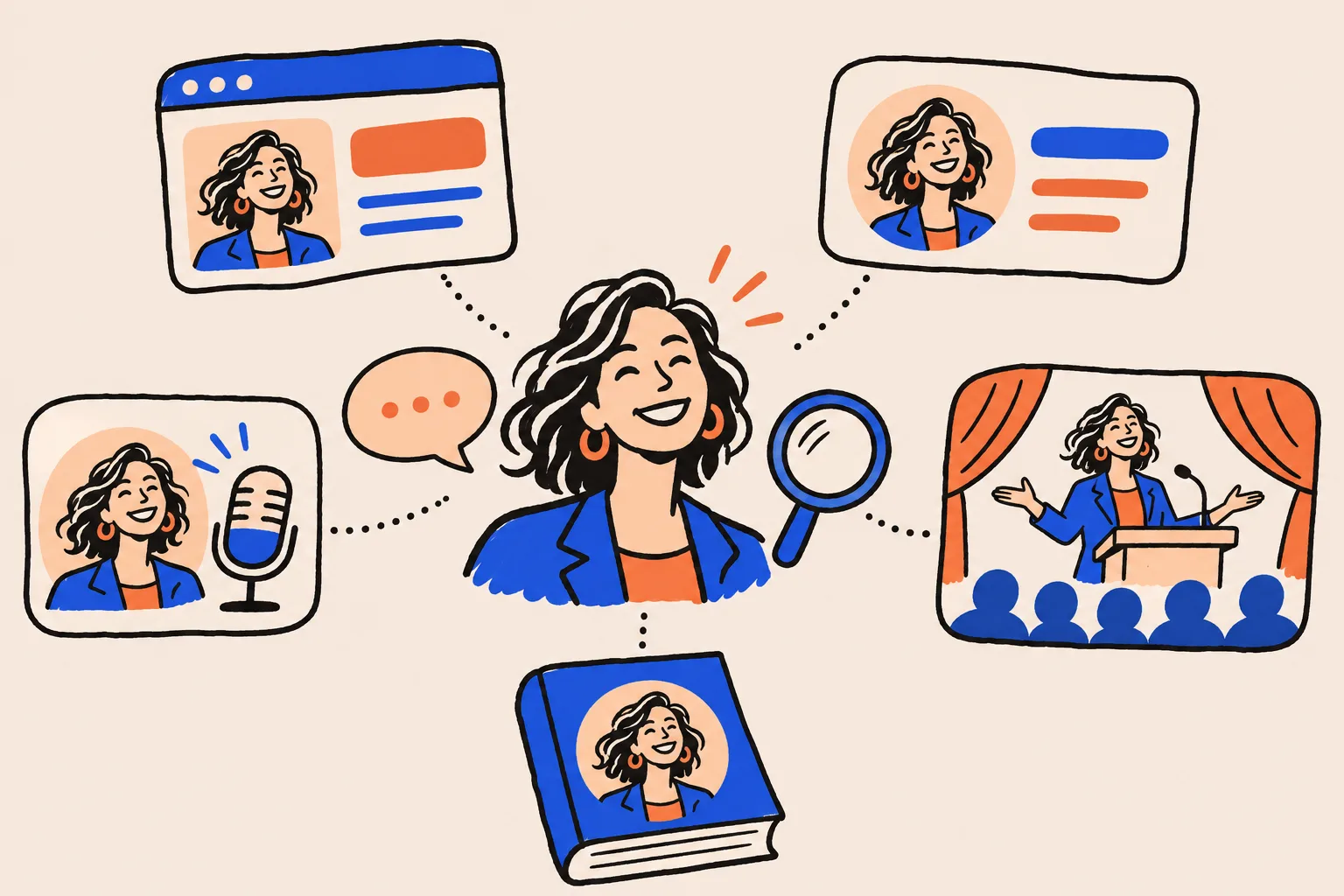
You fix a weak name search by choosing one accurate description of yourself and making every source about you agree with it. Search engines and AI tools are trying to work out who you are from many pages at once. When those pages agree, confirming you is easy. When they disagree, you get vague answers, mixed-up namesakes and no panel.
Make one page the home of your identity
Your website About page should be the clearest, most complete statement of who you are: full name, the role you want to be known for, who you coach, credentials, books, talks and links to every genuine profile.
Use the same words everywhere
Same name format, same title, same niche, same headshot, same short bio on LinkedIn, your coaching directory listings, speaker pages and podcast guest pages. Change “life coach” in one place and “executive coach” in another, and you split yourself in two.
Link both ways
Every profile should link back to your About page, and your About page should link out to each profile. That is how machines learn that these pages describe one person.
Add Person structured data
A short block of code on your About page states your name, role, employer and profiles in a format search engines read reliably.
Earn pages that others write about you
Podcast episode pages, conference speaker bios, interviews and guest articles. Ask each host to use your current bio and link to your About page.
Recheck every quarter
Repeat the 20-minute audit, especially before a launch, a fee increase or keynote season.
LinkedIn deserves extra care, because it often ranks near the top for a coach’s name and its headline often appears in the result. How Google Reads Your LinkedIn Headline explains how to get it right.
A Google Knowledge Panel is a vanity badge for celebrities.
Panels belong to entities Google can identify with confidence. For a working coach, a panel is a sign that Google has connected your sources into one clear picture.
None of this guarantees a panel or an AI mention. Google decides what it shows, and so do the AI companies. What you control is the quality and consistency of the information they have to work with, and that is also what a human prospect responds to.
Where does the rest of your coach marketing fit?
The rest of your coach marketing feeds the confirmation layer, so you don’t have to choose between them. Every podcast you guest on, every talk, every bylined article and every directory listing becomes a page that a prospect, Google or ChatGPT may find when they look you up.
The difference is in how you treat each appearance:
- Before you agree to it, ask whether the host will publish a page about the episode or talk, with your name, a short bio and a link to your site.
- When you send your bio, send the same master version every time, so the pages about you keep agreeing.
- After it goes live, add it to your About page and to your structured data, so it supports your identity instead of floating loose.
Makes your marketing count twice
- One master bio sent to every host and event
- Episode and speaker pages that link to your About page
- The same niche named in the same words everywhere
- Old profiles updated or closed
Makes it work against you
- A different title on every platform
- Guest appearances with no page or no link
- Directory profiles you’ve forgotten, with an old photo and job
- A niche change on LinkedIn that your website never caught up with
This is also where the attention you have already earned keeps paying off. A podcast you recorded three years ago can still be confirming your expertise today, if it describes you the way you describe yourself now.
Where to start
Start by finding out what a prospect sees today. Run the 20-minute audit above, or check your name in the free Knowledge Panel Checker and the AI Mention Checker. Then fix your About page and LinkedIn first, because they carry the most weight, and work outwards from there.
Your marketing earns the referral. Your name search decides whether it turns into a call.
If you would rather have it done for you, DotVisible works with coaches and consultants on exactly this layer: see how it works for coaches and consultants. Our done-for-you program, The Authority Magnet, builds the sources Google needs for a Google Knowledge Panel, with the panel guaranteed within 150 days of onboarding, or you choose between a refund of your deposit and free continued work. Google still decides whether and when a panel shows, which is why the guarantee is written that way. Ongoing AI visibility work is a commitment to keep improving what ChatGPT, Gemini and Perplexity can find about you, not a promise that they will mention you.
You can also book a free audit, browse more guides for coaches and consultants, or read the rest of our name search guides. For the step-by-step path to a panel, see How to Get a Google Knowledge Panel.
Frequently asked questions
What is the best marketing for coaches?
There is no single best channel. Referrals, speaking, podcasts, LinkedIn and content all work for different coaches. What every channel has in common is that interested prospects then search your name or ask an AI tool about you before they book, so the most reliable investment is making sure that check confirms what the referral or the content promised.
Do referred prospects really search a coach before booking?
The best available research says yes. In a 2014 Hinge Research Institute survey of 1,028 professional services buyers, over 99% checked providers out before hiring and over 80% looked at the provider's website. In a 2015 Hinge survey of 523 professional services firms, 51.9% of respondents had ruled out a referral before ever speaking to the referred firm. Neither study covers coaching, and both are more than a decade old, so treat them as a direction rather than a precise measure.
Do coaches need a Google Knowledge Panel?
No coach needs one to get clients. A Google Knowledge Panel is a useful confirmation signal, because it shows a prospect that Google recognises you as a distinct, real professional. Google generates panels automatically and decides on its own whether to show one, so treat it as the result of clear, consistent information about you rather than a marketing channel.
How do I find out what ChatGPT says about me?
Open a fresh chat and ask the questions a prospect would ask: who you are, what you do, and whether you would suit a particular kind of client. Ask several times, because answers vary. Note anything wrong, missing or borrowed from someone else with your name. DotVisible's free AI Mention Checker runs a similar check.
How long does it take to fix a weak name search?
The parts you control, such as your website About page, LinkedIn and directory profiles, can be made consistent in a few weeks. Search results and AI answers then update on their own schedule, which nobody outside Google or OpenAI controls. Expect gradual change over weeks to months rather than an overnight switch.
Should coaches stop posting content and focus on search instead?
No. Content, podcasts and speaking create the attention and the third-party mentions that a name search draws on. The point is to make each appearance count twice: once when people see it, and again when a prospect or an AI tool looks you up and finds the same story told consistently.
Sources
- 1Coaching Industry Continues Global Growth with $5.34 Billion USD Revenue, New Research Reveals (2025 ICF Global Coaching Study)International Coaching Federation · 16 Sep 2025↩
- 2New Research Study: How Professional Services Buyers Check You Out (Lee Frederiksen)Hinge Research Institute · 17 Feb 2014↩
- 3New Research Report: Referral Marketing for Professional Services Firms (Lee Frederiksen)Hinge Research Institute · 26 Jan 2015↩
- 4Referral Marketing for Professional Services Firms (research report)Hinge Research Institute · 2015↩
- 52026 ICF Global Consumer Awareness Study (summary page; sample size and publication date not stated)International Coaching Federation · Accessed 17 Nov 2026↩
- 6About knowledge panelsGoogle Knowledge Panel Help · Accessed 17 Nov 2026↩
- 734% of U.S. adults have used ChatGPT, about double the share in 2023Pew Research Center · 25 Jun 2025↩
- 8Google users are less likely to click on links when an AI summary appears in the resultsPew Research Center · 22 Jul 2025↩
- 9AI features and your websiteGoogle Search Central · Updated 10 Dec 2025↩
Keep reading
 Name searchPersonal Branding Consultant vs Agency: What a Coach or Consultant NeedsShobin K Jose · 17 Nov 2026 · 17 min read
 Name searchHow Google Reads Your LinkedIn HeadlineShobin K Jose · 29 Oct 2026 · 15 min read
 Name searchExecutive Personal Branding: What Investors and Hires FindShobin K Jose · 17 Nov 2026 · 15 min read