How to Get ChatGPT to Recommend You (for Professionals)
Most advice on this is written for companies selling products. This guide is for people whose name is the business: what OpenAI actually documents, what the research shows and what you can do this quarter.
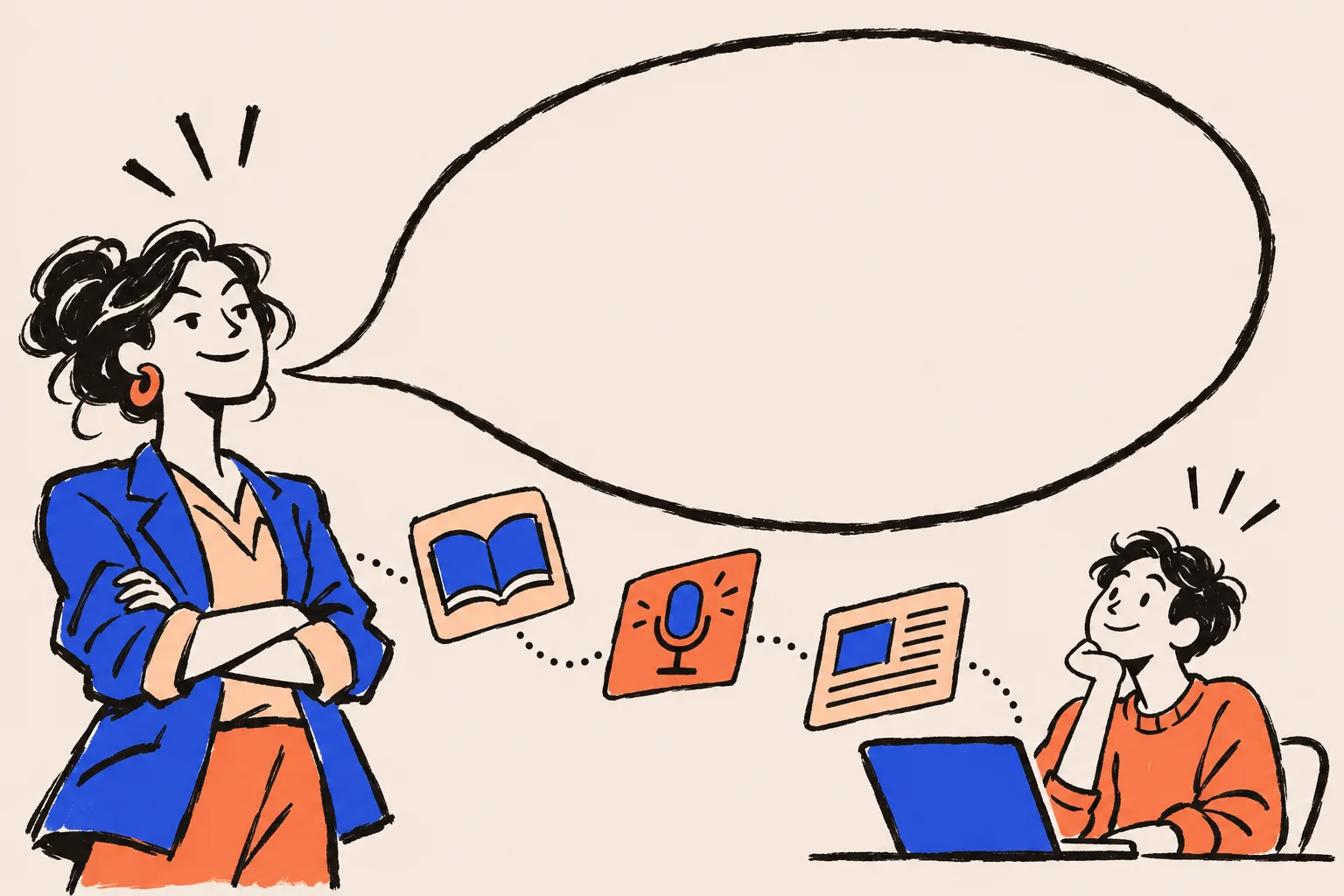
To get ChatGPT to recommend you, make it easy for ChatGPT search to find, read and confirm who you are. That means letting OpenAI's search crawler reach your website, stating plainly what you do, for whom and where, and getting the same facts about you published on credible pages you don't own. Nobody can guarantee a mention, because OpenAI hasn't published how it chooses names, but each of these steps rests on something OpenAI or published research has actually documented.
Why does a ChatGPT recommendation matter now?
ChatGPT has become a place where people ask for help choosing who to hire, as well as for answers. OpenAI said in February 2026 that ChatGPT had reached 900 million weekly users, up from 800 million in October 20251. A study by OpenAI researchers and economist David Deming found that by July 2025 about 10% of the world's adults had adopted it, and that seeking information was one of its three most common uses2.
In the US, Pew Research Center's 2026 survey found that 44% of adults have used ChatGPT, more than double the 18% of 20233. Among adults under 50, the figure was 57%. Pew found that searching for information was the most common way Americans used chatbots of any kind: 42% of adults said they do it3.
| Item | Value |
|---|---|
| 2023 | 18% |
| 2024 | 23% |
| 2025 | 34% |
| 2026 | 44% |
Source: Pew Research Center, survey of 5,119 US adults, 17–23 Feb 20263
For a consultant, coach or founder, this matters in a particular way. Your work comes through referrals and reputation, and the people referred to you check you out before they get in touch. More of them now ask ChatGPT. Some ask it about you by name. Others never hear your name, because they asked ChatGPT for "a fractional CFO for a Series A startup" and it named three other people.
This guide is about the second group, the people who never hear your name. If you want to know how ChatGPT chooses between candidates once it has them, read how ChatGPT decides which coaches to recommend. It covers training data, live search and the industry studies in detail. This post is about the work you can do.
Which two questions do clients ask about you?
Clients ask ChatGPT two different kinds of question about professionals, and each needs different work from you.
Name questions sound like "Who is Priya Raman?" or "Is Priya Raman a good executive coach?" The person already has your name, usually from a referral. ChatGPT has to work out which Priya Raman they mean and say something accurate about her. If it mixes you up with a namesake or describes a job you left five years ago, the referral loses its warmth. How often AI gets people wrong covers how common those errors are.
Category questions sound like "Recommend a leadership coach for new managers in Manchester" or "Who are good advisers on SaaS pricing?" The person doesn't have a name yet. ChatGPT has to come up with candidates, and you're in the answer only if it can connect you to that exact need.
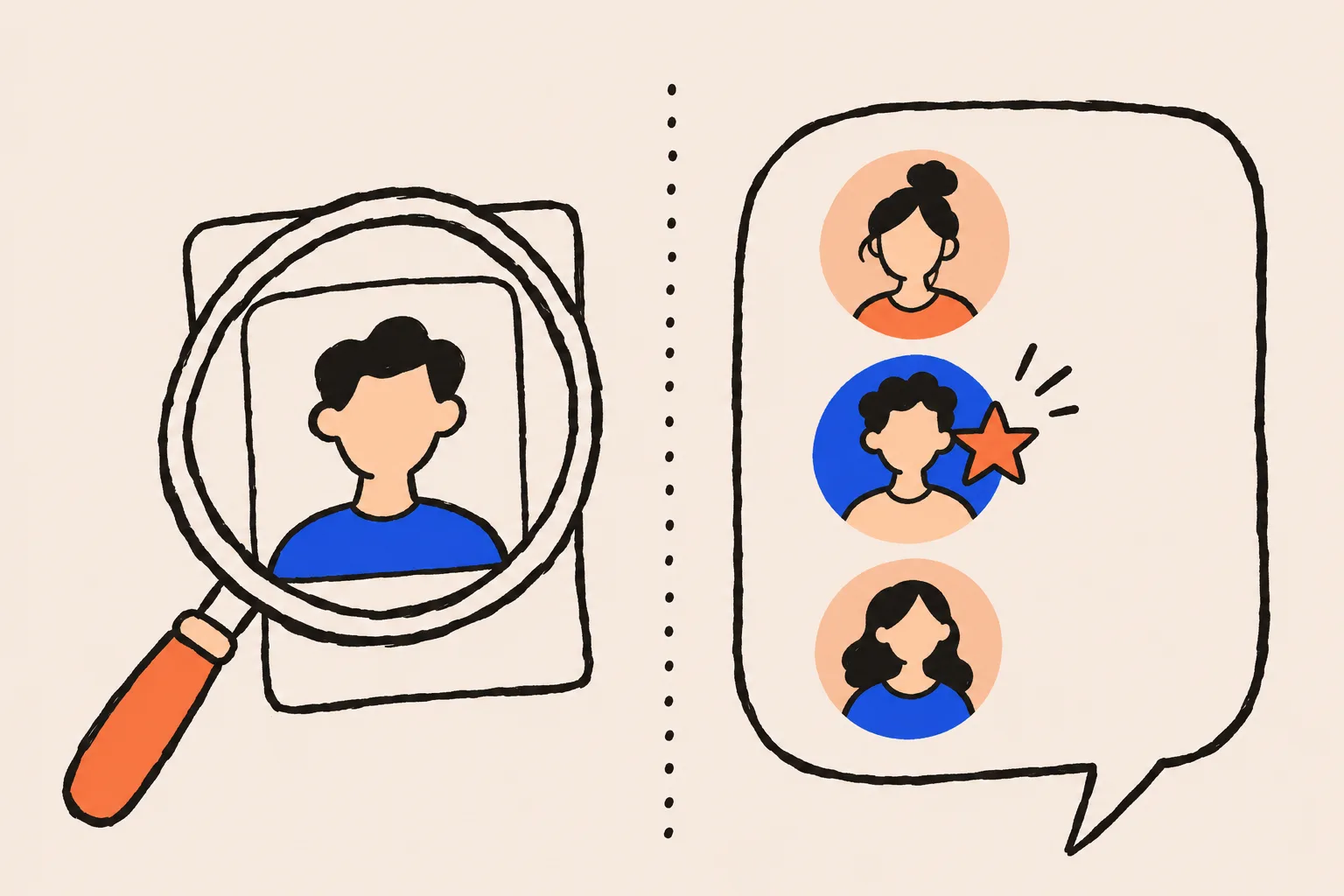
Name questions
- “Who is [your name]?”
- The asker already has your name
- Risk: confusion with a namesake, out-of-date facts
- Fix: one clear, consistent story about you everywhere
Category questions
- “Who should I hire for [problem] in [place]?”
- The asker has no name yet
- Risk: you never appear at all
- Fix: specific positioning, and mentions on pages that search returns
Most guides on this topic deal only with category questions, because they're written for businesses whose name nobody searches. As a professional, you need both. Luckily the groundwork is shared, because a clear, consistent and well-corroborated public record helps with each.
Can ChatGPT reach your website at all?
ChatGPT can only use your website in search answers if OpenAI's search crawler is allowed to visit it. Check this first, because it's the one problem that quietly cancels every other effort.
OpenAI launched ChatGPT search on 31 October 2024. It searches the web automatically "based on what you ask", draws on third-party search providers and content from partners, and links to its sources5. It has been open to everyone, without an account, since 5 February 20255.
OpenAI documents the crawlers involved. OAI-SearchBot is the one used to surface websites in ChatGPT search, and OpenAI says sites that opt out of it "will not be shown in ChatGPT search answers", although they may still appear as plain navigational links6. Each robots.txt setting is independent, and OpenAI says a robots.txt change takes about 24 hours to reach its search systems6.
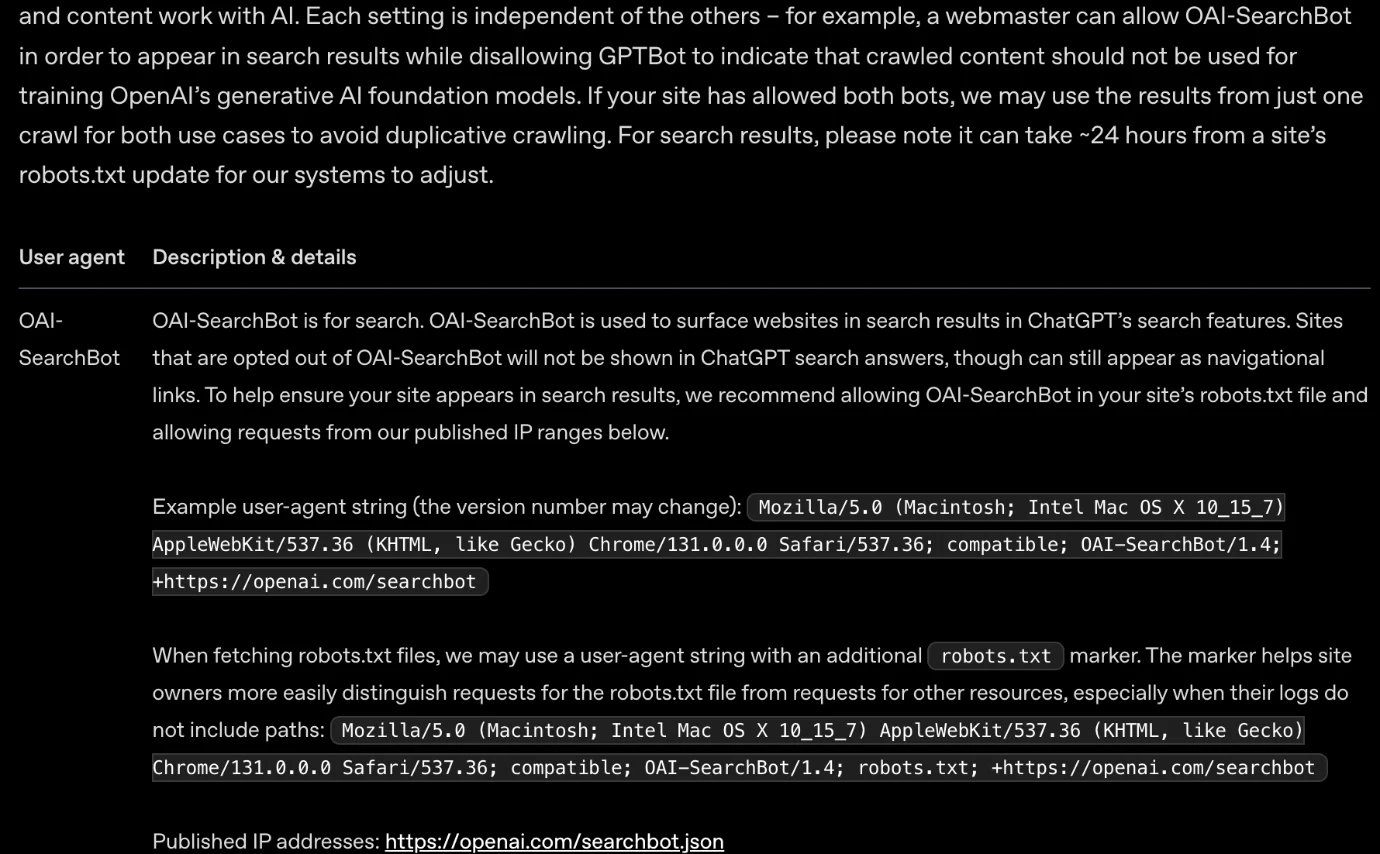
OpenAI's Publishers and Developers FAQ says the same in plainer terms: any public website can appear in ChatGPT search, as long as you aren't blocking OAI-SearchBot7. It adds one detail worth knowing. A page you've blocked can still show up as a link and title in ChatGPT Atlas, OpenAI's browser. To stop that, OpenAI says to use a noindex tag and let the crawler in so it can read the tag7.
| Setting | What it controls | What it means for you |
|---|---|---|
| Allow OAI-SearchBot | Whether your pages can be shown in ChatGPT search answers | Keep it allowed if you want to be found |
| Disallow GPTBot | Whether your content may be used to train OpenAI’s models | Optional. Doesn’t affect search, because each setting is independent |
| ChatGPT-User | Visits a page when a user’s request needs it | Not automatic crawling. OpenAI says robots.txt rules may not apply |
| noindex meta tag | Stops a blocked page’s link and title being shown in ChatGPT Atlas | Use it on pages you don’t want shown, and let the crawler read them |
| utm_source=chatgpt.com | Added by ChatGPT to links it sends to your site | Lets you count ChatGPT visits in your analytics |
Source: OpenAI crawler documentation and Publishers and Developers FAQ67
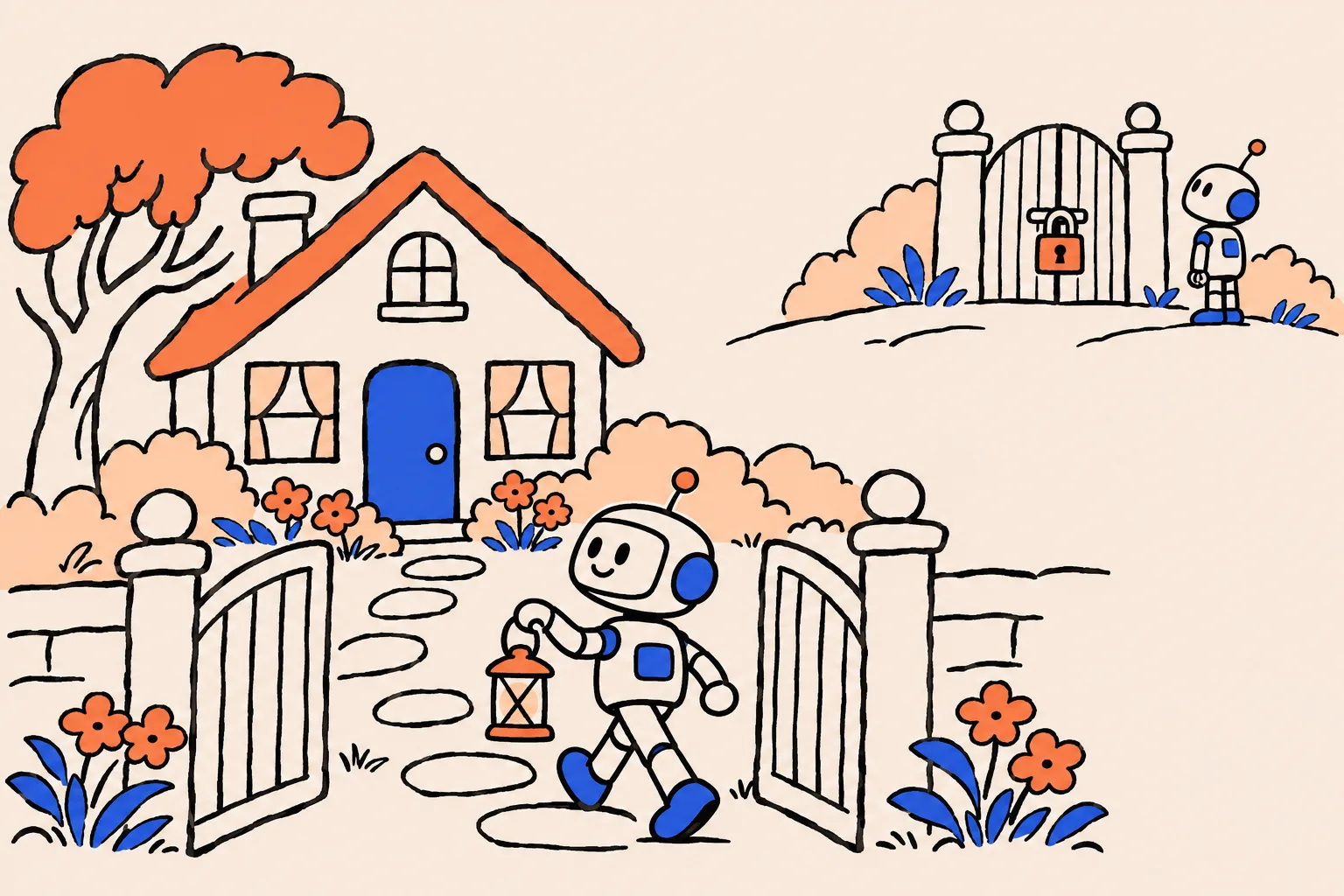
Your website may block the crawler without your knowing. Site builders, security plugins and hosting firewalls can all do it. Cloudflare, for example, announced in July 2025 that it would block AI crawlers that lack permission by default and ask every new domain at sign-up whether to allow them8. Ask whoever runs your site to check robots.txt and any bot settings, and to confirm OAI-SearchBot is allowed.
# Let ChatGPT search find your pages
User-agent: OAI-SearchBot
Allow: /

# Optional: opt out of model training (doesn't affect search)
User-agent: GPTBot
Disallow: /
What should your own site say about you?
Your site should state in plain sentences who you are, what you do, who you do it for and where, with proof attached. A system can only match you to "a leadership coach for new managers in Manchester" if those words, or close to them, are written down somewhere it can read.
Start with your About page. Open it with a sentence that would still make sense if it were quoted on its own: "Priya Raman is an executive coach in Manchester who works with first-time managers at technology companies." Then add the evidence, such as years in practice, accreditations, clients you're allowed to name, books, talks and results you can stand behind.
What the research says about writing for AI answers
The best evidence on how wording affects AI answers comes from a 2024 study by researchers at Princeton and IIT Delhi, presented at KDD, a peer-reviewed computer science conference9. They built a benchmark of 10,000 queries and tested nine ways of rewriting web content to see which made it more visible in AI-generated answers9.
The authors report that their methods can raise visibility by up to 40%9. On the paper's main measure, a word count weighted by where a source appears in the answer, adding quotations from relevant sources scored highest, followed by adding statistics, improving fluency and citing sources. Keyword stuffing, the old SEO habit of repeating a phrase, scored below leaving the content unchanged on that measure. In a separate test on Perplexity, a live AI search engine, the methods improved visibility by up to 37%9.
| Item | Value |
|---|---|
| Adding quotations | 27.2 |
| Adding statistics | 25.2 |
| Improving fluency | 24.7 |
| Citing sources | 24.6 |
| Using technical terms | 22.7 |
| Making it easy to understand | 22 |
| Authoritative tone | 21.3 |
| Using unique words | 20.5 |
| No change (baseline) | 19.3 |
| Keyword stuffing | 17.7 |
Source: Aggarwal et al., GEO, KDD 2024, Table 1, raw scores for all nine methods (position-adjusted word count, overall)9
This was a lab benchmark, not ChatGPT itself, and the authors found the methods worked differently in different subject areas9. Still, the lesson for a professional is practical. Specific, checkable facts work better than adjectives. A line such as "has coached first-time managers since 2016, and was interviewed about it by a named trade magazine" gives an AI system something to use. "Passionate about unlocking potential" gives it nothing.
Why do other people's pages matter more than yours?
Independent pages about you matter because AI search appears to lean on them heavily, and because a claim backed up elsewhere is easier to trust than one you make about yourself.
A 2025 study from the University of Toronto compared the sources Google and web-enabled GPT returned for the same consumer questions about which products and brands to choose. It split sources into brand-owned, social and "earned", meaning independent coverage such as reviews and articles. In all six market-and-category comparisons the authors report, GPT drew on earned sources far more heavily than Google did, and it almost never cited social platforms10. The authors describe a "systematic and overwhelming bias towards Earned media"10.
| Item | GPT | |
|---|---|---|
| Automotive, US | 45.1% | 81.9% |
| Software, US | 45.4% | 72.7% |
| Automotive, Canada | 40.6% | 69.1% |
| Electronics, Canada | 54.1% | 77.6% |
| Software, Canada | 31.8% | 74.2% |
Source: Chen et al., University of Toronto, arXiv preprint, Sep 202510
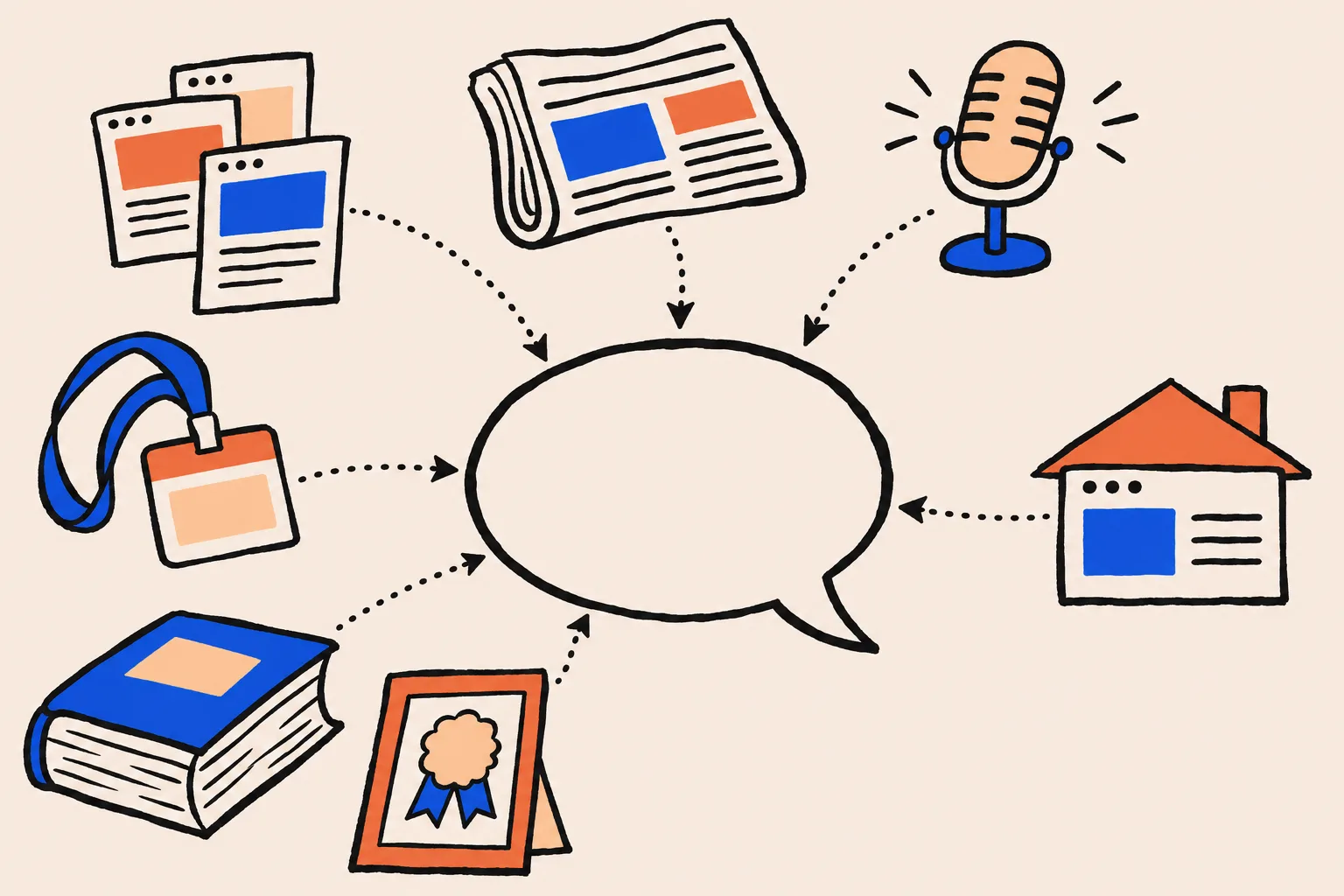
Two cautions apply. The study looked at products and brands, not people, and it's a preprint posted on arXiv, not a peer-reviewed paper. Still, the idea behind it is common sense. A podcast host introducing you, a conference listing you as a speaker or an industry body listing you as a member is somebody else vouching for you.
Earned sources that suit professionals
For a consultant, coach or founder, the most useful independent pages tend to be these:
- Podcast guest pages with show notes that name you, your role and your specialty.
- Conference and event speaker pages, which often carry a bio and a photo.
- Professional bodies and directories in your field, such as coaching federations, consulting institutes or startup databases.
- Interviews and bylined articles in trade or local press.
- Client case studies published by the client, where they're allowed to name you.
- "Best of" lists and awards from credible organisations in your niche.
A few strong pages that describe you accurately are worth more than dozens of thin directory listings. And each one should use the same name, role and short description you use on your own site.
How do you make ChatGPT see that it's all the same you?
ChatGPT can only add up mentions of you if it can tell they're all about the same person. Consistency is what makes that possible.
Pick one version of your name and use it everywhere. Pick one way to describe your role. Use the same headshot. Make sure your website, LinkedIn, speaker bios, directory listings and guest pages agree on the facts that matter: your current firm, your title, your city and your specialty. Then link them together, with your site pointing to your profiles and your profiles pointing back.
This matters most if you share your name with someone else. "John Smith, consultant" could be anyone. "John Smith, supply-chain consultant to mid-sized food manufacturers, based in Leeds" gives a system enough context to separate you from the others. If your LinkedIn headline says something different from your website, fix the headline first. How Google reads your LinkedIn headline explains why that one line travels so far.
The same discipline helps on Google. A Google Knowledge Panel appears when Google is confident about who a person is, and the habits that build that confidence are the ones described here. What is a Google Knowledge Panel explains how Google decides. Be clear about one limit, though. OpenAI hasn't said that ChatGPT uses Google's Knowledge Graph, so a panel helps on Google and makes your record more consistent, but it isn't a direct route into ChatGPT.
Being recommended starts with being easy to confirm.
How do you know if it's working?
You can measure two things: whether ChatGPT names you, and whether it sends people to your site.
Ask ChatGPT what your clients would ask
Write down five to ten questions a real prospect might ask. Include at least one name question ("Who is [your name]?") and several category questions in your clients' own words, with the location, industry or problem they'd mention. Ask each one in a fresh chat, several times, and note how often you appear and which sources ChatGPT cites.
Repeat each question because answers vary a lot. SparkToro's research, reported by Search Engine Journal, ran 12 brand-recommendation prompts 60 to 100 times each on ChatGPT, Claude and Google's AI. ChatGPT and Google's AI returned the same list of brands in fewer than 1 in 100 runs11. The researchers concluded that how often you appear is a more stable measure than where you appear in the list11. One screenshot of one answer tells you very little.
The AI Mention Checker runs a version of this test for you. It puts the questions your buyers ask to ChatGPT, Gemini and Perplexity and shows whether you're named and who is named instead.
Count the visits ChatGPT sends you
OpenAI says ChatGPT automatically adds utm_source=chatgpt.com to the links it sends to websites, so you can track that traffic in your analytics7. In Google Analytics, look for chatgpt.com as a traffic source. If you see visits to your About page or services page from that source, people are finding you through ChatGPT answers.
Visits only show part of it. Many people read your name in ChatGPT and then search for you on Google or ask a colleague. So add one question to your enquiry form or discovery call: "How did you hear about me?" Include ChatGPT as an option.
What doesn't work?
Some popular advice on this subject is wrong, and some of it is a waste of money.
You can pay to be recommended by ChatGPT.
OpenAI doesn’t publish any way to buy a place in its answers.
OpenAI's publisher guidance is about access and measurement: allowing OAI-SearchBot, using noindex and tracking referrals7. It says nothing about paid placement in answers. Treat any "guaranteed ChatGPT recommendation" as a red flag.
Repeating your keywords helps AI find you.
In the GEO benchmark, keyword stuffing scored below unchanged content on the paper's main visibility measure.
The researchers wrote that "simple methods like Keyword Stuffing traditionally used in SEO don't perform well"9. Write for a smart reader instead.
Blocking OpenAI’s bots protects you, with no downside.
Blocking GPTBot only opts you out of training. Blocking OAI-SearchBot removes your site from ChatGPT search answers.
OpenAI treats these as separate settings6. Decide on each one deliberately.
You need an llms.txt file.
OpenAI’s crawler documentation and publisher FAQ don’t say its crawlers use one.
There's no harm in having one, but OpenAI hasn't said it uses one. Put your time into the steps OpenAI does document.
A plan you can work through this quarter
You can do most of this alongside client work. Here's an order that puts the cheapest, most important fixes first.
Check access
Confirm robots.txt, your site builder and any firewall allow OAI-SearchBot. Check that your About and services pages aren't set to noindex.
Write your one-sentence description
Name, role, who you help and where, in words a client would use. Make it the first line of your About page.
Add proof in plain sentences
Years in practice, credentials, named clients where allowed, books, talks and results, with numbers and sources where you have them.
Make every profile match
LinkedIn, speaker bios, directories, your firm’s team page and podcast guest pages: same name, role, photo and short bio, all linking back to your site.
Earn three to five independent pages
A podcast interview, a speaker listing, a professional directory, a trade article. Choose the ones your clients already read.
Set up measurement
Find chatgpt.com in your analytics and add ChatGPT to your “How did you hear about me?” options.
Test, then retest in three months
Run your list of client questions several times and record how often you appear and which pages are cited.
Expect slow, uneven progress. New pages need to be crawled, and AI answers shift from one run to the next. Nobody outside OpenAI controls the result, so treat this as building a public record that's accurate and easy to confirm, not as a switch you can flip.
If ChatGPT is saying something wrong about you already, fix that before anything else. Why ChatGPT says the wrong thing about you walks through how. And for a person-by-person map of the sources ChatGPT tends to draw on, see where ChatGPT gets its information.
Where to start
Getting ChatGPT to recommend you comes down to three things. ChatGPT search has to be able to reach your site. Your site has to say clearly who you are and who you help. And independent pages have to say the same thing. OpenAI documents the first, peer-reviewed lab research supports the second, and an early, not yet peer-reviewed study on the third points the same way.
Start this week by running your clients' questions through the free AI Mention Checker, and checking that your site lets OAI-SearchBot in. If you'd like help, DotVisible builds Google Knowledge Panels and AI visibility for coaches and consultants and CEOs and founders. Our optional ongoing AI visibility work is a commitment to keep improving what ChatGPT and other AI tools can find about you, not a promise that they'll name you. To see what's helping and what's missing first, book a free audit. More guides on this topic are on the AI search hub.
Frequently asked questions
Can I pay to get ChatGPT to recommend me?
OpenAI doesn't publish any way to buy a place in ChatGPT's answers. Its publisher guidance covers letting its search crawler reach your site and tracking referrals, not paying for placement. Be wary of anyone who sells a guaranteed mention.
How long does it take for ChatGPT to start mentioning me?
Nobody can give a firm timeline. OpenAI says robots.txt changes take about 24 hours to affect ChatGPT search, but being named depends on what is published about you across the web, and AI answers vary from one run to the next.
Does ChatGPT read my website?
It can, if you let it. OpenAI's OAI-SearchBot crawler collects pages for ChatGPT search, and OpenAI says sites that block it won't be shown in ChatGPT search answers. Check that your robots.txt file and any firewall or bot-blocking setting allow it.
Will blocking GPTBot stop ChatGPT from recommending me?
Not on its own. OpenAI says GPTBot is for model training and OAI-SearchBot is for search, and each robots.txt setting is independent. You can opt out of training and still appear in ChatGPT search.
How can I tell if people find me through ChatGPT?
OpenAI says ChatGPT adds utm_source=chatgpt.com to links it sends to websites. Look for that source in Google Analytics or whatever analytics your site uses, and ask new enquiries how they heard of you.
Do I need an llms.txt file?
OpenAI's crawler documentation and publisher FAQ don't say its crawlers read an llms.txt file. Allowing OAI-SearchBot, keeping pages indexable and publishing clear, factual information are the steps OpenAI does describe.
Is this different for a person than for a company?
The mechanics are the same, but people face two extra problems: being confused with someone who shares their name, and having most of their reputation live on other people's pages, such as podcasts, events and press, rather than on their own site.
Sources
- 1ChatGPT reaches 900M weekly active users (Aisha Malik)TechCrunch, reporting OpenAI · 27 Feb 2026↩
- 2How People Use ChatGPT (Chatterji, Cunningham, Deming, Hitzig, Ong, Shan, Wadman), Working Paper 34255National Bureau of Economic Research · Sep 2025↩
- 3Americans and AI 2026: Chatbots, smart devices and views on impactPew Research Center · 17 Jun 2026↩
- 4How people are using ChatGPTOpenAI · 15 Sep 2025↩
- 5Introducing ChatGPT searchOpenAI · 31 Oct 2024, updated 5 Feb 2025↩
- 6Overview of OpenAI crawlersOpenAI · Accessed 17 Nov 2026↩
- 7Publishers and Developers FAQOpenAI Help Center · Accessed 17 Nov 2026↩
- 8Cloudflare just changed how AI crawlers scrape the internet-at-largeCloudflare · 1 Jul 2025↩
- 9GEO: Generative Engine Optimization (Aggarwal, Murahari, Rajpurohit, Kalyan, Narasimhan, Deshpande), KDD 2024arXiv · Revised 28 Jun 2024↩
- 10Generative Engine Optimization: How to Dominate AI Search (Chen, Wang, Chen, Koudas), preprintarXiv · 10 Sep 2025↩
- 11AI recommendations change with nearly every query: SparkToro (Matt G. Southern)Search Engine Journal · 30 Jan 2026↩