What Is AI Visibility for a Person (Not a Brand)?
Almost every definition of AI visibility is written for brands. Here is what it means when the thing being looked up is you, how to measure it with nothing but a spreadsheet, and what actually moves it.

AI visibility for a person is whether AI assistants and AI search, such as ChatGPT, Gemini, Perplexity and Google’s AI Overviews, can find you, describe you correctly and name you when someone asks for a person like you. For a brand, the usual measure is how often it gets mentioned. For a professional whose name is the business, the accuracy of what AI says about you counts just as much as the mention.
What does AI visibility mean for a person?
AI visibility for a person means three things at once: AI systems can find information about you, they describe you accurately, and they bring your name up when someone asks for help you provide. Miss any one of those and the other two are worth less.
Most definitions of AI visibility are written for brands: how often and how prominently a brand appears when people ask ChatGPT, Gemini or Perplexity for recommendations or answers. That definition fits a company selling headphones. It leaves out the part that keeps professionals up at night.
A brand rarely worries that ChatGPT will mix it up with a different brand of the same name, give it a job it left five years ago or credit its book to someone else. People do. So a person’s AI visibility has three layers, and the order matters.
AI visibility for a brand
- Mostly about share of mentions
- Measured against competitors on buying prompts
- Identity is rarely in doubt
- Tracked with dashboards across thousands of prompts
AI visibility for a person
- Found: AI can locate information about you at all
- Described: your role, credentials and work come out right, with no namesake mixed in
- Recommended: your name comes up for the questions buyers ask
- Measurable by hand with a few dozen prompts
Found is the floor. If ChatGPT says it has no information about you, or Perplexity cites only a directory listing, nothing else can happen. Described is where most professionals lose quietly: the answer exists, but it is out of date, vague or blended with someone else. Recommended is the layer people usually mean when they say “AI visibility”, and it depends on the first two.
A recommendation built on a wrong description is not visibility you want.Why does AI visibility matter for people whose name is the business?
It matters because the background check that used to happen on Google now happens in AI tools as well. When a referral mentions your name, a careful buyer looks you up. More and more of them ask a chatbot, or read the AI summary at the top of Google, before they click anything.
The adoption numbers are no longer niche. In Pew Research Center’s survey of US adults in February 2026, 44% said they use ChatGPT, rising to 61% of adults under 30 and 55% of those aged 30 to 491. Pew’s figure for ChatGPT was 18% in 2023 and 34% in 2025. Treat the jump to 44% with some care: from 2023 to 2025 Pew asked “Have you ever used ChatGPT?” only of people who had heard of it, and in 2026 the question also asked about other chatbots, a wording change Pew flags on its chart2.
| Item | Value |
|---|---|
| ChatGPT | 44% |
| Gemini | 24% |
| Copilot | 17% |
| Meta AI | 14% |
| Grok | 8% |
| Claude | 6% |
Source: Pew Research Center, survey of US adults, 17–23 Feb 20261
The companies’ own figures point the same way. OpenAI said in February 2026 that ChatGPT had 900 million weekly active users3. Google said in July 2025 that AI Overviews reach more than 2 billion monthly users in over 200 countries and territories4, and in July 2026 that AI Mode had passed 1 billion monthly active users since its global expansion5. In October 2026 it said the Gemini app had reached one billion users6. These are self-reported and count different things, so don’t add them together. The direction is clear enough.
The last two numbers deserve a second look. Pew tracked the real Google browsing of 900 US adults in March 2025. When an AI summary appeared, people clicked a traditional result on 8% of visits, against 15% when there was no summary. Only 1% of visits included a click on a link inside the summary itself, and 26% of pages with a summary ended the browsing session, against 16% without7.
For a person, that changes the job. If the summary is what the reader takes away, the summary is your first impression. “Who is [your name]?” is exactly the kind of question-word search that tends to trigger one.
Where do AI answers about you come from?
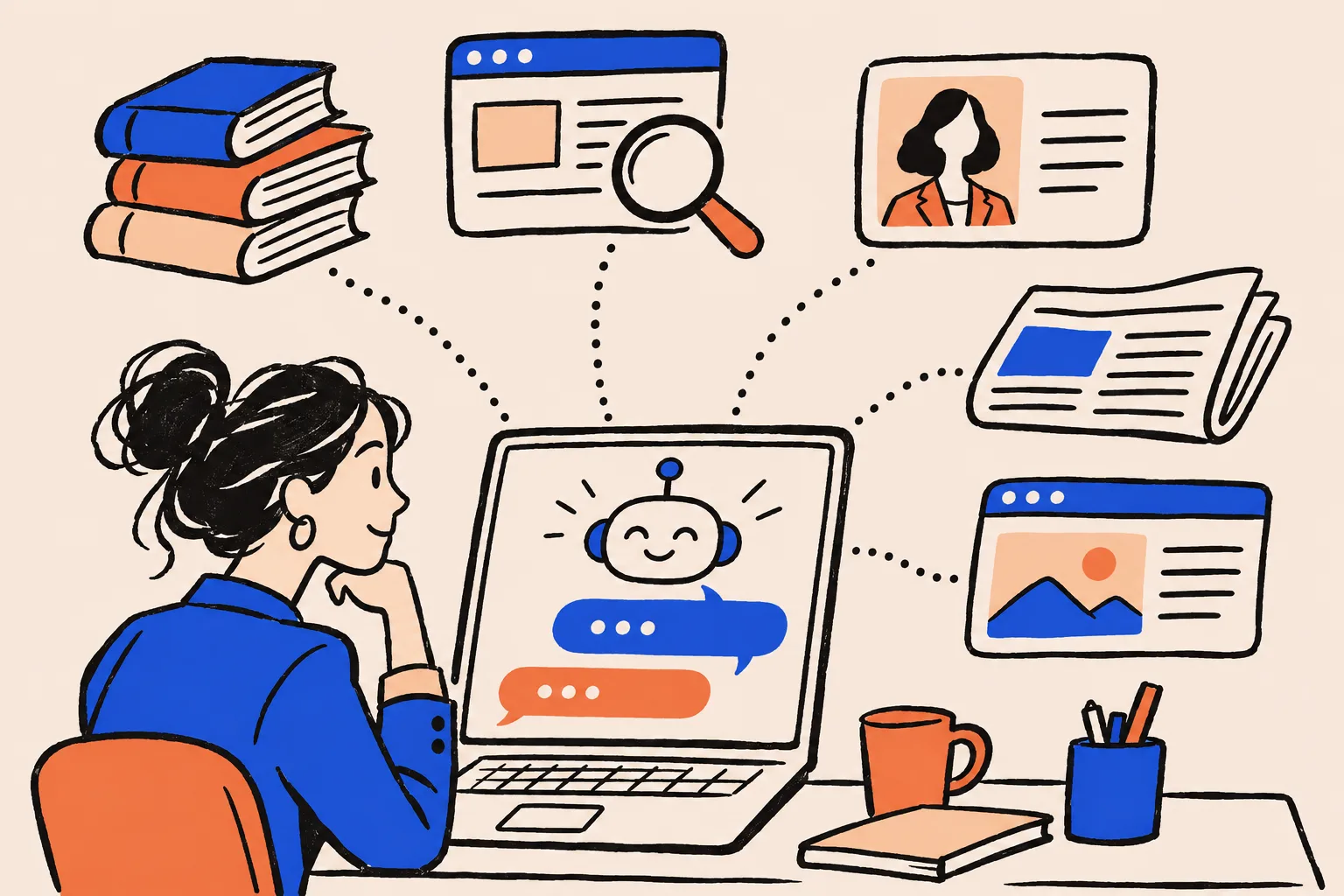
AI answers about a person come from two places: what the model already absorbed in training, and what it finds when it searches the web for the question. The second is the part you can work on in weeks rather than years.
Each engine handles that search step a little differently, and each one documents it in its own words.
| Engine | How it finds current information | What that means for you |
|---|---|---|
| Google AI Overviews and AI Mode | Uses Google Search’s index and may run “query fan-out”, several related searches across subtopics | Pages need to be indexed and eligible for a snippet in ordinary Google Search |
| ChatGPT search | OAI-SearchBot surfaces websites for ChatGPT’s search features | Sites that block OAI-SearchBot are not shown in ChatGPT search answers |
| Perplexity | Searches the internet in real time and footnotes its sources | The pages it cites are the ones it can find and read today |
| Gemini app | Google has not published a separate method for people | Test it alongside Google Search rather than assuming it matches |
Source: Google Search Central8, OpenAI9, Perplexity Help Center10
Google is unusually direct about its requirements. Its Search Central page on AI features says that to appear as a supporting link in AI Overviews or AI Mode, a page must be indexed and eligible to be shown with a snippet, that there are no additional technical requirements, and that specific optimisation isn’t required8.

OpenAI separates two crawlers. OAI-SearchBot finds pages for ChatGPT search, and blocking it keeps your site out of those answers. GPTBot collects content that may be used to train OpenAI’s models, which is a separate decision. A change to your robots.txt can take about 24 hours to reach ChatGPT search9.
Training memory is the slower half. What a model learned before its cutoff can be months or years old, which is one way a stale job title or a blended namesake ends up in an answer. How often that goes wrong is covered in How Often Does AI Get Facts About People Wrong?. How ChatGPT chooses which names to put forward is covered in How ChatGPT Decides Which Coaches to Recommend.
How do you measure your own AI visibility?
You measure it by asking the same fixed set of questions in each engine, several times each, and scoring every answer the same way. Paid tracking tools do the same thing at larger scale. For one person, a spreadsheet and an hour a month is enough to see where you stand.
Write 10 to 15 prompts in three groups
Identity prompts (“Who is [full name]?”), context prompts (“Who is [name], [profession] in [city]?”) and buyer prompts (“Who are good executive coaches for first-time founders in Chicago?”). Use the words your clients actually use.
Pick your engines
At minimum ChatGPT, Gemini, Perplexity and a Google search that shows an AI Overview or AI Mode. Add Copilot or Claude if your clients use them.
Test clean
Use a private window and stay logged out where the engine allows it, so your own history and saved memory don’t colour the answers.
Run each prompt several times
Three to five runs per prompt per engine is a practical minimum for one person. Start a fresh chat each time.
Score every answer the same way
Record whether you were found, whether the description was right and whether you were recommended, plus the sources cited. The scoring sheet is in the next section.
Repeat on the same day each month
Keep the prompts fixed so the numbers are comparable. Change one thing at a time on your side and watch what moves.
Why one test tells you almost nothing
Running each prompt several times isn’t fussiness. AI answers vary from run to run, and the variation is larger than most people expect.
In a study published in January 2026, Rand Fishkin of SparkToro and Patrick O’Donnell of Gumshoe ran 12 recommendation prompts 60 to 100 times each across ChatGPT, Claude and Google’s AI, 2,961 runs in all. ChatGPT and Google’s AI returned the same list of brands less than 1% of the time, and the same list in the same order less than 0.1% of the time11. Fishkin’s conclusion was that a “ranking position” in AI answers tells you little, while how often a name appears across many runs is more consistent11.
Two caveats. The study tested product and service categories, not individual professionals, and Gumshoe sells AI tracking tools, which the authors disclosed. It hasn’t been peer-reviewed11. The practical lesson still carries over: count how often you appear, not where.

What should you record for each answer?
Record three yes-or-no judgements and two notes for every answer: found, described correctly, recommended, plus which sources were cited and anything wrong. Keep the scoring blunt so that you, or whoever helps you, scores it the same way next month.
| Column | What to record | Why it matters |
|---|---|---|
| Prompt and engine | The exact wording and the tool used | Results only compare if the prompt is identical |
| Found | Yes if the answer clearly refers to you | The floor: no information, no visibility |
| Described correctly | Yes only if role, firm, location and credentials are all right and no namesake is mixed in | Errors here travel with every mention |
| Recommended | Yes if you’re named in answer to a buyer prompt | The layer most people mean by “AI visibility” |
| Sources cited | The pages the engine linked to or footnoted | Shows which pages are carrying your story |
| Errors | Anything out of date, wrong or borrowed from someone else | Your fix list |
Source: DotVisible method, built from the measurement approach described above
At the end of each round, turn the columns into three simple rates: the share of identity prompts where you were found, the share of answers that described you correctly, and the share of buyer prompts where you were recommended. Watch those three numbers over time, by engine.
The sources column is often the most useful. If Perplexity keeps citing a directory profile with your old firm, or Google’s AI Overview quotes a conference bio from 2021, you’ve found the page to fix first.
If you’d rather not run the first round by hand, our free AI Mention Checker asks ChatGPT, Gemini and Perplexity the questions your buyers ask and shows whether you’re named and who is named instead.
What actually moves AI visibility?
What moves a person’s AI visibility is mostly the same work that makes you easy for any search system to understand: pages that can be found, one clear description of you, and other sources that agree with it. None of it is a trick, and none of it is guaranteed to produce a mention.
Be findable where the engines look
Check the basics first. Your main site should be indexed in Google and eligible for a snippet, because Google says that’s the requirement for its AI features8. Make sure your robots.txt isn’t blocking OAI-SearchBot if you want to appear in ChatGPT search9, and check that a website template or security plugin isn’t blocking crawlers without your knowledge. If your site has a Google Search Console account, Search Console now has a setting, rolled out to all sites by 31 August 2026, that lets owners exclude a site from AI Overviews and AI Mode. Inclusion is the default, so just confirm nobody has switched it off12.
Give every engine the same description
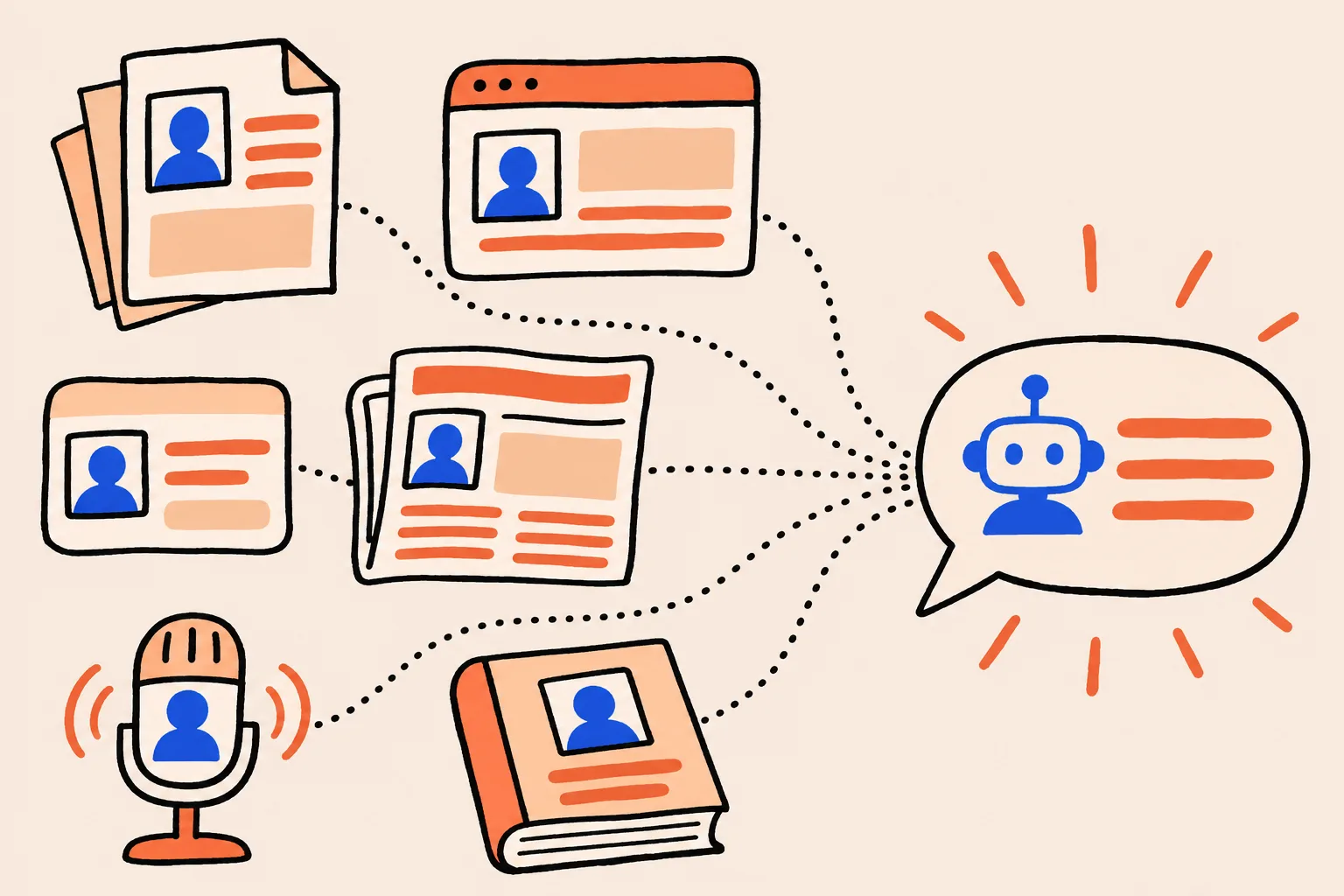
Pick one description of yourself (name, role, who you help, where, and your strongest credentials) and use it on your website, LinkedIn, speaker pages, podcast guest pages and professional directories. When five sources say the same thing, an engine summarising them has little room to improvise. When they disagree, it picks one, blends them or hedges. Our name search checklist covers the places to check first.
Earn sources you didn’t write
Pages about you written by someone else, such as interviews, podcast pages, conference speaker listings, articles and association directories, give an engine something to confirm your own claims against. In Pew’s study, the sites Google’s AI summaries cited most often were Wikipedia, YouTube and Reddit, not the subjects’ own websites7. A few credible pages about you in your field beat dozens of thin profiles.
Help Google understand you as one person
Google’s AI Overviews and AI Mode sit on top of Google Search, so being clearly understood by Google helps. A Google Knowledge Panel is the most visible sign that Google holds you as a distinct entity. Having one doesn’t guarantee an AI mention, and OpenAI’s crawler documentation says nothing about ChatGPT using Google’s Knowledge Graph. What carries over is the clarity that earns one.
You need an llms.txt file or special AI markup to show up in AI answers.
Google says there are no additional technical requirements for AI Overviews or AI Mode beyond being indexed and snippet-eligible, and lists AI text files such as llms.txt among the tactics you can ignore.
Google’s guide to generative AI search is explicit on this point. It also says structured data isn’t required and there is no special schema.org markup to add, though it is still worth using for rich results13. Treat structured data as one clear signal, not a switch.
If ChatGPT named you once, you’re visible.
AI answers vary from run to run. Visibility is how often you appear across repeated tests, not whether you appeared once.
The SparkToro and Gumshoe runs showed how rarely the same list repeats11. One good screenshot is not a trend.
How is AI visibility different from SEO and a Knowledge Panel?
AI visibility overlaps with SEO and with having a Google Knowledge Panel, but it isn’t the same as either. SEO is about where your pages rank. A Knowledge Panel is Google’s summary box about you. AI visibility is about what a conversational answer says about you, across several companies’ systems.
| SEO | Google Knowledge Panel | AI visibility | |
|---|---|---|---|
| What you see | A list of links | One summary box beside or among results | A written answer that may name, describe or recommend you |
| Who decides | Google’s ranking systems | Google’s Knowledge Graph | OpenAI, Google, Perplexity and others, each separately |
| Main unit | Your pages | You, as one entity | Your name inside an answer |
| Typical failure | Your site doesn’t rank | No panel, or a namesake’s | You’re missing, out of date or confused with someone else |
| How to check | Search your name | Search your name | Fixed prompts, several runs, several engines |
The three reinforce each other. Pages that rank are pages AI search can find and cite. The consistency that helps Google understand you as one entity also gives every AI engine one story to repeat. Pew’s data on clicks is the reason the third column now matters as much as the first: when a summary answers the question, fewer people scroll down to the links7.
What can’t you control?
You can’t control what any AI system finally says. OpenAI, Google and Perplexity each decide how their products answer, and they change those systems often. Training data you can’t edit may hold old information about you for a long time. Answers vary from run to run even when nothing has changed.
That has two practical consequences. First, judge progress over months and many runs, not by one answer on one day. Second, be wary of anyone promising a guaranteed AI recommendation. Good work makes accurate information about you easier to find and confirm. It can’t buy the outcome, and nobody outside these companies can promise it.
You can’t write the answer. You can make sure the sources it’s built from all tell the truth about you.
If an engine is getting you wrong right now, start with the source it cites, correct that page, and then correct the other pages that repeat the error. Fixing the answer itself isn’t possible. Fixing what it reads is.
Where to start
Start with a baseline. Write ten prompts, run them three times in ChatGPT, Gemini, Perplexity and Google, and fill in the scoring sheet. You’ll know within an hour whether your problem is being found, being described correctly or being recommended, and each needs different work.
If you want a faster first look, run your name through the free AI Mention Checker. For the bigger picture across Google and AI search, the AI search hub collects everything we’ve written on the topic. And if you’d like the work done for you, see our services or book a free audit.
Frequently asked questions
What is AI visibility for a person?
It is whether AI assistants and AI search features such as ChatGPT, Gemini, Perplexity and Google AI Overviews can find you, describe you correctly and name you when someone asks for a person like you. For a brand the focus is usually how often it is mentioned. For a person, being described accurately and not confused with a namesake matters just as much.
How do I check my AI visibility?
Write a short set of prompts: your name, your name with your profession, and the questions a buyer would ask when looking for someone like you. Run each one several times in ChatGPT, Gemini, Perplexity and Google, logged out where you can, and record whether you appear, whether the description is right and which sources are cited. Repeat monthly.
Why do I get a different answer every time I ask ChatGPT about my field?
AI answers vary from run to run. A SparkToro and Gumshoe study published in January 2026 found ChatGPT and Google’s AI returned the same list of brands less than 1% of the time across repeated runs. That is why one test proves little, and why you should count how often you appear across many runs.
Is AI visibility the same as SEO?
They overlap. Google says AI Overviews and AI Mode link to pages that are indexed and eligible for a snippet in normal Search, and ChatGPT search and Perplexity also search the web. But AI answers summarise and name people rather than list links, so clear, consistent information about who you are matters as much as ranking.
Do I need special markup or an llms.txt file to show up in AI answers?
Not for Google. Google’s Search Central documentation says there are no additional technical requirements to appear in AI Overviews or AI Mode beyond being indexed and eligible for a snippet. Its guide to generative AI search lists AI text files such as llms.txt among the tactics you can ignore, and says structured data is not required and there is no special schema.org markup to add. Structured data is still worth keeping as part of normal SEO.
Can anyone guarantee that ChatGPT will recommend me?
No. OpenAI, Google and Perplexity decide what their systems say, and answers vary from run to run. Good work makes accurate information about you easier to find and confirm. It cannot promise a mention, and you should be wary of anyone who says it can.
Which AI tools matter most for professionals in the US?
ChatGPT is the most used chatbot: 44% of US adults said they use it in Pew Research Center’s February 2026 survey, ahead of Gemini at 24% and Copilot at 17%. Google’s AI Overviews reach far more people because they appear inside ordinary Google searches, so test both.
Sources
- 1ChatGPT tops the list of chatbots Americans use, across age groupsPew Research Center · 17 Jun 2026 (survey 17–23 Feb 2026); accessed 17 Nov 2026↩
- 2Americans and AI 2026: Chatbots, Smart Devices and Views on Impact. Appendix: Detailed chart and tablesPew Research Center · 17 Jun 2026; accessed 17 Nov 2026↩
- 3ChatGPT reaches 900M weekly active usersTechCrunch · 27 Feb 2026↩
- 4Q2 earnings call: CEO’s remarksGoogle blog · 23 Jul 2025↩
- 5Q2 2026 earnings call: Remarks from our CEOGoogle blog · 22 Jul 2026↩
- 6Q3 2026 earnings call: Remarks from our CEOGoogle blog · 28 Oct 2026↩
- 7Google users are less likely to click on links when an AI summary appears in the resultsPew Research Center · 22 Jul 2025↩
- 8AI features and your websiteGoogle Search Central · Updated 10 Dec 2025; accessed 17 Nov 2026↩
- 9Overview of OpenAI crawlersOpenAI · Accessed 17 Nov 2026↩
- 10How does Perplexity work?Perplexity Help Center · Accessed 17 Nov 2026↩
- 11AI recommendations change with nearly every query: SparkToro (Matt G. Southern)Search Engine Journal · 30 Jan 2026↩
- 12Search generative AI controlSearch Console Help · Accessed 17 Nov 2026↩
- 13Optimizing your website for generative AI features on Google SearchGoogle Search Central · Updated 10 Jul 2026; accessed 17 Nov 2026↩
Keep reading
 AI searchGEO vs SEO: What Changes When Clients Ask AI About YouShobin K Jose · 17 Nov 2026 · 15 min read
 AI searchHow to Get ChatGPT to Recommend You (for Professionals)Shobin K Jose · 17 Nov 2026 · 17 min read
 AI searchWhere Does ChatGPT Get Its Information About People?Shobin K Jose · 17 Nov 2026 · 16 min read