
How to Get Speaking Engagements (and the Speaker Page Planners Check)
Planners find most speakers through recommendations, then search the name before they send an inquiry. Here's how to get recommended, and how to pass the search that follows.
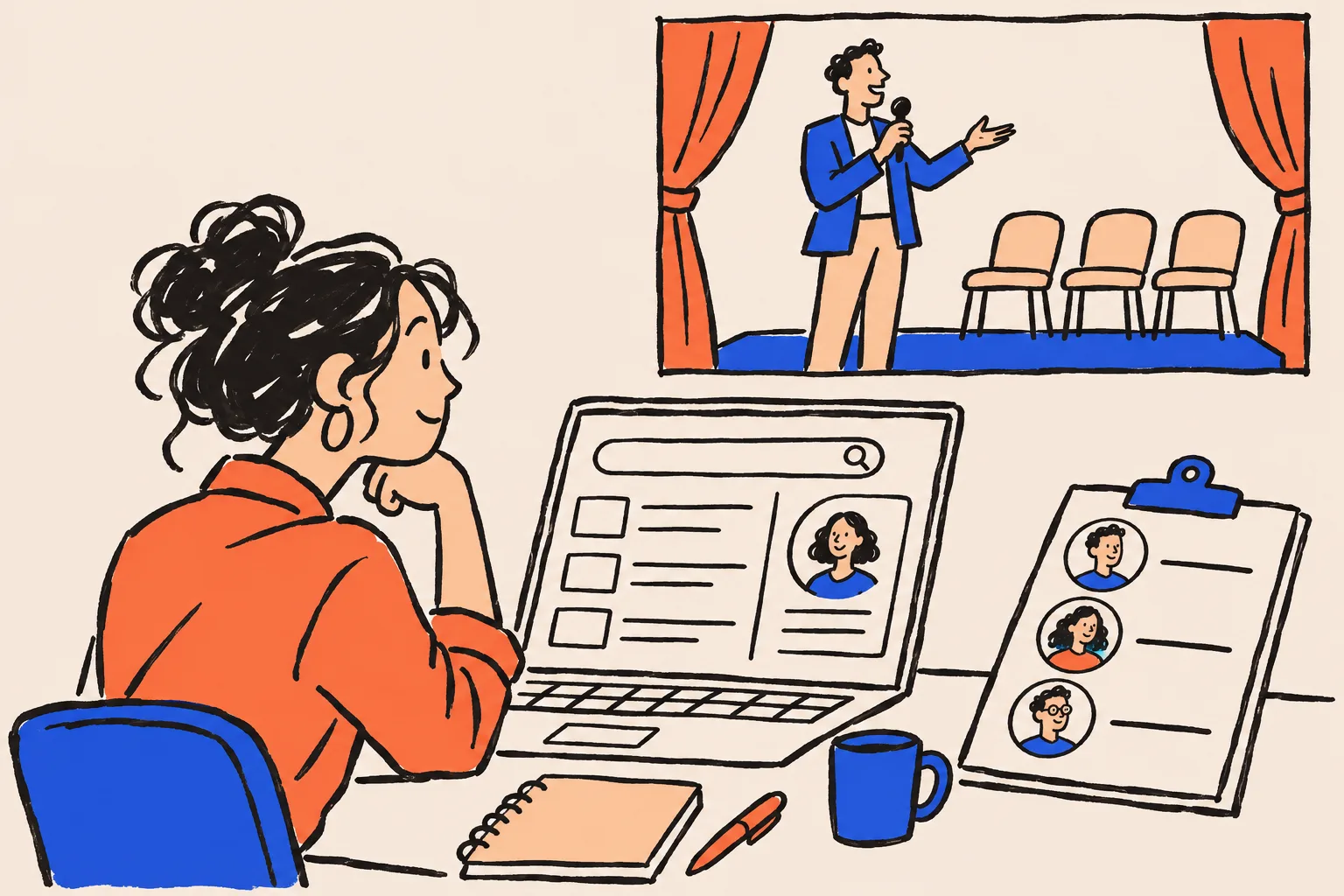
You get speaking engagements mostly through people: planners book speakers they've seen on stage or that someone they trust recommends. So the fastest route is to speak often in front of the audiences you want, make each talk easy to recommend, and ask for the next introduction. A recommendation only gets you onto a shortlist, though. Before an inquiry goes out, the planner and their colleagues search your name, look for a speaker page and a demo video, and check that what they find agrees.
How do speakers actually get booked?
Speakers get booked mainly through word of mouth and live performance, with online search playing a supporting role. That's the clearest finding from the planner surveys that exist, and it shapes everything else in this guide.
In 2020, the speaker management firm Michelle Joyce Speakers, the author and speaker Jay Baer and the bureau Speak, Inc. surveyed 150 meeting planners about how they source keynote speakers12. Fewer than half said they used Google, videos, podcasts or social channels to find speakers. The number one route was non-digital: seeing a speaker in person, or a recommendation from a bureau, another speaker or someone else1. All three sell speaking services, and the full results sit in a gated report, so treat these as the published highlights.
An older poll points the same way. When Meetings & Conventions asked planners in 2015, 72% said they relied on suggestions from colleagues and 65% on events they had attended3.
150
Meeting planners surveyed in 2020 on how they find speakers. Fewer than half used Google, video, podcasts or social media to do it1
72%
Of planners relied on colleagues’ suggestions to find speakers (Meetings & Conventions poll, 2015)3
<8%
Of event organizers make speaker decisions alone (survey of 340 organizers by the bureau AAE Speakers, 2024)4
Video does matter to some planners at the discovery stage, and more to the most experienced. In the 2020 survey, 42% of planners with more than 20 years in the job said they sometimes rely on YouTube and speaker demo videos to find speakers, against 23% of those with 11 to 20 years and 28% of those with 10 years or less1.
| Item | Value |
|---|---|
| 0–10 years | 28% |
| 11–20 years | 23% |
| 21+ years | 42% |
Source: Michelle Joyce Speakers, with Jay Baer and Speak, Inc.1
Two things follow. First, your most reliable marketing is the talk you're giving right now, because the people in that room are your next referrals. Second, the internet's main job isn't to get you discovered. It's to confirm you once someone has heard your name.
A recommendation puts you on the shortlist. The search decides whether you stay there.
Where do you start if nobody has booked you yet?
Start small, close to your buyers, and treat every early talk as a way to collect the three things that get you the next one: a recording, a testimonial and an introduction.
Pick one problem for one audience
Planners book a talk because it helps their attendees with something specific. “Leadership” is a category. “How first-time managers in fast-growing tech firms handle their first underperformer” is a talk. Write a title, a three-sentence description and three takeaways.
Go where your buyers already meet
Professional associations and their local chapters, industry meetups, trade-show education tracks, alumni groups, company lunch-and-learns and podcasts your buyers listen to. These hosts need content regularly.
Answer calls for speakers properly
Conferences that run a call for proposals publish what they want. Read the past programme, write for that audience, and submit only to calls that fit your topic. One sharp proposal beats ten generic ones.
Get every talk recorded
Ask the host whether they film sessions. If not, bring a phone on a tripod and a clip-on microphone. Clean footage from a live audience is the raw material for your demo video.
Ask for the testimonial and the next introduction
Within a day of the talk, thank the organizer, ask for two or three sentences you can quote with their name and role, and ask who else they know who runs events for a similar audience.
Keep a booking record
Log every event, audience, date and contact. Bureaus and planners ask for recent clients, and a list you can send in a minute looks like a speaker who is in demand.
How do you pitch an organizer and get a reply?
Write the pitch about their audience, not about you. In 2024 the speakers bureau AAE Speakers surveyed 340 event organizers and 378 speakers for its Speaking Industry Benchmark Report. As a bureau, it has a stake in the answers, but the findings are useful. Asked about problems working with speakers, 42% of organizers said they'd had none. The next most common answer, from 19%, was that speakers don't understand who is in the audience4. Audience engagement was organizers' biggest priority when booking a speaker, named by 67%4.
A pitch that gets read is short and specific:
- One line on the event. Show that you've looked at the programme and know who attends.
- The talk, framed for them. The title, the problem it solves for their attendees and what people will do differently afterwards.
- Proof. One or two similar audiences you've spoken to, and a one-line quote from an organizer.
- The links. Your speaker page and your demo video, nothing else.
- An easy next step. Offer a 15-minute call to hear more about their audience.
Remember who reads it. Fewer than 8% of organizers in the AAE survey make speaker decisions alone. Nearly 7 in 10 said two to five people are involved, and about a quarter said more than five4. Your pitch gets forwarded, and every person it reaches can search your name.
Do you need a speakers bureau?
Not to get started. Bureaus mostly take on speakers who already have demand, and their own submission pages say so plainly.
Executive Speakers Bureau says it has more than 3,500 active speakers in its database and recommends applicants include a referral from a reputable speaker or a strong track record of bookings6. National Speakers Bureau says it receives more than 1,000 proposals from potential speakers every year and can't reply to each one7. Eagles Talent says its management services are generally not geared towards speakers starting their careers, and points newcomers to the National Speakers Association for guidance8.
What their pages are useful for is a checklist. Here's what three bureaus ask you to send.
| Item | Executive Speakers Bureau | Eagles Talent | National Speakers Bureau |
|---|---|---|---|
| Topics | Topics and presentation descriptions, most popular first | At least 3 topics, plus programmes with descriptions | Areas of expertise on its form |
| Demo video | 4–5 minutes, live audience, no contact details in the video | At least a 5–10 minute live presentation | Not specified on the page |
| Bio and photo | High-resolution photo | Full bio | Not specified on the page |
| Fees | Fee schedule (keynote, full day, half day, non-profit) | Current fee, expenses and commission offered | Not specified on the page |
| Track record | Past clients from the last two years | Not specified | Credibility in your field |
| Your website | Not specified | Website URL and social profiles | Says it visits your website periodically for updates |
Source: Executive Speakers Bureau, National Speakers Bureau and Eagles Talent submission pages, accessed 17 Nov 2026678
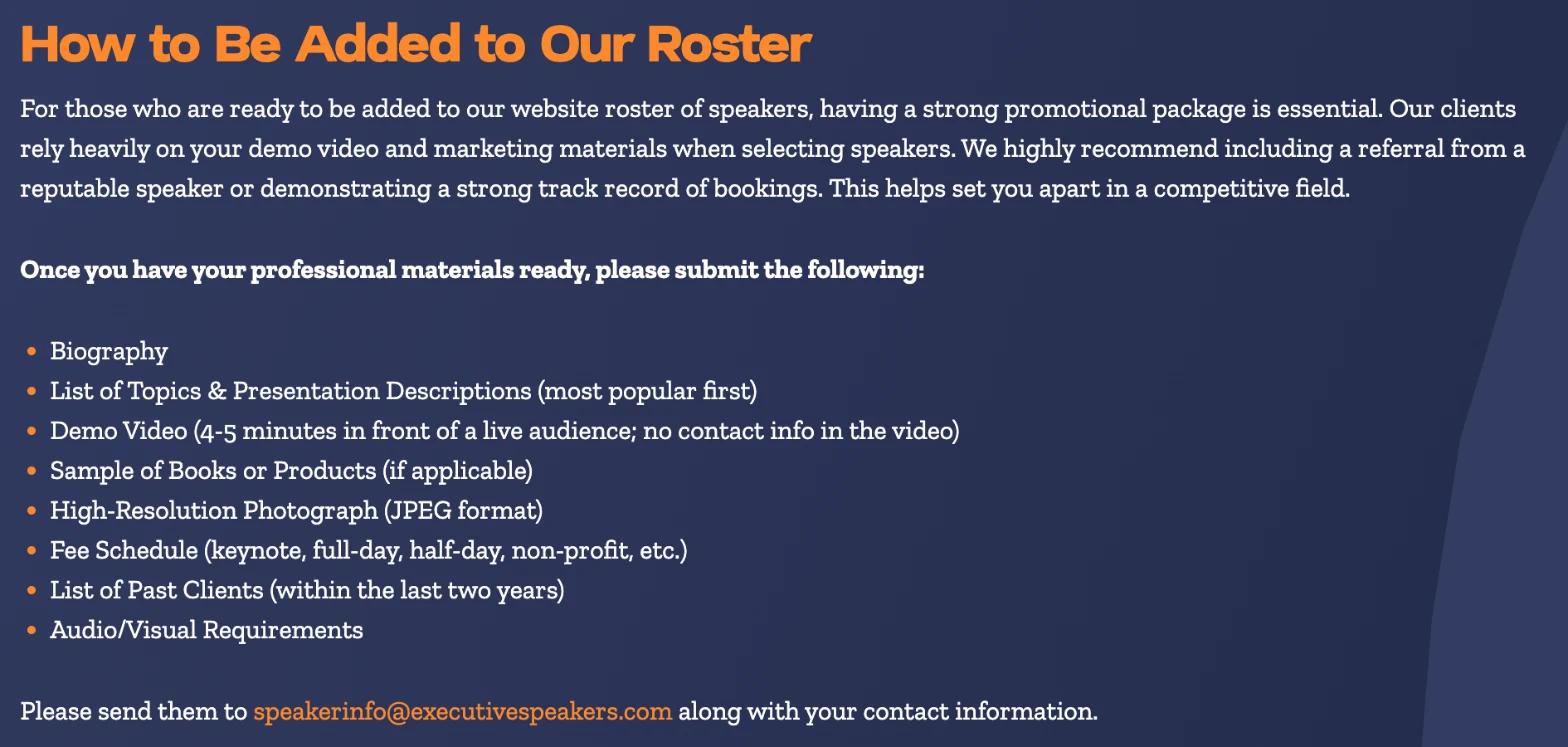
Notice the last row. Bureaus and the planners they serve don't only read what you send. National Speakers Bureau says outright that it checks your website for updated topics7, and Executive Speakers Bureau says its clients rely heavily on your demo video and marketing materials when choosing speakers6.
What happens after someone recommends you?
The planner checks you out, and so do the colleagues who share the decision. A typical sequence looks like this, though no survey measures each step.
Your name arrives on a shortlist
From a colleague, a bureau, another speaker or someone who saw you on stage.
Someone searches your name
Often in a meeting, on a phone, alongside the other three or four names on the list.
They look for a speaker page
Topics, a video, clients and a way to check availability. If your homepage sells coaching and mentions speaking in the footer, they have to dig.
They watch a few minutes of video
Long enough to judge whether you'd hold their room and fit their audience.
They compare what they find
Does your LinkedIn title match your website? Is the photo the same person? Is there a namesake in the results?
They forward the link
To the people who share the decision, who often repeat the search themselves.
Bureaus suggest planners go further than a quick look. The Speakers Group, writing for planners, warns that a short, polished demo video can show only the best moments of a talk. It recommends a phone call with the speakers whose videos catch your interest, and, when narrowing the list, asking for a past client list and talking to clients in a similar field9. So the testimonials on your page should carry real names, roles and organizations that a planner could contact.
What should your speaker page include?
Your speaker page is the one place where a planner can confirm everything at once. Put it on your own site, at a simple address such as yourname.com/speaking, and make it the link you send everywhere.
| Section | What to include | Why it matters |
|---|---|---|
| Opening line | Your name, who you speak to and the problem you solve | Confirms in seconds that this is the right person and topic |
| Talks | 2–4 talk titles, each with a short description and takeaways | Planners book a specific talk for a specific audience |
| Demo video | A short reel embedded on the page, plus one full-length talk | Lets them judge stage presence without leaving your site |
| Bios | A 50-word and a 150-word version, written in the third person | Ready to paste into a programme or an introduction |
| Headshots | Two or three high-resolution photos to download | Saves an email, and matches the face they saw elsewhere |
| Proof | Past clients, named testimonials, books and media | Gives the committee something to check |
| Formats | Keynote, workshop, panel, virtual, and audience sizes you work with | Answers the fit question before they ask |
| Booking | A short form asking for date, location, audience and budget range | Turns a visit into an inquiry |
A one-sheet PDF is still worth having, because bureaus and planners pass them around. But a PDF attached to an email is hard to find again, can't be searched, and goes out of date quietly. The page should be the source, and the one-sheet a printable copy of it.
One-sheet PDF only
- Usually lives in inboxes, not on your site
- Easy to forward an out-of-date version
- No video, no booking form
- Separate from the page planners land on when they search
Speaker page plus one-sheet
- Can rank when someone searches your name plus “speaker”
- Always current: update once, every link stays right
- Video, testimonials and booking in one place
- Can carry structured data about you
Make the page easy for Google to read
Two pieces of Google's guidance apply directly. For video, Google says a video is eligible for its video features when the page is indexed, the video is embedded on it and there is a valid thumbnail. It recommends a dedicated watch page with a unique title and description for each video, and says YouTube embeds can be indexed both on your page and on YouTube10.
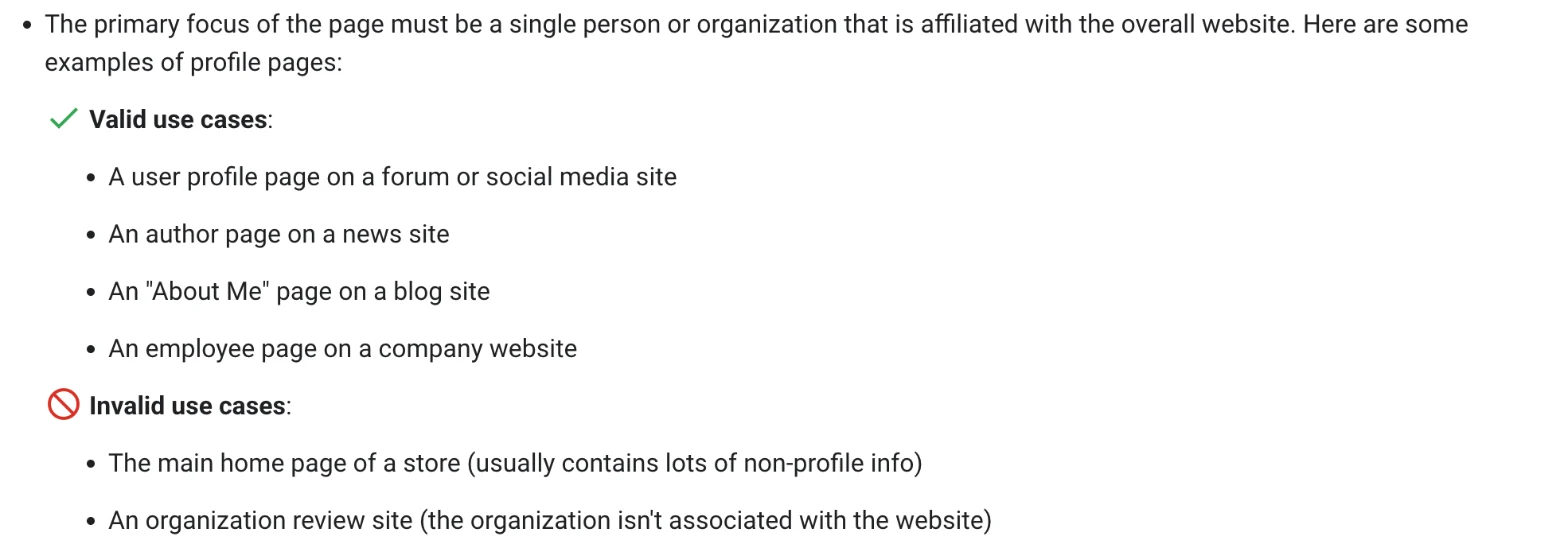
For you as a person, Google's ProfilePage structured data lists an "About Me" page as a valid use. It requires a mainEntity of type Person (or Organization) and recommends properties such as sameAs links to your other profiles, an image and a description11. Google also says it doesn't guarantee that structured data will produce any feature in search11. If markup is new to you, Structured Data in Plain English explains it from the start.
How long should your demo video be?
There is no industry standard, and the people who book speakers disagree. Here is what four of them say.
| Source | Who they are | What they say |
|---|---|---|
| Executive Speakers Bureau | Speakers bureau | 4–5 minutes, in front of a live audience, no contact details in the video |
| Eagles Talent | Speakers bureau | At least a 5–10 minute live presentation |
| The Speakers Group | Speakers bureau, writing for planners | Most demo videos run about 10 minutes, and short reels can show only the best parts |
| The Speaker Lab | Speaker training company | A demo video over 5 minutes can cost you a booking |
Source: Submission and guidance pages, accessed 17 Nov 202668912
The common ground is more useful than the disagreement. Every source wants real footage from a live audience, not a talking head filmed at your desk. A practical answer is a 3 to 5 minute reel at the top of your speaker page, with one or two full-length talks below it for the planner who wants to see you hold a room for 45 minutes. Leave your phone number and email out of the video itself, as Executive Speakers Bureau asks6, so a bureau can share it.
What do planners see when they search your name?
They see whatever Google shows a stranger, which may not be what you see. Google's Search Help says signed-in results can be personalized from your activity, offers a "Try without" link at the bottom of results to see them unpersonalized, and notes that Google still uses things like your location and device even with personalization off13. So use a private window, signed out, and search the way a planner would:
- Your name on its own.
- Your name plus "speaker" and your name plus "keynote".
- Your name plus your main topic.
- Your name plus the title of your book, if you have one.
For each search, ask four questions. Does your speaker page come up on the first page? Do your LinkedIn, website and bureau profiles show the same title and photo? Is a namesake mixed in? And is there anything old, such as a former job title or a talk you no longer give, that contradicts the rest? The full routine is in The Name Search Checklist.
Where a Google Knowledge Panel fits
For some speakers, a Google Knowledge Panel appears beside the results: an information box with your photo, a short description, your books and links to your profiles. Google says panels are generated automatically for people and things in its Knowledge Graph, using sources across the web, and that people who are the subject of a panel can claim it and suggest changes14. There's no application form, and Google alone decides whether a panel shows. What Is a Google Knowledge Panel? explains how Google decides.
For a speaker, a panel does a specific job: it tells a planner at a glance that Google recognizes you as one distinct person with a body of work. The things that help Google get there are the same things that help a planner. That means one definitive page about you, the same name, title and photo everywhere, and independent pages, such as conference speaker listings and podcast guest pages, that describe you the same way. If you're also an author, First-Time Authors: Set Up Your Search Presence Before Launch Day covers the book side of it, including your Amazon author page.
Are planners asking AI for speakers yet?
Nobody knows yet, because the published data is thin. In the 2024 AAE Speakers survey, 32% of organizers said they weren't using AI tools in their work and had no plans to, and another 26% weren't using them yet but planned to that year4. That survey asked about AI use in general, not about finding speakers, and no survey we found measures how often planners ask ChatGPT, Gemini or Perplexity for speaker ideas.
It's still worth checking what those tools say about you. Ask each one "Who is [your name]?" and "Who are good speakers on [your topic] for [your audience]?" If the description is wrong or thin, the fix is the same work as above: a clear speaker page, consistent profiles and independent sources that agree. How to Get ChatGPT to Recommend You covers what OpenAI says about where ChatGPT's answers come from. Nobody can guarantee you'll be named.
A 30-day plan to get your next booking
If you do nothing else this month, do these in order.
Week 1: write the talk down
One title, one audience, one problem, three takeaways. Write the 50-word and 150-word bios. Choose one headshot and use it everywhere.
Week 2: build the speaker page
Talks, video, bios, headshots, clients, testimonials, formats and a booking form, on your own site. Then make your LinkedIn title and photo match it.
Week 3: run the name search
Search yourself signed out, as a planner would. Fix any profile that disagrees, and ask past organizers to update old speaker listings.
Week 4: pitch five events
Five associations, chapters or conferences where your buyers gather. Tailor each pitch to the audience, and link to your speaker page and video.
After every talk
Get the recording, the testimonial and one introduction. Add the event to your booking record.
Speaking leads to speaking. The work above makes sure that when someone recommends you, the search that follows backs them up. If you speak and write for a living, our service for speakers and authors builds the Google Knowledge Panel and AI visibility side of this for you, and more guides for speakers are on the speakers and authors hub and in the name search topic. Not sure where you stand? Book a free audit, or run your name through the Knowledge Panel Checker.
Frequently asked questions
How do beginners get their first speaking engagement?
Start where your buyers already gather: their professional associations, local chapters, industry meetups and podcasts. Pick one problem you solve for one audience, offer a talk built around it, get it recorded, and ask every host for a testimonial and an introduction to one more organizer. Planners find most speakers through people who have seen them or vouch for them, so each talk is how you get the next one.
How do event planners find speakers?
Mostly through people. In a 2020 survey of 150 meeting planners by the speaker management firm Michelle Joyce Speakers, the author Jay Baer and the bureau Speak, Inc., seeing a speaker in person and recommendations from bureaus, other speakers and colleagues were the top ways, and fewer than half used Google, videos, podcasts or social media to find speakers. Online research matters more at the next stage, when the planner checks the names on the shortlist.
What should a speaker page include?
Your name and one clear line on who you speak to, your talk titles with a short description and outcomes for each, a demo video embedded on the page, a short bio and a longer one, a downloadable headshot, past clients and testimonials, formats you offer and a simple booking form. Keep the name, title and photo identical to your LinkedIn, one-sheet and bureau profiles.
How long should a speaker demo video be?
There's no single standard. Executive Speakers Bureau asks for 4 to 5 minutes in front of a live audience, Eagles Talent asks for at least a 5 to 10 minute live presentation, and The Speakers Group says most demo videos run about 10 minutes. A 3 to 5 minute reel plus one or two full-length talks on your page covers most requests.
Do I need a speakers bureau to get booked?
No, especially early on. Bureaus mostly take on speakers who already have demand: Eagles Talent says its services generally aren't geared to speakers starting out, and National Speakers Bureau says it receives more than 1,000 proposals a year. Build a booking record and client list first, then approach bureaus with the materials they ask for.
Can I pay to speak at a TEDx event?
No. TED's rules say TEDx speakers can't pay or be charged in any form, and any fee-based service promising a TEDx talk is illegitimate. Only apply to events that publish a public application form, and note that TED says TEDx isn't a platform for professional or circuit speakers.
Does a Google Knowledge Panel help me get booked as a speaker?
It can help a planner confirm quickly that you are who you say you are, with your books and profiles in one place. It doesn't book talks by itself, and Google alone decides whether a panel appears. Treat it as one part of a clean name search, alongside your speaker page, demo video and consistent profiles.
Sources
- 1Top Ways Meeting Planners Find Speakers (survey of 150 meeting planners with Jay Baer and Speak, Inc.)Michelle Joyce Speakers · 19 Feb 2020; accessed 17 Nov 2026↩
- 2The Top 9 Ways Meeting Planners Find Keynote Speakers (Leah Doyle)Speak, Inc. · 2020; accessed 17 Nov 2026↩
- 3How Do You Choose Speakers? (Loren G. Edelstein)Meetings & Conventions · 1 Sep 2015; accessed 17 Nov 2026↩
- 4Survey Explores Speaker and Planner Dynamics (Curt Wagner), on AAE Speakers’ 2024 Speaking Industry Benchmark ReportPCMA Convene · 15 Apr 2024↩
- 5Speaking at TEDxTED · Accessed 17 Nov 2026↩
- 6Become a SpeakerExecutive Speakers Bureau · Accessed 17 Nov 2026↩
- 7Become a SpeakerNational Speakers Bureau · Accessed 17 Nov 2026↩
- 8Keynote Speaker and Entertainment SubmissionEagles Talent Speakers Bureau · Accessed 17 Nov 2026↩
- 9Six Keys to Booking the Perfect Speaker for Your Next Event (Shawn Ellis)The Speakers Group · Accessed 17 Nov 2026↩
- 10Video SEO best practicesGoogle Search Central · Updated 18 Dec 2025↩
- 11Profile page (ProfilePage) structured dataGoogle Search Central · Accessed 17 Nov 2026↩
- 12What Event Planners Look for in SpeakersThe Speaker Lab · Updated 24 May 2026↩
- 13Personalization & Google Search resultsGoogle Search Help · Accessed 17 Nov 2026↩
- 14About knowledge panelsGoogle Knowledge Panel Help · Accessed 17 Nov 2026↩
Keep reading
 Name searchThe Name Search Checklist: 12 Things Prospects See Before They CallShobin K Jose · 29 Oct 2026 · 19 min read
 Name searchExecutive Personal Branding: What Investors and Hires FindShobin K Jose · 17 Nov 2026 · 15 min read
 Name searchHow Prospects Vet a Financial Advisor Online, and What You Can Check FirstShobin K Jose · 17 Nov 2026 · 18 min read