
How AI Search Engines Decide Who to Cite: Ranking Factors for Individuals
Let me tell you what’s actually happening when an AI names someone as an expert.
It’s not choosing the most experienced person in the room. It’s not picking the professional with the best reputation, the most clients, or the most impressive credentials. It’s running a specific set of technical checks — and the professionals who pass those checks get cited, while everyone else gets left out.
I’ve watched this play out repeatedly. A coach with 20 years of experience and a waiting list of clients. Invisible in ChatGPT. Meanwhile, a newer practitioner with half the credentials gets cited constantly in the same niche. The difference wasn’t expertise. It was seven specific signals the second person had built and the first person hadn’t.
This isn’t a meritocracy. It’s a technical system. And once you understand how it works, the path to getting cited becomes clear.
This post maps all seven signals using the best available citation research. If you want to understand how to get cited by AI as a thought leader, start here.
Key Takeaways
- Brand mentions (correlation: 0.664) outperform backlinks (0.218) as the strongest predictor of AI citation visibility (Ahrefs, 2025).
- Entities verified on Wikidata, Wikipedia, and 4+ third-party platforms earn 2.8x more AI citations than those without verified status (Metrics Rule, 2025).
- Citing external sources lifts AI visibility by +115% for lower-ranked content; adding statistics adds +41% (Princeton GEO Paper, ACM KDD 2024).
- 73% of sites have technical barriers blocking AI crawlers, preventing citation regardless of content quality (OtterlyAI, 2026).
- Each AI platform uses distinct citation criteria: ChatGPT leans on Wikipedia; Perplexity leans on Reddit and real-time results; Google AI Overviews leans on organic rank signals.
Why Everything You Know About SEO Won’t Get You Cited by AI
The research here is blunt, and it should change how you think about your online presence. Domain authority — the metric SEO professionals have treated as a proxy for credibility for 20 years — is nearly irrelevant to AI citation selection.
A 2025 Ahrefs study found that branded web mentions correlate with AI Overview visibility at 0.664, while backlinks correlate at only 0.218 — a three-fold difference. Separately, a Metrics Rule study found that domain authority correlation with AI citation selection dropped to just r=0.18 (Metrics Rule, 2025).
This isn’t a small adjustment. It’s a structural shift. For 20 years, SEO practitioners focused on link acquisition and domain rating as the primary trust signals. AI systems weight those signals minimally. They care far more about whether you exist as a recognized entity in the knowledge ecosystem they were trained on.
Turns out, the game has changed completely. And most professionals haven’t noticed yet.
For individuals, this is both a challenge and an opportunity. The challenge: most professionals haven’t built the type of entity presence that AI systems recognize. The opportunity: entity authority can be built systematically, and its effect on AI citation probability is measurable and significant.
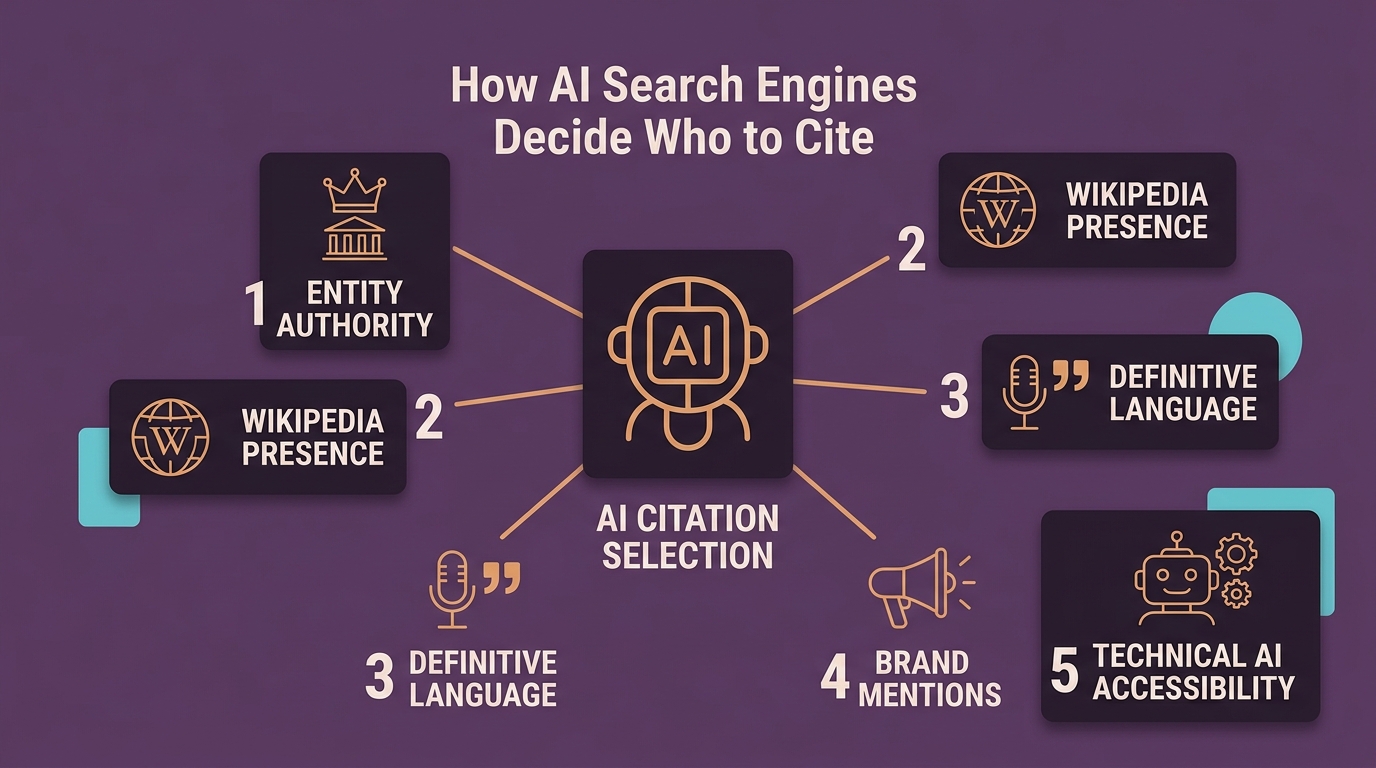
The 7 Signals That Determine Who AI Cites
Signal 1: Entity Authority (Not Domain Authority)
Entity authority is the most powerful citation signal available to individuals — and it has almost nothing to do with how many backlinks you have. A 2025 Metrics Rule study found that pages with 15 or more connected Knowledge Graph entities show a 4.8x higher probability of AI Overview selection — while domain authority had almost no predictive power (Metrics Rule, 2025). Your goal isn’t link acquisition. It’s becoming a recognized, connected node in the Knowledge Graph.
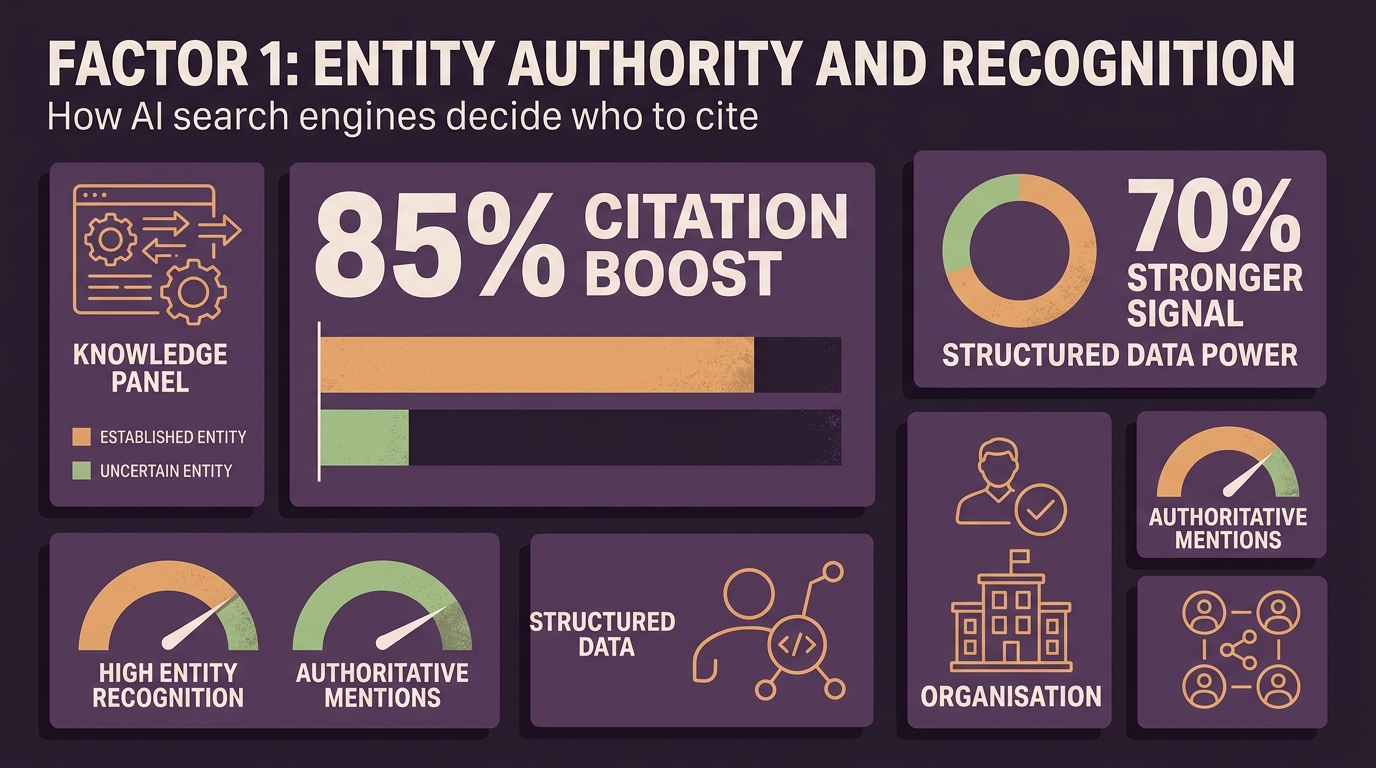
For individuals, entity authority means being unambiguously identifiable: your name, expertise area, credentials, and professional history consistently confirmed across multiple independent sources. AI systems trained on billions of documents learn to associate your name with a specific domain. Each corroborating source strengthens that association. Learn more about how Knowledge Graph entities drive AI citations.
Signal 2: Wikipedia and Wikidata Presence
Here’s a number that should get your attention: Wikipedia accounts for 47.9% of ChatGPT’s top-cited sources in a Profound analysis of 680 million citations (Status Labs, August 2024-June 2025). GPT-3 was trained on approximately 3 billion Wikipedia tokens, representing roughly 3% of its full training corpus. That history makes Wikipedia a foundational truth anchor for ChatGPT specifically.
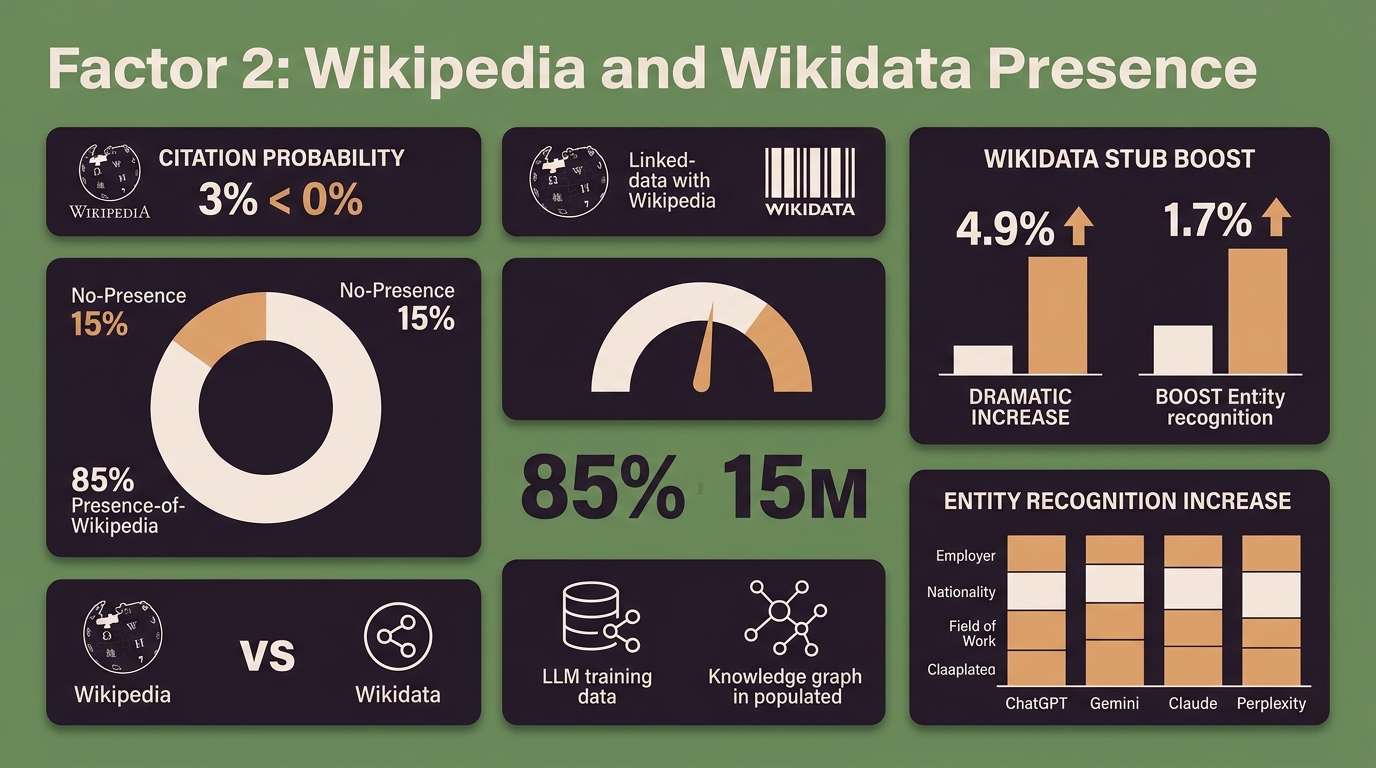
The weight of Wikipedia varies by platform. For Google AI Overviews, Wikipedia accounts for a smaller 5.7% citation share. Wikidata directly feeds the Knowledge Graph, making a Wikidata entry critical for Google’s understanding of who you are as a Person entity. Both matter. They serve different functions in the AI citation stack.
Getting a Wikipedia page as an individual requires meeting notability standards: coverage in multiple reliable, independent sources. Many professionals who qualify haven’t pursued it. Wikidata has lower barriers and can be created by professionals on their own behalf, provided claims are supported by verifiable sources.
Signal 3: Where Your Key Claims Live in the Document
Where you place your best content matters enormously. A Growth Memo analysis of 1.2 million AI citations found that 44.2% of all LLM citations come from the first 30% of page content (Growth Memo / Kevin Indig, 2025). Your introduction and first section carry disproportionate extraction weight. Most professionals bury their credentials and key claims mid-article.
The same analysis found that cited content has an entity density of 20.6%, compared to 5-8% in normal English text. Cited pages are saturated with recognized entities: named individuals, organizations, credentials, locations, publications, and concepts. If your content reads like plain prose without specific named references, it’s less extractable.
Front-load your entity attributes in every piece of content. Your name, your credential, your specific expertise area, the organizations you’re affiliated with, and the named concepts you’re known for should all appear in the first few paragraphs. Don’t make the AI dig for it.
Signal 4: Definitive Language and Q&A Format
The way you write is a citation signal. A Growth Memo study of 98,000 citation rows found that content with definitive language (“is defined as,” “the answer is,” “research shows”) is cited nearly 2x more than hedged language: 36.2% vs. 20.2% citation rate (Growth Memo, 2025). AI systems are looking for clear, extractable answers, not cautious opinions.
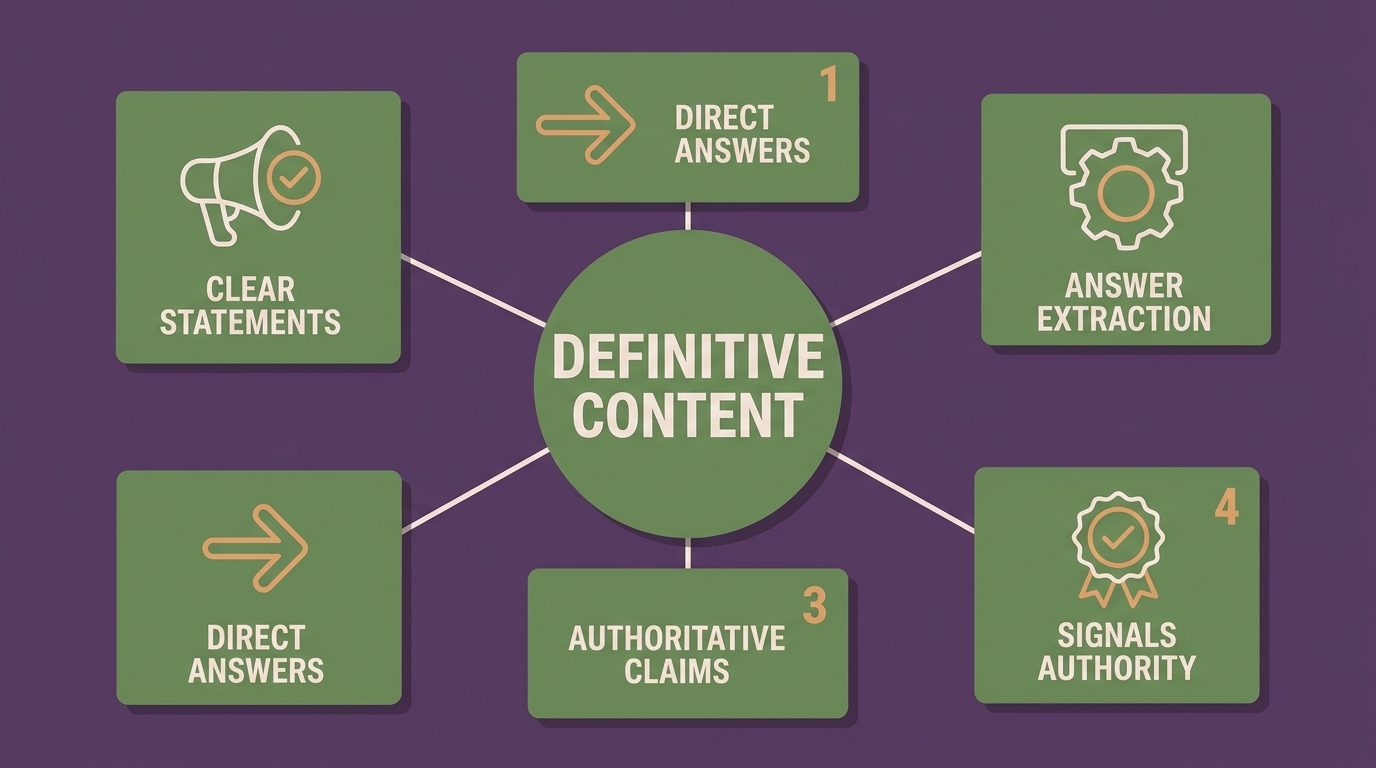
Q&A-format content is cited 2x more frequently than standard prose: 18% vs. 8.9% (Growth Memo, 2025). This isn’t surprising. AI systems are built to answer questions. Content organized around questions and direct answers maps naturally to how these systems extract and present information.
Write declarative sentences about your area of expertise. “The most common mistake executives make when building their digital authority is…” is more citable than “In my experience, it might be the case that executives sometimes…” Confidence in language signals authority. Hedging signals uncertainty. AI systems respond accordingly.
Signal 5: Cross-Platform Consistency and Brand Mentions
Unlinked brand mentions are three times more strongly correlated with AI visibility than backlinks (Ahrefs, 2025). This reshapes how professionals should think about their online presence strategy. Acquiring a link from a publication matters less than being mentioned by name in that publication. Being mentioned consistently across many publications matters more.
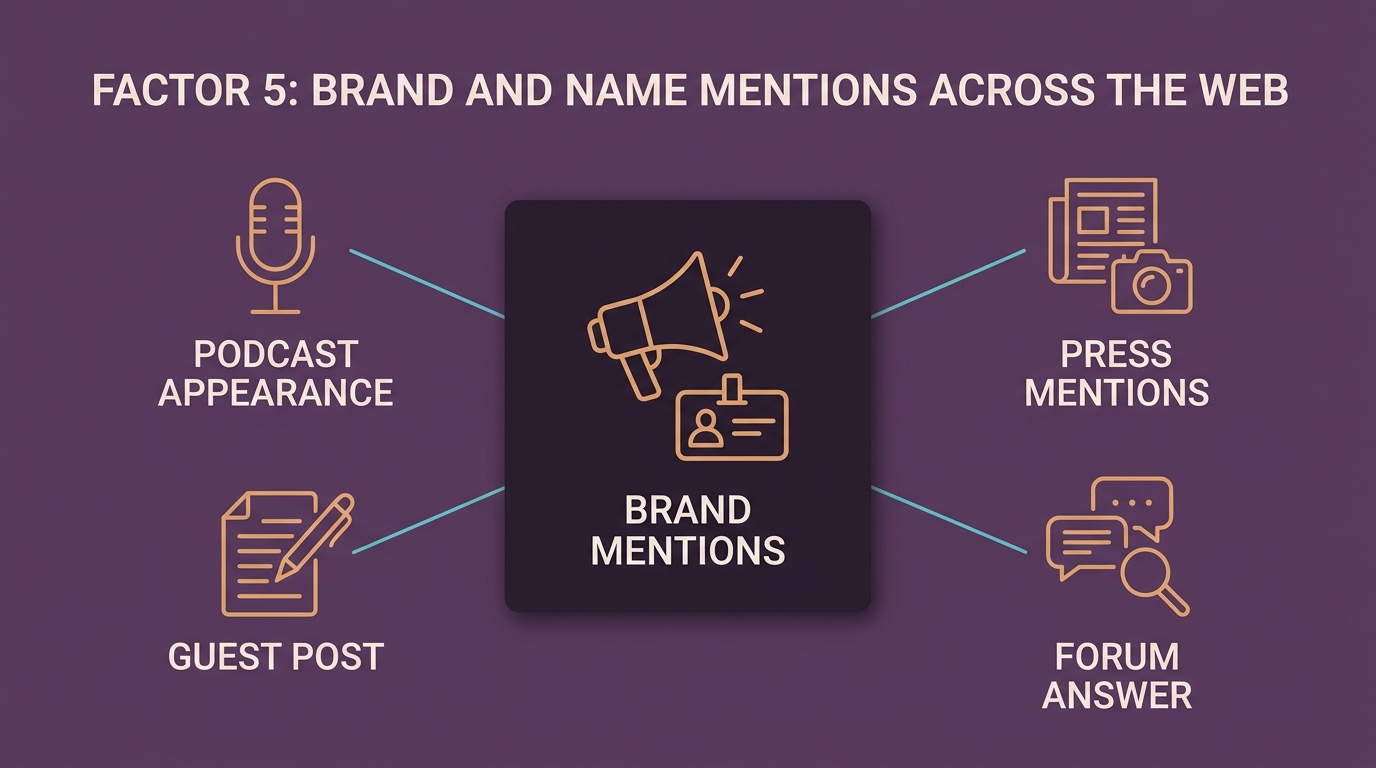
Entities verified on Wikidata, Wikipedia, and four or more third-party platforms experience 2.8x more AI citations than those without verified entity status (Metrics Rule, 2025). Each platform counts separately: a speaker bureau listing, a podcast guest bio, a conference speaker profile, a university faculty page, a professional association directory. Consistency of name, credentials, and expertise across all these sources is what AI systems use to build confidence in your identity. Person schema markup is one of the most direct ways to reinforce these cross-platform signals.
Signal 6: Content Freshness
AI platforms favor fresh content in ways that are measurable. Ahrefs found that AI platforms cite content that is 25.7% fresher than traditional organic results (Ahrefs, 2025). More specifically, 76.4% of ChatGPT’s most-cited pages were updated in the last 30 days.
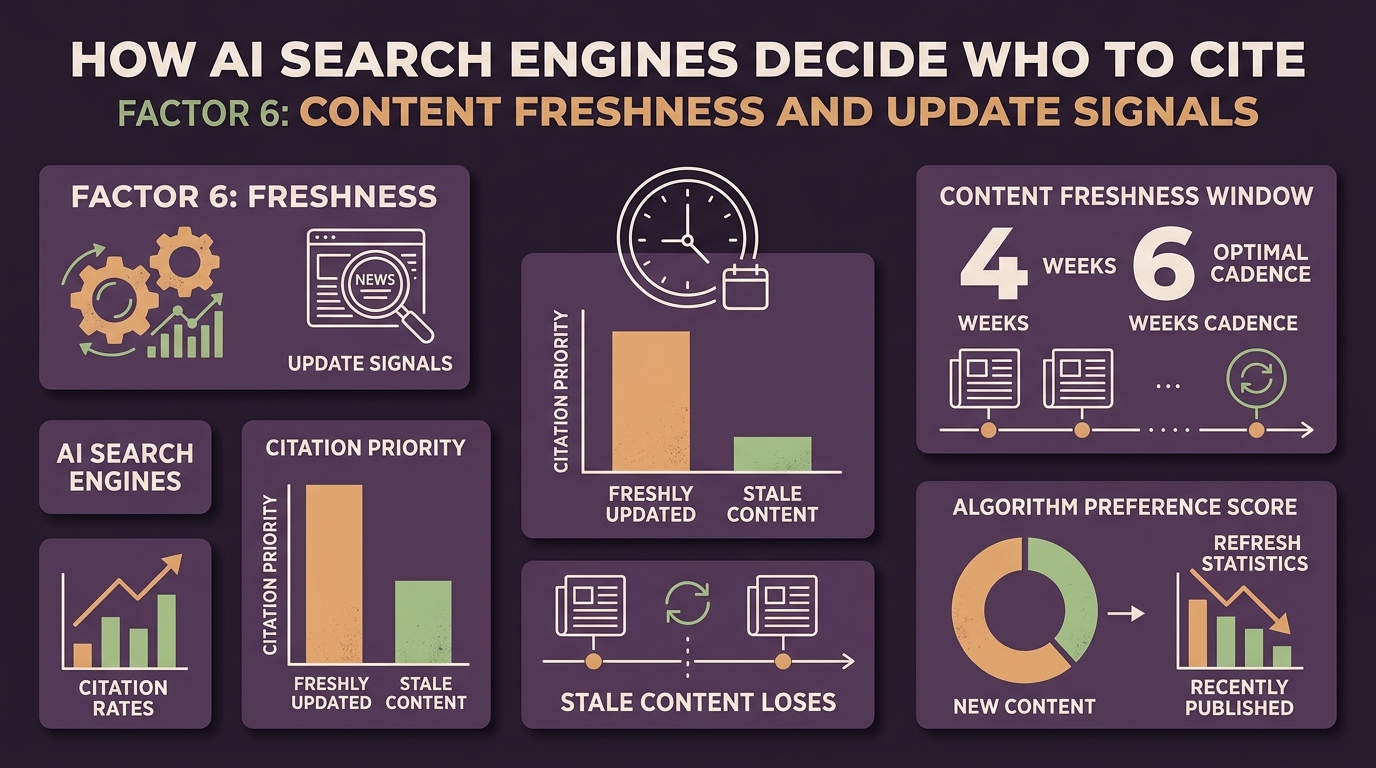
For professionals, this creates a practical mandate: publish or update content on a consistent schedule. A page left untouched for six months loses freshness signals. An article updated with current data, recent examples, or new research maintains its citation probability. This isn’t about producing volume. It’s about keeping your most important pages current.
BrightEdge data adds another dimension: AI Overview citations from top-10-ranking pages grew from 32.3% to 54.5% over 16 months from May 2024 to September 2025, a 69% relative increase (BrightEdge, September 2025). Organic ranking still matters for AI Overviews. Updating content to maintain rankings also maintains AI citation probability.
Signal 7: Technical AI Crawler Accessibility
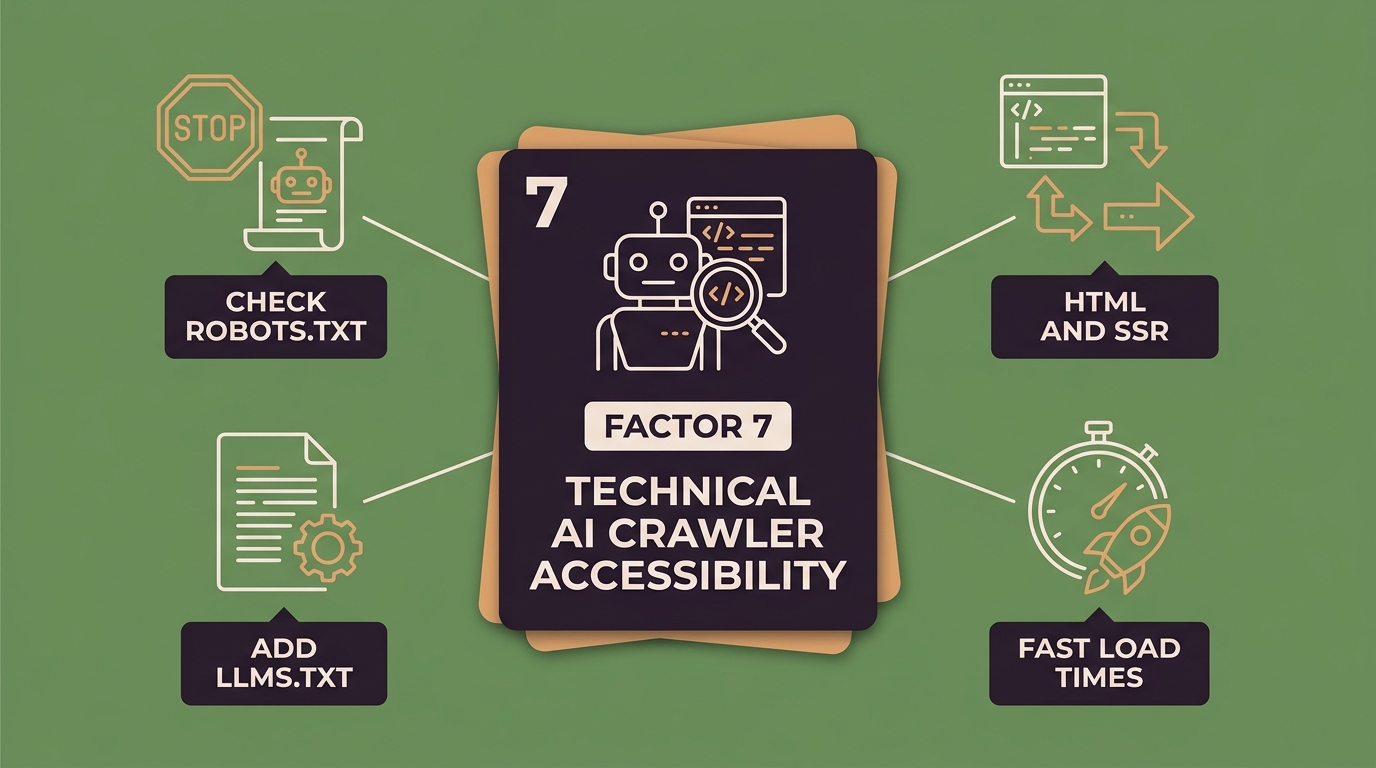
None of the above factors matter if AI crawlers can’t access your site. OtterlyAI’s 2026 citation report found that 73% of sites have technical barriers blocking AI crawler access (OtterlyAI, 2026). These barriers are often unintentional: robots.txt rules written to block scraping that inadvertently block citation crawlers.
The major AI crawlers have distinct user agents. GPTBot is OpenAI’s crawler. ClaudeBot is Anthropic’s. PerplexityBot is Perplexity’s. Googlebot-Extended covers Google’s AI systems. Check your robots.txt to confirm none of these are blocked. Check your hosting platform settings for any rate-limiting or bot-blocking rules that might affect these crawlers.
Our experience: In auditing personal brand websites, the most common blocking issues come from security plugins and CDN configurations that treat AI crawlers identically to content scrapers. The fix is usually a targeted robots.txt allowance rather than any structural site change.
What the Princeton GEO Research Actually Tells Us
The Princeton GEO paper is the most rigorous controlled study of AI citation factors to date — and the findings are counterintuitive for anyone trained in traditional SEO thinking.
Citing external sources lifted AI visibility by +115% for lower-ranked content. Adding statistics added +41%. Adding quotations added +28%. But here’s where most people are surprised: keyword stuffing reduced visibility by -10%. Word count alone added nothing (Aggarwal et al., ACM KDD 2024).
Think about it. Every traditional SEO playbook tells you to include more keywords, write longer posts, optimize density. AI systems actively penalize the first approach and ignore the third entirely. What they reward is evidence-based writing — the structure of professional and academic writing, not marketing copy.
For professionals writing about their area of expertise, this means referencing research in your field, citing professional standards bodies, quoting colleagues and co-authors, and grounding claims in data. The structure of academic and professional writing is closer to AI-optimized content than the structure of traditional SEO blog posts.
| Optimization Technique | AI Visibility Lift |
|---|---|
| Citing external sources (lower-ranked content) | +115% |
| Statistics addition | +41% |
| Quotation addition | +28% |
| Word count alone | 0% |
| Keyword stuffing | -10% |
Source: Aggarwal et al., ACM KDD 2024 (Princeton GEO Paper)
And here’s one more number worth sitting with: 96% of AI Overview content comes from sources with verified E-E-A-T signals (Wellows, 2025). Demonstrating experience, expertise, authoritativeness, and trustworthiness through content signals is not optional for individuals seeking AI citation. This is the core of the Answer Engine Optimization framework.
Do All AI Platforms Use the Same Criteria? (They Don’t)
Each platform has a distinct citation architecture, and the differences are significant enough to require different strategies. Perplexity averages 21.87 citations per question, while ChatGPT uses only 7.92. Only 11% of cited domains appear across both platforms (Profound, 2025). Treating them as interchangeable is a strategic error.
The table below maps how each major platform weights the primary citation signals.
| Signal | ChatGPT Priority | Perplexity Priority | Google AI Overviews Priority |
|---|---|---|---|
| Wikipedia presence | Very high (47.9% citation share) | Medium | Lower (5.7% citation share) |
| Reddit/community presence | Lower | Very high (46.7%) | Medium (21%) |
| Google organic rank | Weak (Bing-aligned) | Very high (91% overlap) | High (86% overlap) |
| Brand domains | 44.7% citation share | 28.9% citation share | 59.8% citation share |
| Freshness | Moderate | Real-time | Moderate |
Source: Profound (680M citations), Semrush AI Mode Study, BrightEdge
ChatGPT’s citation behavior leans heavily on its training data, which over-represents Wikipedia and established editorial domains. It cites fewer sources (7.92 per query) and favors sources it was trained on. Perplexity is a real-time retrieval system. It cites more sources per query, leans heavily on live web content, and has a 46.7% Reddit citation share — which means genuine community expertise participation isn’t optional if Perplexity visibility matters to you.
Google AI Overviews have the highest overlap with traditional organic rankings (86%) and heavily favor brand domains with strong E-E-A-T signals. A 43.2% citation rate for #1-ranked pages versus a 12.4% rate for pages ranked beyond the top 20 shows that organic ranking still matters significantly for Google’s AI system (Growth Memo, 2025). See also: how Knowledge Graph entities drive AI citations.
How to Prioritize These 7 Signals
Not all seven factors produce equal returns for individuals. Research confirms that entity-level signals drive the most impact: brand mentions (0.664 correlation) and cross-platform verification (2.8x citation multiplier) outperform content-only tactics (Ahrefs, Metrics Rule, 2025). Start with entity infrastructure, then layer in content and technical fixes.
Start with entity authority and cross-platform consistency. These two factors have the strongest correlation with AI citation probability and the widest gap between professionals who’ve addressed them and those who haven’t. Building a Wikidata entry, claiming your Wikipedia presence if you qualify, and auditing your name and bio for consistency across platforms is foundational work.
Address technical accessibility immediately. If your site’s robots.txt blocks GPTBot, ClaudeBot, or PerplexityBot, you’re invisible regardless of everything else. This is a quick audit with a potentially high return.
Restructure content for definitive language and Q&A format. Most professionals have existing content that could be reformatted for higher citation probability. Adding direct Q&A sections to existing pages, front-loading entity attributes in each piece, and citing external sources in your writing are high-impact changes that don’t require new content creation.
Commit to freshness on your most important pages. You don’t need to publish constantly. You need to keep your most important professional content pages updated on a regular schedule.
Our finding: Professionals who address entity accessibility first, then content formatting, see measurable improvements in AI citation tracking within 60-90 days. Entity changes take longer to propagate through AI training cycles, but content formatting changes can influence retrieval-based systems like Perplexity and Google AI Overviews almost immediately.
Frequently Asked Questions
What is the single most important factor for getting cited by AI search engines?
Entity authority is the strongest single predictor. Pages with 15 or more connected Knowledge Graph entities show 4.8x higher AI Overview selection probability, and domain authority correlation dropped to r=0.18 in the same study (Metrics Rule, 2025). For individuals, this means building a recognized, connected Person entity in the Knowledge Graph, not acquiring more links. Our Knowledge Graph Optimization guide covers the full process.
Does having a Wikipedia page help individuals get cited by ChatGPT and AI Overviews?
Yes, and the effect is large for ChatGPT specifically. Wikipedia accounts for 47.9% of ChatGPT’s top-cited sources in an analysis of 680 million citations (Status Labs, 2025). For Google AI Overviews, the direct effect is smaller at 5.7% citation share, but Wikidata (the structured sibling project) directly feeds the Knowledge Graph. For professionals who meet Wikipedia’s notability standards, pursuing a Wikipedia page is one of the highest-return AI visibility investments available.
Why do brand mentions matter more than backlinks for AI search visibility?
AI systems are trained on text, not link graphs. A backlink is a structural relationship between documents. A brand mention is a claim — “Jennifer Park, CFP at Clearview Wealth, argues that…” — that teaches a language model to associate a name with a domain of expertise. Ahrefs found brand mentions correlate with AI visibility at 0.664 versus backlinks at 0.218 (Ahrefs, 2025). Unlinked mentions carry more weight than most SEO practitioners expect.
How does the Princeton GEO paper’s research apply to individuals getting cited by AI?
The Princeton GEO paper tested which content interventions improved AI visibility and by how much. The largest lift came from citing external sources (+115% for lower-ranked content), followed by adding statistics (+41%) and quotations (+28%) (Aggarwal et al., ACM KDD 2024). For individuals, this means writing in an evidence-based style: reference research in your field, cite professional bodies, quote colleagues. This pattern mirrors how academics and journalists write — and both groups are heavily represented in AI training data.
Do different AI search engines (ChatGPT vs. Perplexity vs. Google AI Overviews) use the same citation criteria?
No, they use meaningfully different criteria. Only 11% of cited domains appear across both ChatGPT and Perplexity (Profound, 2025). ChatGPT over-indexes on Wikipedia and training-data sources. Perplexity leans on real-time results with a 46.7% Reddit citation share. Google AI Overviews have an 86% overlap with organic rankings and favor brand domains. Individuals need a platform-specific strategy, not a one-size-fits-all approach. get cited by AI as a thought leader covers the platform-specific tactics in detail.
What to Do Next
You now understand what’s actually driving AI citation decisions. The question is whether you’ve built the signals that pass the test — or whether you’re currently invisible in AI responses while a less experienced competitor with better entity infrastructure gets named instead.
The fastest way to find out is a Digital Footprint Audit. It maps where you appear, what AI systems currently know about you, what’s blocking you from citation, and what to fix first — across Google, ChatGPT, Perplexity, and the 50+ platforms that feed your credibility signals.
Get Your Free Digital Footprint Audit →
No obligation. 15 minutes. You’ll walk away knowing exactly where you stand.
[INTERNAL-LINK: complete Answer Engine Optimization guide → /blog/aeo-ai-visibility/] [INTERNAL-LINK: Knowledge Graph Optimization → /blog/knowledge-graph-optimization/]